Around 66 million years ago, the end-Cretaceous extinction event reshaped Earth’s biodiversity, yet its impact on marine fishes remains debated due to gaps in the fossil record. In new research, paleontologists described an assemblage of marine fish fossils from the 62.2-million-year-old site of Qreiya 3 in the Eastern Desert of Egypt, providing a window into this transition. Among the findings are the earliest known fossil skeletons of jack, a type of sportfish, moonfish and pipefish, the family to which seahorses belong.
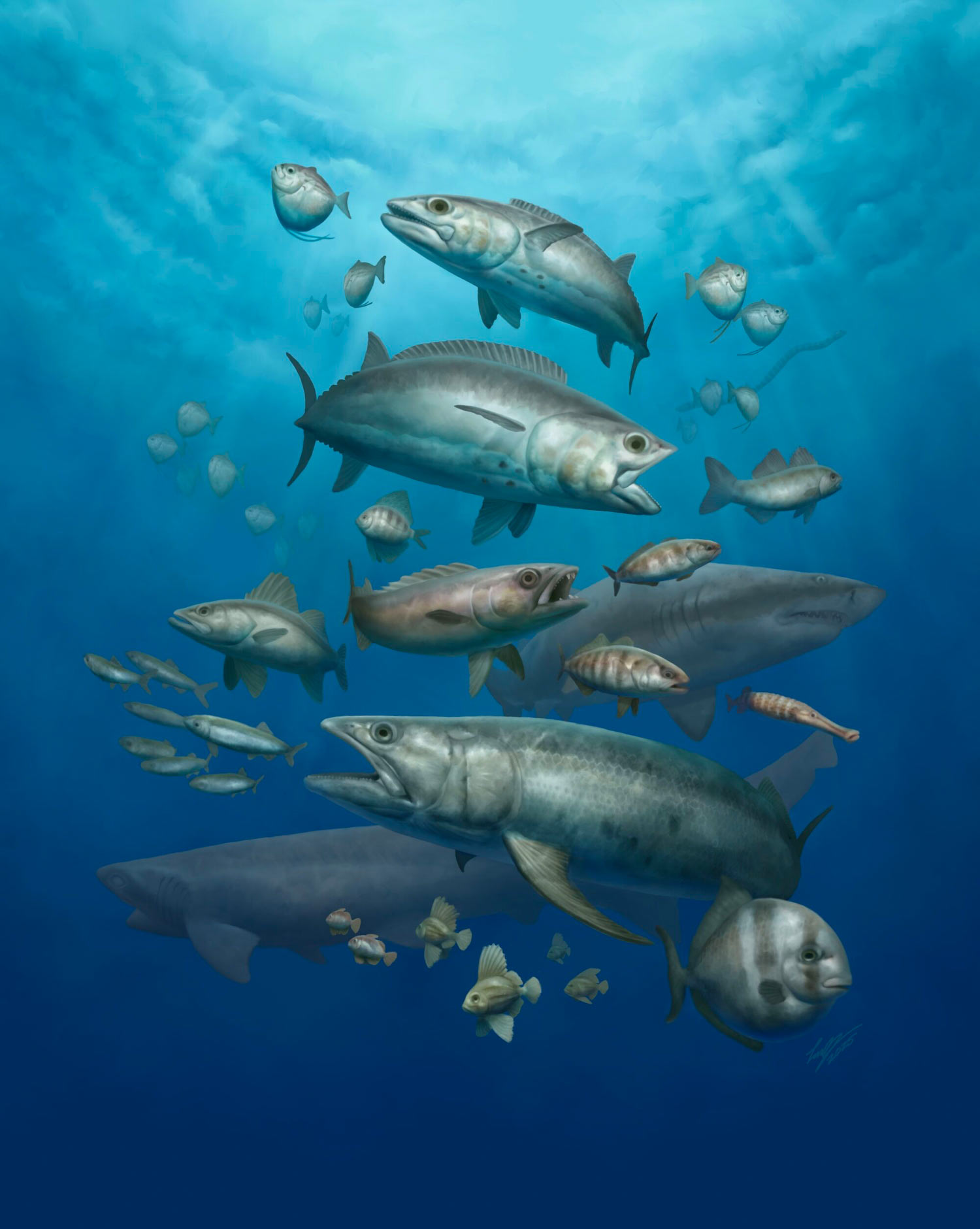
Marine fishes from the Early Paleocene site of Qreiya 3 in the Eastern Desert of Egypt. Image credit: Ian Baylatry.
“We have this 10 million year gap with a very limited fossil record,” said study lead author Sanaa El-Sayed, a doctoral candidate at the University of Michigan.
“We know the asteroid impacted the marine environment, but it was unclear how the oceans came to have these modern fishes.”
“It was mindblowing that this site is now helping us answer the questions of when and where and what was present in the modern ocean just a few million years after the dinosaurs went extinct.”
At the Qreiya 3 site, El-Sayed and colleagues found fossils of 21 kinds of fishes across nine orders.
“Most of the fishes are percomorphs, a major group in today’s oceans but which were relatively uncommon during the age of dinosaurs,” said co-author Professor Matt Friedman, director and curator of the University of Michigan’s Museum of Paleontology.
“The findings also reinforce the idea that the biological crisis event linked to the asteroid impact, called the end-Cretaceous mass extinction, led to the demise of certain kinds of fishes, followed by the rapid establishment of other groups of fishes that look distinctly modern.”
A fossil-poor part of the record around the end-Cretaceous mass extinction is called Patterson’s Gap after a paleontologist who had previously noted it.
Because of its timing, the gap muddies our picture of how fishes were impacted by the extinction.
“This gap early in the Cenozoic record leads to two interrelated questions,” Professor Friedman said.
“First, did the fish that we generally assume went extinct at the end of the Cretaceous period really not limp into the next interval, called the Paleogene, and we’ve just missed them because the record is poor?”
“Second, when did the more familiar modern groups appear?”
“The gap represents a long span of time during which we have poor grasp of what happened, and it’s frustratingly coincident with one of the most interesting intervals of Earth’s more recent history.”
“Here we have this remarkable deposit that opens a new window on this critical time.”
“There are plenty of skeletons preserved, but none of the kinds of fishes we thought went extinct were there.”
“Our findings suggest that those fish likely did go extinct at or around that major cataclysm at the end of the Cretaceous, rather than their absence just reflecting a lousy record.”
“At the same time, the site provides direct evidence that a lot of these modern-looking fish groups were established pretty early on.”
The researchers also wondered what their findings meant in the broader context of the fossil record early after the end-Cretaceous mass extinction.
Comparing their findings to information from other fossil deposits, they found that most of the percomorphs found just after the extinction event were mostly in the tropics.
There appeared to be fewer percomorphs in higher latitudes.
Only long after the extinction did percomorphs seem to become common everywhere.
“There is a coarse but intriguing geographic pattern to how these modern-looking faunas arose,” Professor Friedman said.
“Maybe they developed in the tropics, for instance, and then spread to higher latitudes as climates changed or as these groups dispersed.”
“That will be something to test more critically as we continue to improve the record.”
The findings were published this week in the journal Science Advances.
_____
Sanaa El-Sayed et al. 2026. Rise of modern marine fishes captured in an Early Paleocene Lagerstätte. Science Advances 12 (23); doi: 10.1126/sciadv.aec8978