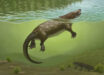
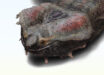
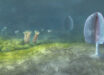
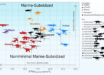
Spriggina floundersi, a marine species that lived during the Ediacaran period 550 million years ago, is one of Earth’s earliest bilaterally symmetrical animals. According to an analysis of over one hundred new fossils from South Australia, Spriggina floundersi consistently bent to the right, hinting that left-right behavioral preferences emerged far earlier in evolution than scientists once thought.
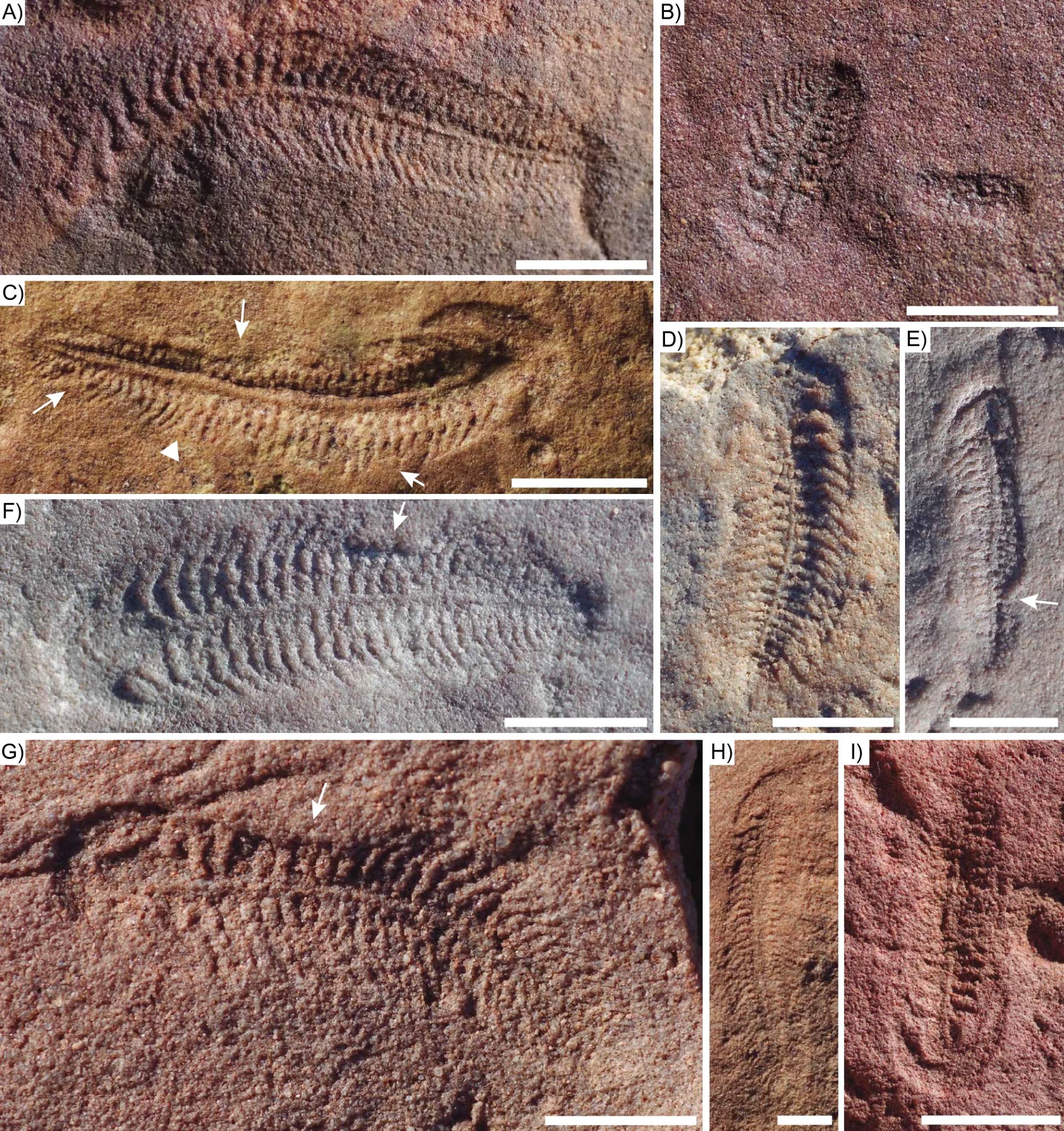
Fossils of Spriggina floundersi from South Australia; white arrows highlight lifted areas, white triangle indicates divergent bend angle of adjacent modules. Scale bars – 10 cm. Image credit: Evans et al., doi: 10.1038/s41598-026-53857-x.
The Ediacaran period (635 to 538 million years ago) marks one of the most transformative chapters in the history of life on Earth.
During this time, microscopic life evolved to become multicellular, large enough to see with the naked eye, and capable of increasingly complex behaviors, including movement.
The Flinders Ranges and surrounding region of South Australia preserves one of the most exceptional records of this fossil assemblage known from this time.
In particular, excavation of individual beds at Nilpena Ediacara National Park reveals communities of the Ediacara biota buried during storm events, capturing snapshots of the seafloor 550 million years ago.
Among the fossil organisms recorded there is Spriggina floundersi, originally described in 1958 based on three specimens.
Spriggina floundersi is one of the earliest known animals with bilateral symmetry — a body plan featuring a distinct front and back, left and right sides, and top and bottom.
This same basic body organization is shared by humans and most animals alive today.
“When we talk about being right-or-left-handed, most people likely think about how they hold a pencil or a kick a soccer ball,” said Dr. Scott Evans, a paleontologist at the American Museum of Natural History and Florida State University.
“But our research shows that an animal without hands or feet, living over 500 million years ago, may have had its own version of handedness.”
To investigate whether Spriggina floundersi exhibited any left-right preference, the researchers examined shape variation in more than 100 exceptionally preserved fossils from the fossil beds at Nilpena and from the collections of the South Australia Museum in Adelaide.
They made a surprising discovery: roughly twice as many specimens appeared bent to the left as to the right.
Because these fossils preserve mirror-image impressions of the original animals, a leftward bend in the rock represents an animal that bent to the right in life.
This consistent pattern suggests that Spriggina floundersi preferentially turned to the right, making it the oldest known animal to display population-wide ‘handedness.’
“It’s a reminder that some of the traits we take for granted today have incredibly ancient origins,” said Dr. Mary Droser, a paleontologist at the University of California, Riverside.
The discovery also provides new clues about how Spriggina floundersi might have perceived the world.
“We know that living animals with this sort of handedness, from insects to octopi to birds and mammals, have complex sensory abilities,” Dr. Evans said.
“So this may be telling us that the nervous system of Spriggina floundersi was relatively complex and more similar to those of animals that we know today.”
The results were published July 9, 2026 in the journal Scientific Reports.
_____
S.D. Evans et al. 2026. Earliest evidence of behavioural handedness in the Ediacaran motile bilaterian Spriggina floundersi. Sci Rep 16, 19924; doi: 10.1038/s41598-026-53857-x