Named Beta Pictoris d, the newly-discovered world is 100 times fainter than Beta Pictoris b — the first planet discovered around the A5-type star Beta Pictoris — and is among the lightest exoplanets ever to be imaged from the ground.
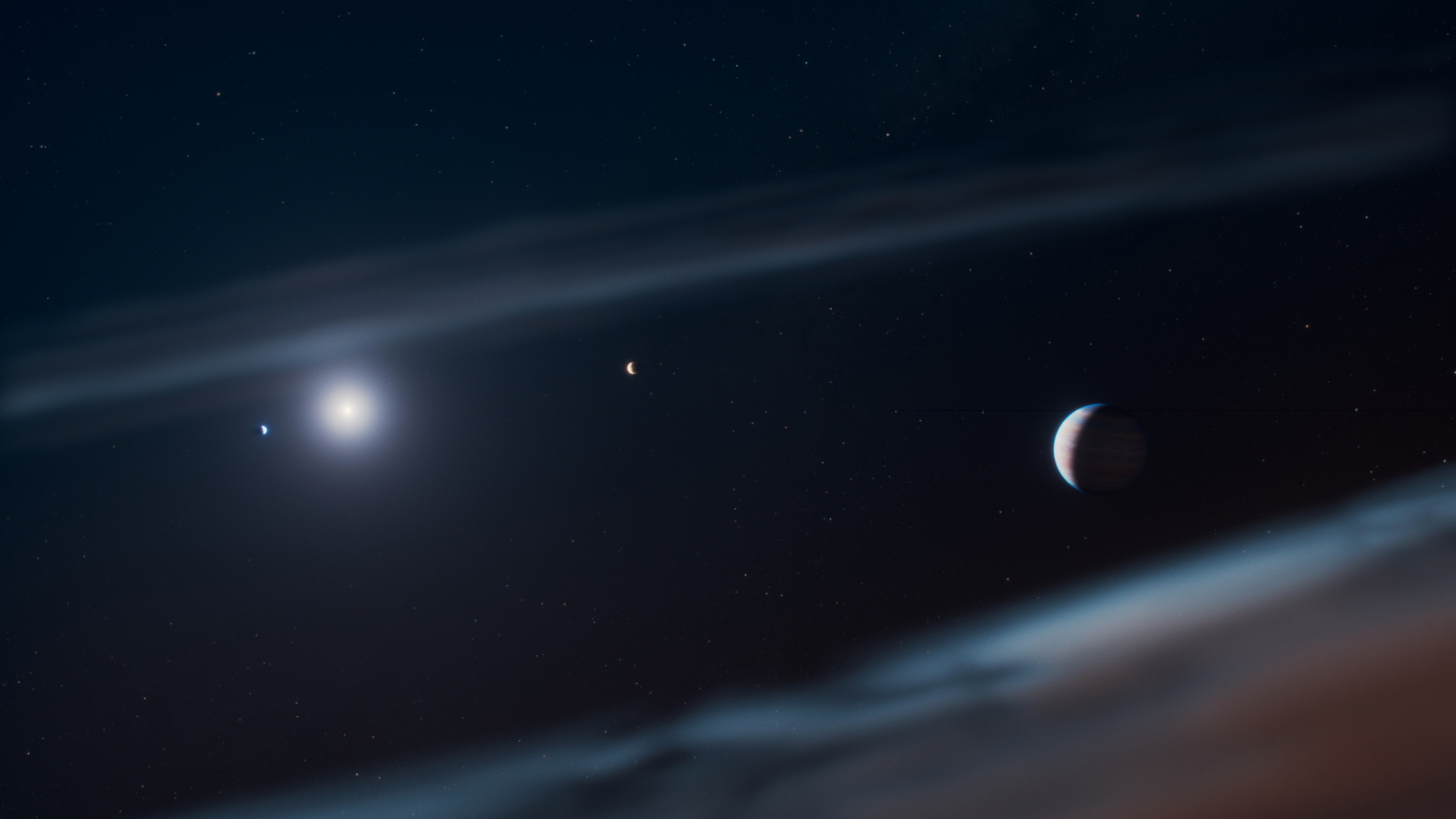
This artist’s concept shows the Beta Pictoris system with the discovered giant exoplanet Beta Pictoris d at the right. Image credit: NASA / ESA / CSA / STScI / Ralf Crawford, STScI.
Beta Pictoris (β Pictoris) is located about 63 light-years away from Earth in the constellation of Pictor.
The star has a mass of about 1.8 times the Sun and an age of only 20 million years.
It was already known to host a circumstellar disk of gas and dust; a large number of comet-like bodies; and two giant planets: Beta Pictoris b and c.
Between 9 to 13 times the mass of Jupiter, Beta Pictoris b orbits the parent star once every 22 years at a distance of 9.8 AU (astronomical units).
Beta Pictoris c has a mass of 8.2 times that of Jupiter and is much closer to its star. It orbits at 2.7 AU and has an orbital period of roughly 1,200 days.
The newly identified Beta Pictoris d makes it only the second planetary system known to contain at least three imaged planets.
“This was a serendipitous discovery,” said Dr. Ben Sutlieff, an astronomer at the University of Edinburgh.
“We initially wanted to look more at a known planet in the system, Beta Pictoris b, to see how it changed over time.”
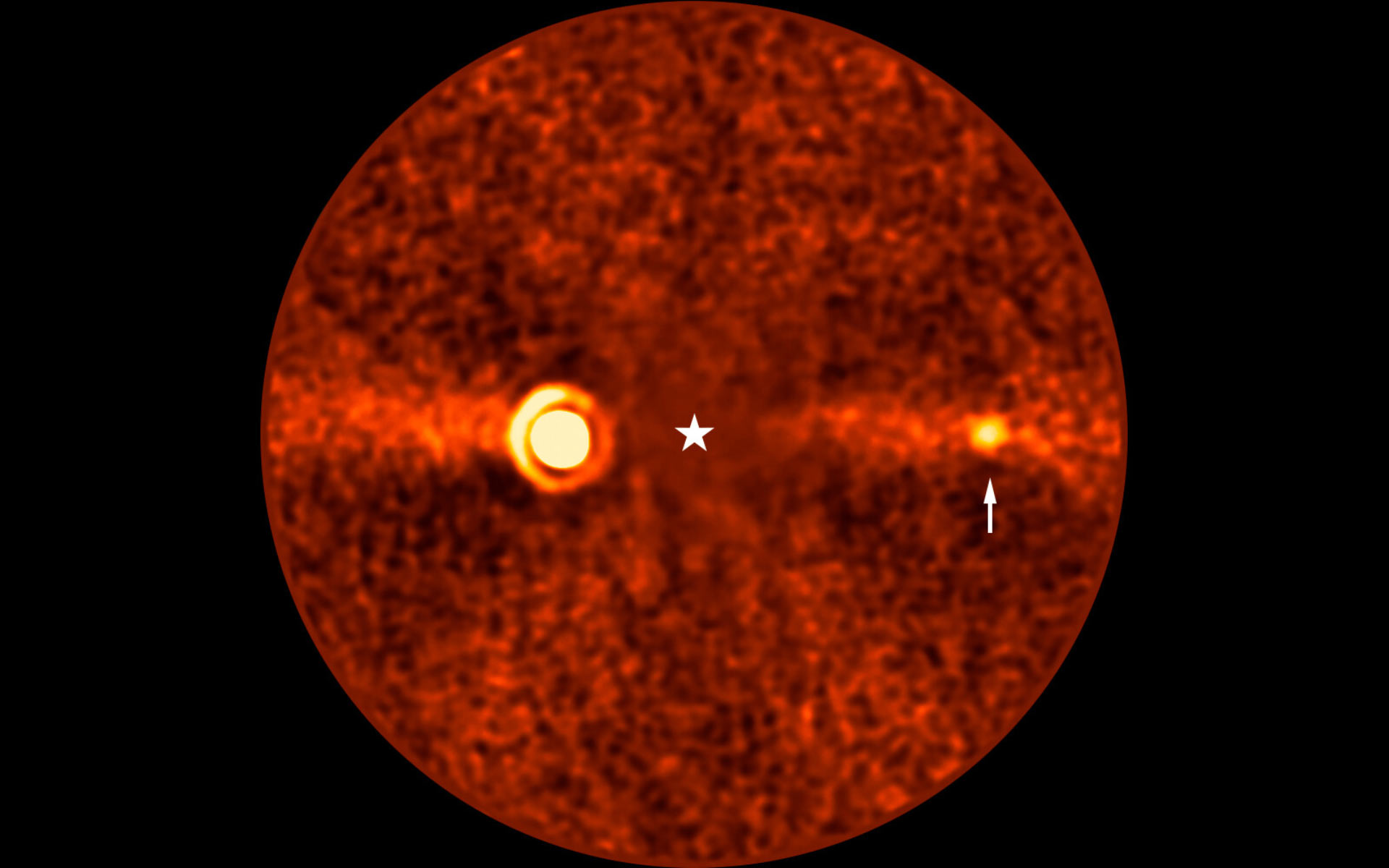
This image, taken with ESO’s Very Large Telescope (VLT) shows Beta Pictoris d, a new planet found orbiting the star Beta Pictoris. The star is at the center of the frame, and was subtracted when processing the data, revealing the environment around it. The new planet, indicated with an arrow, is the third one found around this star. The other two are Beta Pictoris b — the bright source to the left, and Beta Pictoris c, orbiting much closer to the star and not seen here. Image credit: ESO / Sutlieff et al.
However, when Dr. Sutlieff and colleagues went to analyze their images of the system, they noticed something else, separated from Beta Pictoris b, that led them down an entirely new path.
To confirm the nature of their detection, the team looked through the ESO archive, a catalogue of past observations made with ESO facilities.
They found the new planet, Beta Pictoris d, in multiple images dating back as far as 11 years ago, including one where it was only just visible against the glare of its larger neighbor Beta Pictoris b.
“Beta Pictoris d, it seems, has been playing a game of hide-and-seek with us for over a decade and only now can we say ‘found you!’” said Dr. Jayne Birkby, an astronomer at the University of Oxford.
Beta Pictoris d is also a gas giant like Jupiter or Saturn, however, it has a much wider orbit than other planets in the system.
The new planet is only 2.4 times more massive than Jupiter, making it one of the lightest ever imaged from the ground. It is also relatively cold and, hence, extremely faint relative to its host star.
“The new planet is 100 times fainter than Beta Pictoris b, the famous planet in the same system, making it the faintest exoplanet ever imaged directly from Earth,” said Dr. Markus Bonse, an astronomer at ESO.
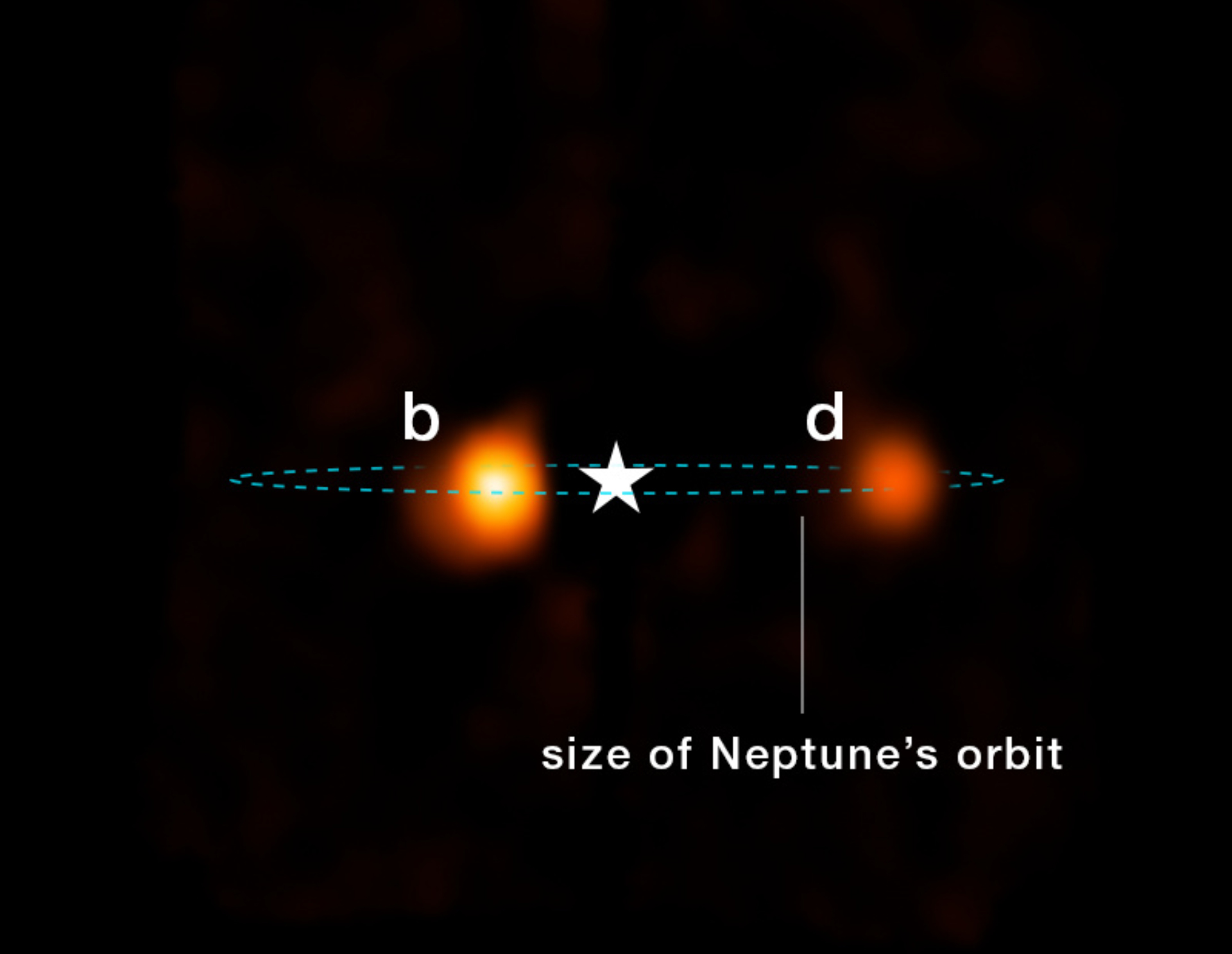
Beta Pictoris d is seen in reconstructed imagery from the Near-Infrared Spectrograph (NIRSpec) aboard the NASA/ESA/CSA James Webb Space Telescope. Image credit: NASA / ESA / CSA / STScI / Aidan Gibbs, UC San Diego / Jean-Baptiste Ruffio, UC San Diego / Alyssa Pagan, STScI.
This first clear detection of Beta Pictoris d was made with the ERIS instrument on ESO’s Very Large Telescope.
An independent team led by University of California, San Diego astronomer Aidan Gibbs also discovered the same planet using the NASA/ESA/CSA James Webb Space Telescope.
“This discovery adds another piece to an already fascinating planetary system,” Dr. Gibbs said.
“Beta Pictoris has long served as a laboratory for understanding how planetary systems form and evolve, and now we have another planet helping us tell that story.”
The discovery is described in two papers published in the same issue of the Astrophysical Journal Letters.
_____
Ben J. Sutlieff et al. 2026. Direct Imaging Discovery of Giant Exoplanet β Pictoris d: A Decade-long Game of Hide-and-seek. ApJL 1006, L10; doi: 10.3847/2041-8213/ae80a0
Aidan Gibbs et al. 2026. Discovery of an Exterior Third Planet Orbiting β Pictoris. ApJL 1006, L11; doi: 10.3847/2041-8213/ae801b