Today, lepidosaurs — the reptile group that includes lizards, snakes and New Zealand’s tuatara — are among the most diverse vertebrates on Earth, but their earliest evolutionary history remains poorly understood. A newly discovered fossil jaw from southern Brazil is helping paleontologists piece together the anatomy and evolutionary history of Cargninia enigmatica, a tiny lepidosaur relative that lived during the Late Triassic epoch alongside some of the earliest dinosaurs.
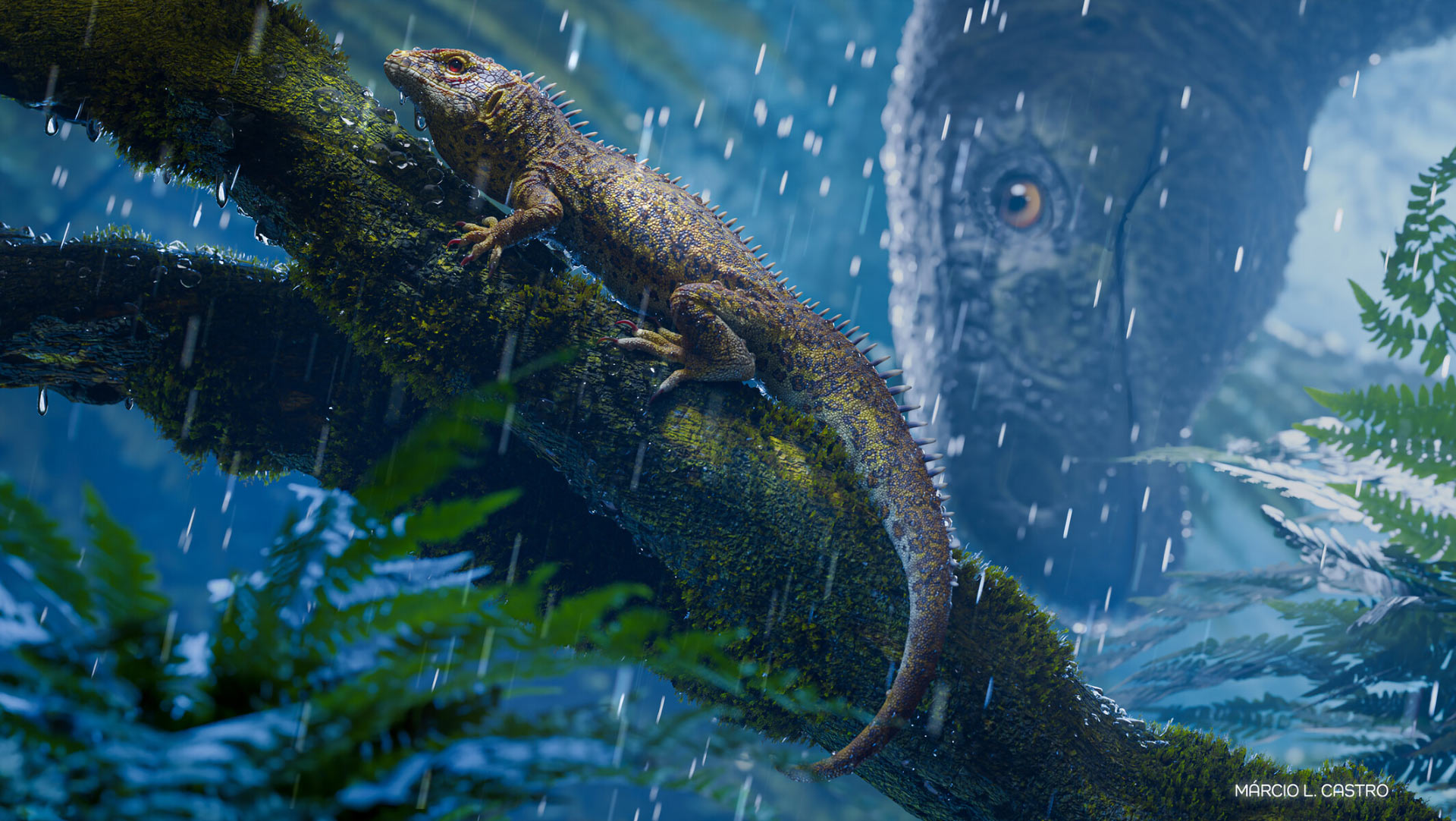
A landscape from the Late Triassic of southern Brazil showing Cargninia enigmatica being observed by the sauropodomorph dinosaur Macrocollum itaquii. Image credit: Marcio L. Castro.
Cargninia enigmatica roamed our planet during the early Norian age of the Late Triassic, around 225 million years ago.
At the time, the animal shared its environment with early dinosaurs, mammal relatives, primitive crocodile-line reptiles and several early relatives of the tuatara.
Cargninia enigmatica was originally described in 2010 from a single fragment of its lower jaw.
The species belonged to a group called Lepidosauromorpha, the broader lineage that eventually gave rise to modern lepidosaurs.
But where exactly Cargninia enigmatica fits on that family tree has long puzzled paleontologists.
“Nowadays, Lepidosauria is a diverse group represented by squamates and the rhynchocephalian tuatara,” said Dr. Lísie Vitória Soares Damke from the Universidade Federal de Santa Maria and colleagues.
“However, their origins date back to the end of the Permian period, when the stem lineages Lepidosauromorpha and Archosauromorpha diverged.”
“Within the lepidosauromorph stem lineage, a few species have been described with unstable phylogenetic placements.”
“In Brazilian strata, the only representative of this lineage is Cargninia enigmatica, a rare taxon known from a single specimen represented by a fragmentary left dentary.”
“In 2010, paleontologists initially interpreted Cargninia as a non-rhynchocephalian lepidosaur based on the presence of teeth with a mesiodistal width of approximately 0.4-0.5 mm and a putative subacrodont implantation pattern.”
“They also noted similarities between the tooth implantation of Cargninia and that of Icarosaurus, a kuehneosaurid reptile from the Late Triassic Lockatong Formation of the United States.”
“However, they argued that this feature alone was insufficient to support the assignment of the taxon to Icarosaurus or closely related forms.”
The new specimen of Cargninia enigmatica was recovered from the type locality, the Linha São Luiz site, located in the municipality of Faxinal do Soturno, Rio Grande do Sul State, Brazil.
The fossil consists of a partial left lower jaw measuring less than 9 mm long.
Although incomplete, it preserves 12 teeth and evidence that the animal would have carried as many as 18 teeth in its dentary.
The researchers used micro-CT scanning to examine the specimen’s internal structure, allowing them to trace the path of the trigeminal nerve, which governs sensation and motor control in the face and jaw.
They found that the nerve’s branching pattern in Cargninia enigmatica closely resembles that of living lepidosaurs.
“Cargninia enigmatica likely perceived its environment, at least with respect to trigeminal sensory inputs, in a manner comparable to that of its extant relatives,” they said.
The scientists also ran Cargninia enigmatica through a large computational phylogenetic analysis.
The species consistently emerged as a non-lepidosaur lepidosauromorph, supporting the idea that it represents an early branch that split off before true lepidosaurs evolved.
“Its phylogenetic position was investigated in a computational context for the first time, and the species was recovered among non-lepidosaur lepidosauromorphs, corroborating previous assumptions,” the authors said.
Their paper appears this month in The Anatomical Record.
_____
Lísie Vitória Soares Damke et al. New fossil unveils the dentary anatomy of the rare lepidosauromorph Cargninia enigmatica from the Upper Triassic of Southern Brazil. The Anatomical Record, published online July 4, 2026; doi: 10.1002/ar.70268