Using the Yebes 40-m and IRAM 30-m radio telescopes, astronomers have discovered erythrulose, a four-carbon sugar commonly found in raspberries and sunless tanning cosmetics, in the molecular cloud G+0.693-0.027.
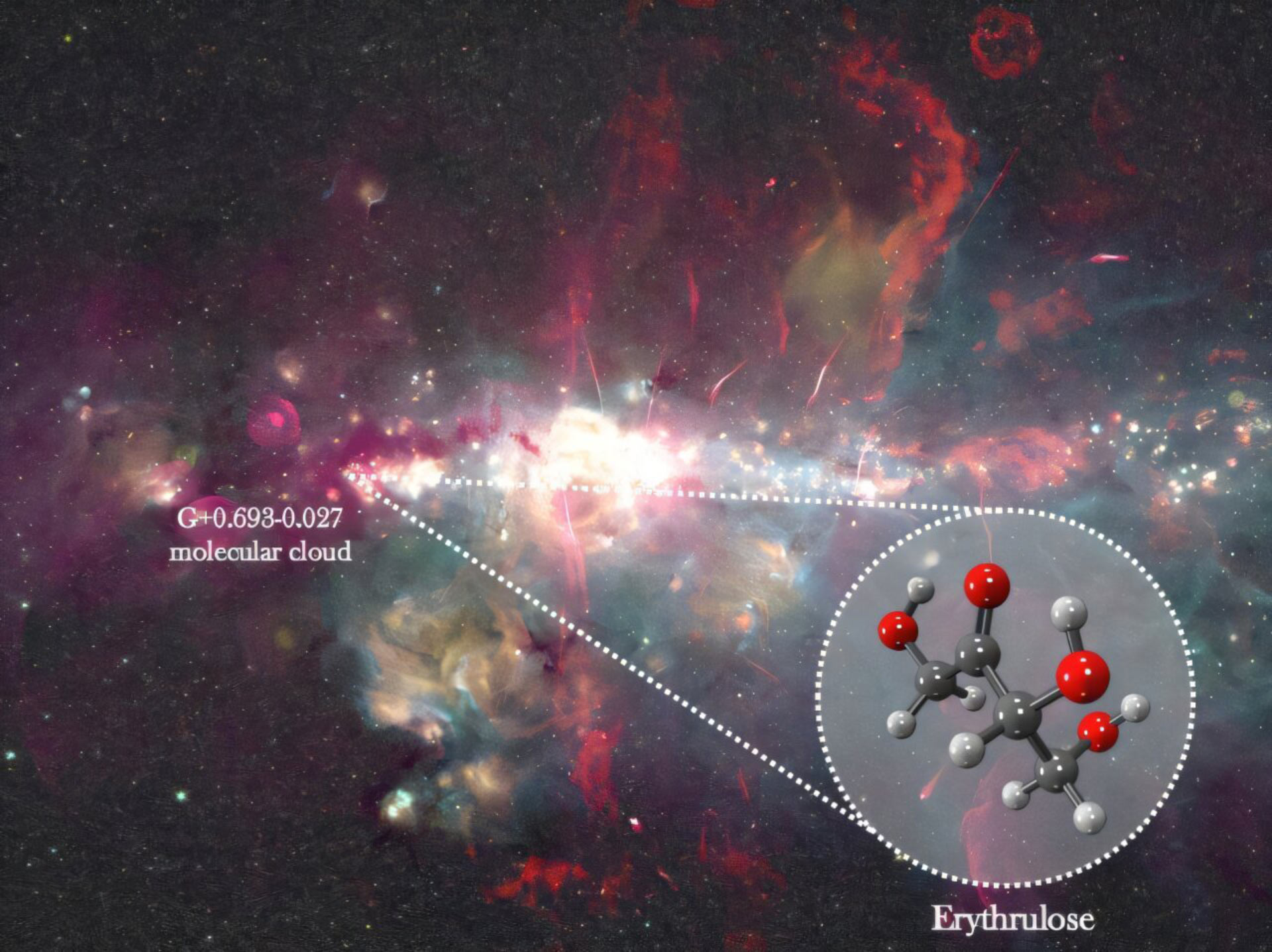
This composite image of the Milky Way’s central region shows the location of the molecular cloud G+0.693-0.027. Image credit: Ashley Barnes / Izaskun Jiménez-Serra / Juan García de la Concepción.
Sugars are essential to life, forming the backbone of DNA and RNA and serving as metabolic fuel, but scientists have long struggled to explain how they could have formed in sufficient quantities on the early Earth.
Lab experiments simulating prebiotic conditions tend to produce sugars only in trace amounts.
The detection of ribose and glucose in meteorites and in samples from the asteroid Bennu has fueled speculation that at least some of Earth’s sugar inventory may have arrived from space.
But until now, no actual sugar had ever been spotted in the interstellar medium itself.
“Sugars are essential biomolecules, serving as metabolic fuels, nucleic acid backbone components and structural or energy-storage polymers,” said Dr. Izaskun Jiménez-Serra from CSIC-INTA and colleagues.
“A central question in origin-of-life research is how monosaccharides formed on the primitive Earth, as laboratory experiments under prebiotic conditions yield insufficient concentrations.”
Using the Yebes 40-m and IRAM 30-m radio telescopes, the astronomers scanned the molecular cloud G+0.693−0.027, a chemically rich region located roughly 8,200 parsecs (26,745 light-years) from Earth near the Milky Way’s center.
They picked up 12 sets of radio emission lines that matched the predicted spectral fingerprint of erythrulose, a four-carbon sugar with the chemical formula C4H8O4.
“Erythrulose, with 14 atoms in its structure, represents the largest non-cyclic molecular species identified so far in the interstellar medium, and the first detected molecule containing four oxygen atoms,” they said.
“It is also the first sugar and the second chiral molecule reported in the interstellar medium.”
“Its detection not only provides direct evidence that complex, chiral species can form under interstellar conditions, but it also takes us to a higher level in the ladder of interstellar chemical complexity, suggesting that other prebiotic — and potentially chiral — molecules could also form and survive under the extreme conditions of the interstellar medium.”
The researchers found erythrulose to be at least eight times more plentiful than three-carbon sugars such as glyceraldehyde and dihydroxyacetone, neither of which was detected at all in the same cloud, despite the survey’s high sensitivity.
The findings suggest that erythrulose can be made from simpler molecules on dust grains in space and may then become part of more complex chemical systems.
“This finding was unexpected, as the prevailing view in astrochemistry is that interstellar molecules grow in size through the sequential addition of carbon atoms,” Dr. Jimenez-Serra said.
“The detection of erythrulose is very exciting because it opens up the possibility of discovering in space other sugars such as ribose, which is part of RNA, and other important molecules for the origin of life,” said Dr. Carlos Briones, also from CSIC-INTA.
The discovery is reported in a paper published today in the journal Nature Astronomy.
_____
I. Jiménez-Serra et al. Detection of a four-carbon sugar in interstellar space. Nat Astron, published online July 13, 2026; doi: 10.1038/s41550-026-02905-7