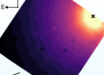
New images of the giant elliptical galaxy NGC 4696 from the NASA/ESA/CSA James Webb Space Telescope reveal gas filaments funneling material into a spinning disk around a supermassive black hole 800 light-years across, solving a decades-old puzzle of how these giants keep growing.

This Hubble image shows the elliptical galaxy NGC 4696. Image credit: NASA / ESA / Hubble / A. Fabian.
Nearly every large galaxy in the Universe has a supermassive black hole at its center millions or even billions of times more massive than the Sun.
When these black holes are actively pulling in surrounding material, they switch on like cosmic engines, blasting powerful jets of energy outward that can sculpt the entire galaxy around them, slowing down the birth of new stars and influencing how the galaxy grows over time. Astronomers call these types of black holes active galactic nuclei (AGN).
But if an AGN’s jets heat up the surrounding gas, it should, in principle, shut off the black hole’s food supply. So how does it keep feeding and growing?
The leading hypothesis is that the gas eventually cools back down, condenses into long thin streamers called filaments, and falls back toward the galaxy’s center in a self-regulating process.
“Webb observations are offering us thousands of new facts and measurements, and I can report it’s a lot to absorb,” said Michigan State University’s Professor Megan Donahue.
“We are all working together to solve the astrophysics questions about how these black holes get their fuel and how they interact with their host galaxy.”
Professor Donahue and her colleagues pointed Webb at NGC 4696, an elliptical galaxy located in the constellation of Centaurus, approximately 116 million light-years away.
Nearly 30,000 light-years across, this galaxy is the largest in the Centaurus Cluster, a swarm of hundreds of galaxies all sitting together.
With nearly eight hours of observing time using the Webb’s NIRSpec instrument, the astronomers produced detailed maps of the gas’ motion deep inside the black hole’s sphere of influence, at a resolution sharp enough to pick out features roughly 30 light-years — a tiny slice of a galaxy hundreds of thousands of light-years wide.
These maps showed that the S-shaped swirl is actually a spinning disk of gas wrapped around the supermassive black hole, nearly 800 light-years across, with material whipping around at up to 600 km per second.
And critically, that disk appears physically connected to one of the large infalling filaments stretching outward into the galaxy.
The observations showed gas flowing along the filament and pouring into the disk that feeds the supermassive black hole.
The study also helps scientists paint a better picture of the full feeding cycle of a supermassive black hole.
Jets from the black hole pump energy into the galaxy’s surrounding gas. That gas eventually cools, becomes unstable, and collapses into long filaments, some only a few hundred light-years wide but stretching thousands of light-years long.
Magnetic forces slow the gas’ rotation as it falls, steering it inward. It accumulates into a spinning disk around the black hole. The disk feeds the black hole. The black hole fires its jets. And the cycle begins again.
To test whether this explanation holds up, the researchers also ran state-of-the-art computer simulations of the system.
The simulated gas behaved in a way that closely matched what Webb observed, lending strong independent support to the proposed picture.
“Our calculations predict that magnetic fields should help feed the Universe’s biggest black holes by channeling cool gas toward them, and it’s amazing to see that happening in these Webb images,” said Michigan State University’s Dr. Mark Voit.
The findings will be published in the Astrophysical Journal Letters.
_____
Julie Hlavacek-Larrondo et al. 2026. JWST reveals how black holes are fed: kiloparsec-scale multiphase filaments feed sub-kiloparsec circumnuclear disks. ApJL, in press; arXiv: 2606.06620