A new genus and species of lambeosaurine hadrosaurid dinosaur has been identified in southern Alberta, Canada, dating back 77 million years to the Campanian age of the Cretaceous period.
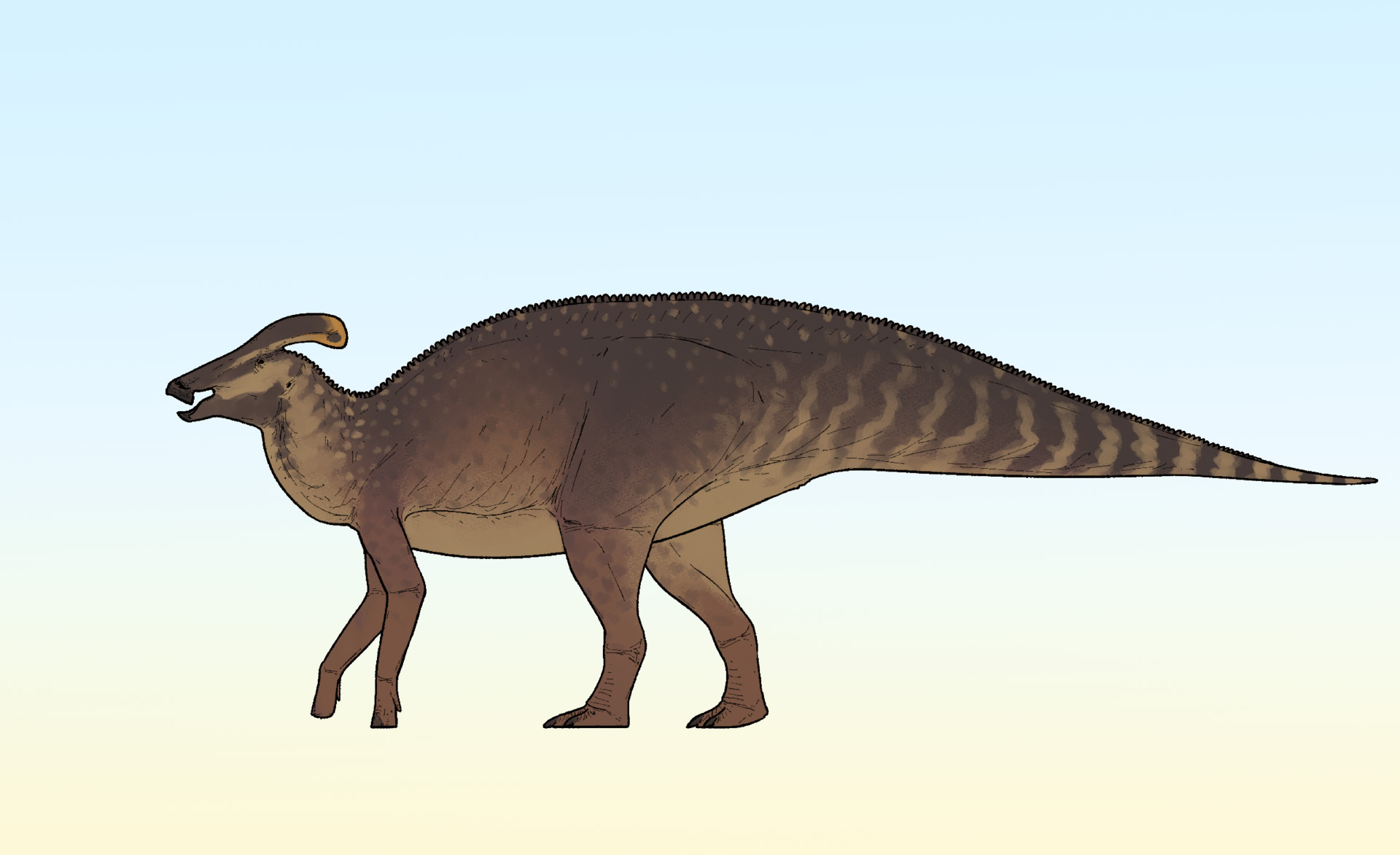
Life reconstruction of Plesiolophus warnerensis. Image credit: Connor Ashbridge / CC BY 4.0.
“Hollow-crested hadrosauroid (duck-billed) dinosaurs belonging to the clade Lambeosaurinae were widely distributed across the northern hemisphere towards the end of the Cretaceous,” Carleton University paleontologist Bradley McFeeters and colleagues wrote in their paper in the Canadian Journal of Earth Sciences.
“Lambeosaurinae is inferred to have likely originated in Asia, where early-diverging members were present as early as the Santonian (86 to 84 million years ago).”
“More derived lambeosaurines were present in western North America (Laramidia) by the Early-Middle Campanian (84 to 78 million years ago), and attained their greatest known abundance and diversity on that landmass later in the Campanian (until 72 million years ago).”
Named Plesiolophus warnerensis, the new lambeosaurine species was identified from a fossilized skull roof and braincase found by fossil hunter Wendy Sloboda near the Milk River Ridge Reservoir, close to the village of Warner in southern Alberta.
The fossil came from the layers of the Oldman Formation, a rock unit that has yielded surprisingly little diagnostic material from the ancestors of the region’s later, more diverse duck-billed dinosaurs.
“Plesiolophus warnerensis represents the first diagnostic material of an adult lambeosaurine from this formation,” the paleontologists wrote in their paper.
Unlike later members of its lineage, Plesiolophus warnerensis retained several ancestral features in its skull.
Yet it also possessed unmistakable characteristics linking it to Parasaurolophini, a clade that eventually produced the iconic hadrosaurid dinosaur Parasaurolophus.
To determine where the new species fit on the evolutionary tree, the researchers compared it with 87 other dinosaur species using a phylogenetic analysis.
The analysis consistently recovered it as one of the earliest members of the North American parasaurolophin lineage.
“Plesiolophus warnerensis is diagnosed by a unique combination of characters, but does not appear to be strongly autapomorphic, and at present cannot be excluded as a potential ancestor to Parasaurolophus, which occurs in the overlying Dinosaur Park Formation,” the scientists wrote in the paper.
“In some regards, the morphology of the new taxon conforms to what could be predicted for a stratigraphically lower representative of Parasaurolophini: the greater morphological similarity to members of Lambeosaurini is reflective of being temporally closer to the phylogenetic divergence from that clade, and the similarity to immature examples of later parasaurolophins is reflective of the heterochronic process hypothesized to have produced the exaggerated crests for which the clade is known.”
_____
Bradley D. McFeeters et al. A new parasaurolophin dinosaur (Hadrosauridae: Lambeosaurinae) from the Oldman Formation of southern Alberta. Canadian Journal of Earth Sciences, published online July 13, 2026; doi: 10.1139/cjes-2026-0013