New research led by University College London paleontologists shows that newly-hatched long-necked giants were prey for multiple carnivores long before Tyrannosaurus rex emerged.
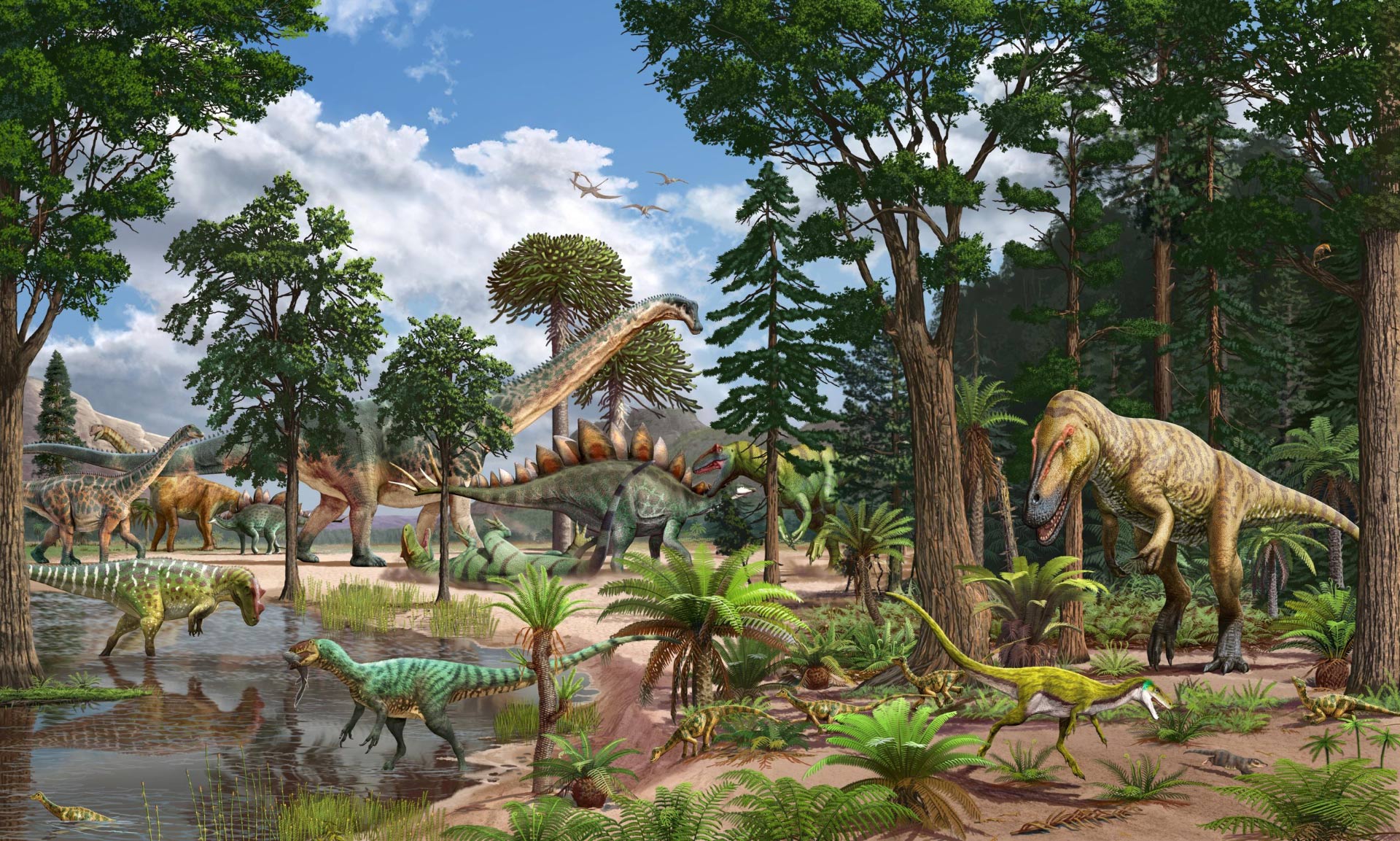
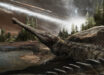
Ecosystem reconstruction of the Late Jurassic Dry Mesa Dinosaur Quarry around 150 million years ago in Colorado, the United States. Image credit: Sergey Krasovskiy / Pedro Salas.
“Adult sauropods such as Diplodocus and Brachiosaurus were longer than a blue whale,” said University College London’s Dr. Cassius Morrison.
“When they walked the Earth would shake. Their eggs, though, were just a foot wide and once hatched their offspring would take many years to grow.”
“Size alone would make it difficult for sauropods to look after their eggs without destroying them, and evidence suggests that, much like baby turtles today, young sauropods were not looked after by their parents.”
In the study, Dr. Morrison and colleagues analyzed fossils discovered in the 150-million-year-old Morrison Formation to map out a food web of the time.
The specimens came from a single quarry, the Dry Mesa Dinosaur Quarry, where a remarkably rich collection of dinosaur fossils was deposited across a time span of up to 10,000 or so years, including at least six species of sauropods such as a Diplodocus, Brachiosaurus, and Apatosaurus.
To determine who ate what, the paleontologists used existing data such as dinosaur size, wear and tear on their teeth, the abundance of certain isotopes in the remains, and in some cases the fossilized contents of their stomach revealing their last meal.
They then mapped out the food web of the time — i.e. all the possible links between dinosaurs, other animals and plants — at a higher resolution than has previously been carried out for dinosaurs, with the help of software typically used for modern ecosystems.
The researchers concluded that sauropods had a key role in this ecosystem, with substantially more links to plants and animals than the other main group of vegetarian dinosaurs, the ornithischians (plant-eaters such as the armored Stegosaurus who were more dangerous prey).
“Sauropods had a dramatic impact on their ecosystem,” Dr. Morrison said.
“Our study allows us to measure and quantify the role they had for the first time.”
“Reconstructing food webs means we can more easily compare dinosaur ecosystems across different periods.”
“It helps us to understand evolutionary pressures and why dinosaurs might have evolved in the way they did.”
The scientists noted that 70 million years later, during the time of Tyrannosaurus rex, fewer sauropods providing easy prey may have helped trigger the evolutionary adaptations (stronger bite force, larger size, better vision) allowing Tyrannosaurus rex to hunt larger, more dangerous animals, such as a Triceratops, which were armed with three large horns.
“The apex predators of the Late Jurassic, such as Allosaurus or Torvosaurus, may have had an easier time acquiring food compared to Tyrannosaurus rex millions of years later,” said Dr. William Hart, a paleontologist at Hofstra University.
“Some Allosaurus fossils show signs of quite horrific injuries — for instance caused by the spiked tail of a Stegosaurus — that had healed and some which hadn’t.”
“But an abundance of easy prey in the form of young sauropods may have allowed injured allosaurs to survive.”
The team’s findings will be published in the New Mexico Museum of Natural History and Science Bulletin.
_____
Cassius Morrison et al. 2026. “Here, size is no accident”: a novel food web analysis of the Dry Mesa Dinosaur Quarry and ecological impact of Morrison Formation sauropod fauna. New Mexico Museum of Natural History and Science Bulletin