Using newly-discovered fossils and cutting-edge imaging, paleontologists have solved the puzzle of Europe’s missing horned dinosaurs (ceratopsians), reclassifying animals once thought to be distant cousins of Iguanodon as true members of the ceratopsian clade.
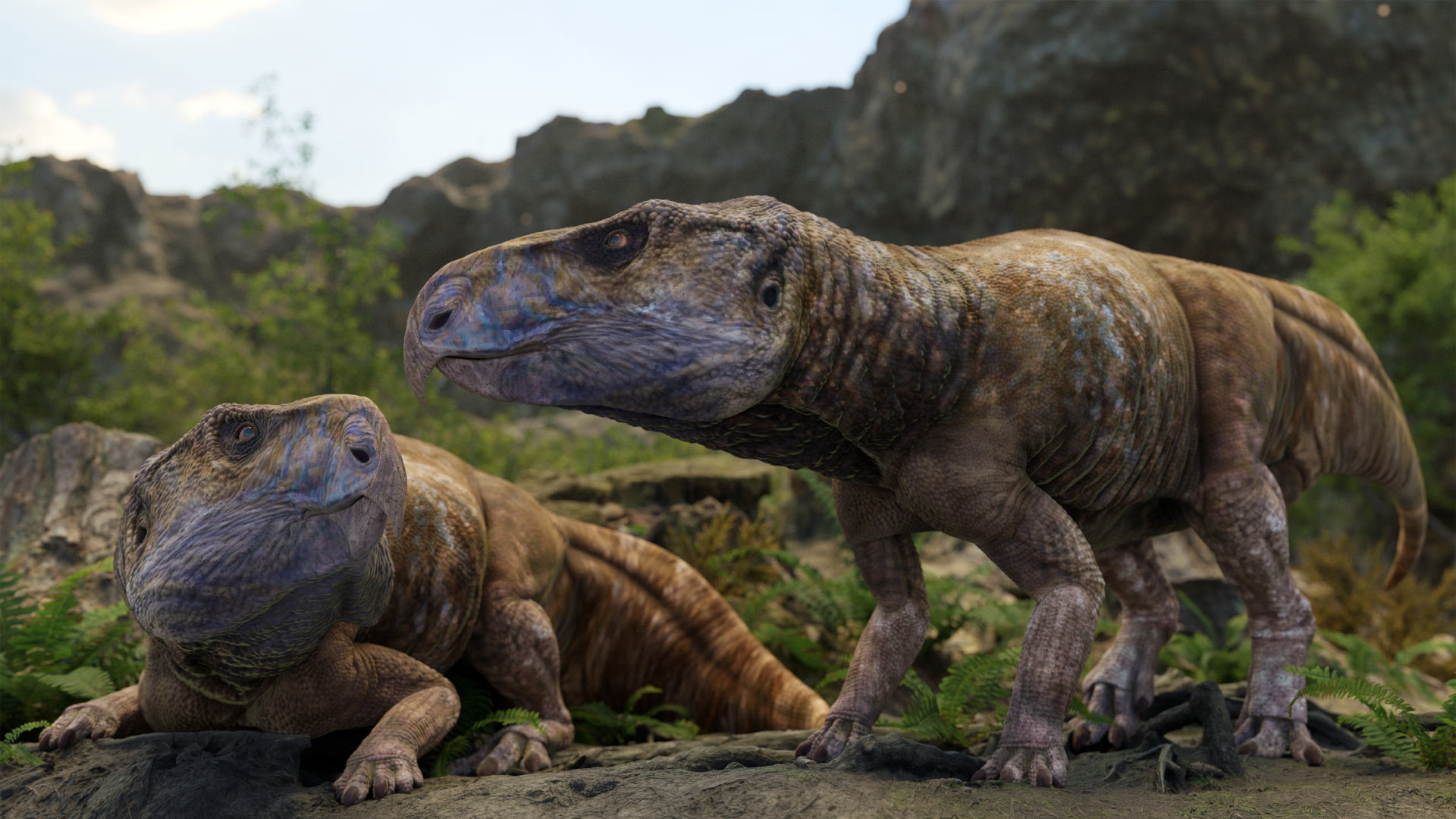
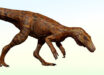
Reconstruction of the possible appearance of Ajkaceratops kozmai. Image credit: Matthew Dempsey.
Ceratopsians were a group of herbivorous ornithischian dinosaurs best known for parrot-like beaks, bony frills and horns.
These dinosaurs lived mainly during the Late Cretaceous epoch, about 100-66 million years ago.
Ceratopsian fossils are abundant in Asia and North America, yet have been almost completely absent from Europe.
Until now, evidence on the continent consisted only of a handful of incomplete and debated specimens.
The discovery of new, more complete fossils of Ajkaceratops from the Late Cretaceous of Hungary prompted a fresh investigation using CT scanning and detailed evolutionary analysis.
First described in 2010, Ajkaceratops has been controversial, with some considering it to be a horned dinosaur, while others interpreted it to be a relative of Iguanodon but with possible characteristics of a ceratopsian.
Using new cranial material, Professor Susannah Maidment, a paleontologist at the Natural History Museum, London and the University of Birmingham, and colleagues found that not only was this dinosaur a ceratopsian, but that a previously described rhabdodontid called Mochlodon was also the same species.
The analyses also showed that some other dinosaurs previously thought to be rhabdodontids had been long misclassified and were also ceratopsians.
“While Iguanodon and Triceratops look very different, the groups they are part of both evolved from a common ancestor, meaning they’ve both inherited certain characteristics,” Professor Maidment said.
“They also independently evolved four-leggedness, complex chewing mechanisms and a large body size.”
“This means that their teeth and limbs look quite similar, both because of their shared history and way of life.”
“So, when we only have small parts of the skeleton to look at, it can be quite difficult to tell what’s what.”
By confirming the existence of ceratopsians in Europe, the study fills in a long-standing gap in the journey of these dinosaurs across the northern hemisphere.
“Because the first fossils discovered of Ajkaceratops were so incomplete it meant lots of scientists doubted it was a ceratopsian,” said University of Birmingham’s Professor Richard Butler.
“What’s so exciting about the new Ajkaceratops fossil is that it allows us to confirm that horned dinosaurs roamed the islands of Cretaceous Europe, but also challenges us to radically rethink our understanding of these ancient ecosystems.”
The earliest ceratopsians, such as Yinlong, evolved in Asia before spreading multiple times into North America, where they evolved into frilled species such as Triceratops and Torosaurus.
The easiest route for these dispersals would be through Europe — but the lack of fossils challenged this.
“We know that dinosaurs were able to cross the Atlantic, which was just starting to open during the Cretaceous,” Professor Susannah said.
“Dinosaurs such as Allosaurus have been found in Portugal and the United States, showing that they had at least some ability to move between continents.”
“Lots of animals can swim and, as the islands of the central European basin weren’t that far apart, it would make sense that dinosaurs were able to island hop.”
“Horned dinosaurs like Triceratops are some of the most iconic dinosaurs but most of them are from North America, and now we’ve found them in Europe, hiding in plain sight because they’ve been misidentified for decades as other types of dinosaurs,” said University of Edinburgh’s Professor Steve Brusatte.
The study was published in the journal Nature.
_____
S.C.R. Maidment et al. A hidden diversity of ceratopsian dinosaurs in Late Cretaceous Europe. Nature, published online January 7, 2026; doi: 10.1038/s41586-025-09897-w