New experiments indicate bird-like oviraptorid dinosaurs could not fully warm their eggs with body heat alone, instead combining brooding with solar warmth in semi-open nests.
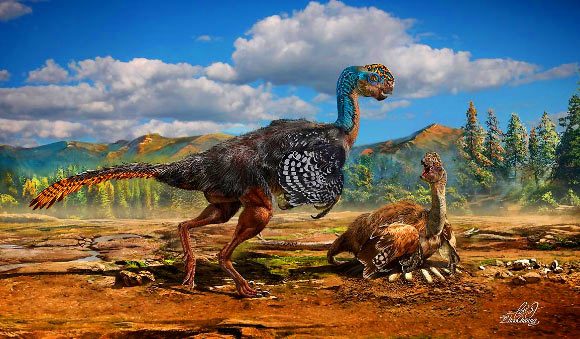
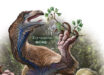
An artist impression of Huanansaurus ganzhouensis. Image credit: Chuang Zhao.
“We show the difference in oviraptor hatching patterns was induced by the relative position of the incubating adult to the eggs,” said Dr. Tzu-Ruei Yang, a paleontologist at Taiwan’s National Museum of Natural Science.
“Moreover, we obtained an estimate of the incubation efficiency of oviraptors, which is much lower than that of modern birds,” said Chun-Yu Su, a researcher at Washington High School.
In the study, the researchers simulated the brooding behavior of Heyuannia huangi, a species of oviraptorid dinosaur that lived in what today is China during the Late Cretaceous epoch, between 70 and 66 million years ago.
Estimated to be around 1.5 m long and weighing around 20 kg, it built semi-open nests made up of several rings of eggs.
The incubating oviraptor’s trunk was made from polystyrene foam and wood for the skeletal frame and cotton, bubble paper, and cloth for the soft tissue.
Eggs were molded from casting resin. In the two clutches used in the experiments, eggs were arranged in double-rings based on real oviraptor clutches.
“Part of the difficulty lies in reconstructing oviraptor incubation realistically,” Su said.
“For example, their eggs are unlike those of any living species, so we invented the resin eggs to approximate real oviraptor eggs as best as we could.”

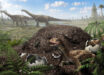
An artist’s depiction of a Late Cretaceous oviraptorosaur, a hadrosaur, and a tyrannosaur in central China. Image credit: Institute of Vertebrate Paleontology and Paleoanthropology, Chinese Academy of Sciences.
When the team ran experiments to find out if clutch attendance of a brooding adult or different environmental circumstances may have impacted hatching patterns, they found that in colder temperatures, where a brooding adult attended the clutch, the eggs’ temperatures in the outer ring differed by up to 6 degrees Celsius, which could have resulted in asynchronous hatching, a pattern where eggs in the same nest hatch at different times.
In warmer conditions, the difference in egg temperatures in the outer ring was just 0.6 degrees Celsius, suggesting that oviraptors living in warmer conditions may have exhibited a different pattern of asynchronous hatching because they could use the Sun as an additional, powerful heat source.
“It’s unlikely that large dinosaurs sat atop their clutches. Supposedly they used the heat of the Sun or soil to hatch their eggs, like turtles,” Dr. Yang said.
“Since oviraptor clutches are open to the air, heat from the Sun likely mattered much more than heat from the soil.”
The researchers also investigated how oviraptor incubation efficiency compares to that of modern birds.
Most birds use thermoregulatory contact incubation, where adults sit directly on the eggs to transfer heat.
The thermoregulatory contact incubation requires three prerequisites — the adult bird must be in contact with every egg, be the main heat source, and maintain all eggs within a constrained temperature range — which oviraptors didn’t fulfil.
“Oviraptors may not have been able to conduct the thermoregulatory contact incubation as modern birds do,” Su said.
“Instead, these dinosaurs and the Sun may have been co-incubators — a less efficient incubation behavior than that displayed by modern birds.”
“Yet, the combination of adult incubation and an ambient heat source — perhaps a behavioral adaptation associated with the evolution from buried to semi-open nests — isn’t necessarily worse.”
“Modern birds aren’t ‘better’ at hatching eggs,” Dr. Yang said.
“Instead, birds living today and oviraptors have a very different way of incubation or, more specifically, brooding.”
“Nothing is better or worse. It just depends on the environment.”
The findings were published in the journal Frontiers in Ecology and Evolution.
_____
Chun-Yu Su et al. 2026. Heat transfer in a realistic clutch reveals a lower efficiency in incubation of oviraptorid dinosaurs than of modern birds. Front. Ecol. Evol 14; doi: 10.3389/fevo.2026.1351288