Paleontologists have described a new species of enigmatic cyclidan crustacean on the basis of three well-preserved specimens from the Early Triassic Guiyang biota of China.

Yunnanocyclus fortis. Image credit: Sun et al., doi: 10.1002/spp2.70052.
Cyclidans are a distinctive group of arthropods that first appeared in the Carboniferous period and survived until the Late Cretaceous.
Their fossil record is sparse, and most finds preserve only the animals’ carapaces (hard shells), leaving many aspects of their anatomy poorly understood.
“Cyclida is an order of arthropods in the Guiyang biota,” said Dr. Xiaoyuan Sun from the China University of Geosciences and his colleagues from China and the United States.
“As an enigmatic and specialized group of crustaceans, they originated in the Mississippian (359 to 323 million years ago) and became extinct in the Late Cretaceous Maastrichtian (73 to 66 million years ago).”
“They are classified as Crustacea on the basis of the possession of features such as antennules, antennae, mandibles, maxillae and maxillipeds.”
“However, our knowledge of cyclidan crustaceans is very limited due to their rarity in the fossil record.”
“Usually, only the hard carapaces are preserved, while their antennules and appendages are extremely rare.”
The new cyclidan species lived during the Late Dienerian age of the Early Triassic, about 251 million years ago.
Named Yunnanocyclus fortis, it is described on the basis of three specimens from the Daye Formation in China’s Guizhou province.
The fossils show an oval carapace with a narrow, smooth marginal rim, along with antennules, antennae and seven pairs of thoracic segments.
Most notably, the specimens preserve a pair of strongly developed mandibles — a feature almost never seen in cyclidan fossils.
The carapace in the holotype specimen measures about 19.8 mm long and 14.7 mm wide, while the mandibles are about 1.7 mm long and 0.8 mm wide.
Using micro-X-ray fluorescence analysis, the paleontologists detected high concentrations of calcium and phosphorus in the mandibles and other structures, indicating that they were thick and strongly mineralized.
“Yunnanocyclus fortis had strongly ovoid mandibles,” they said.
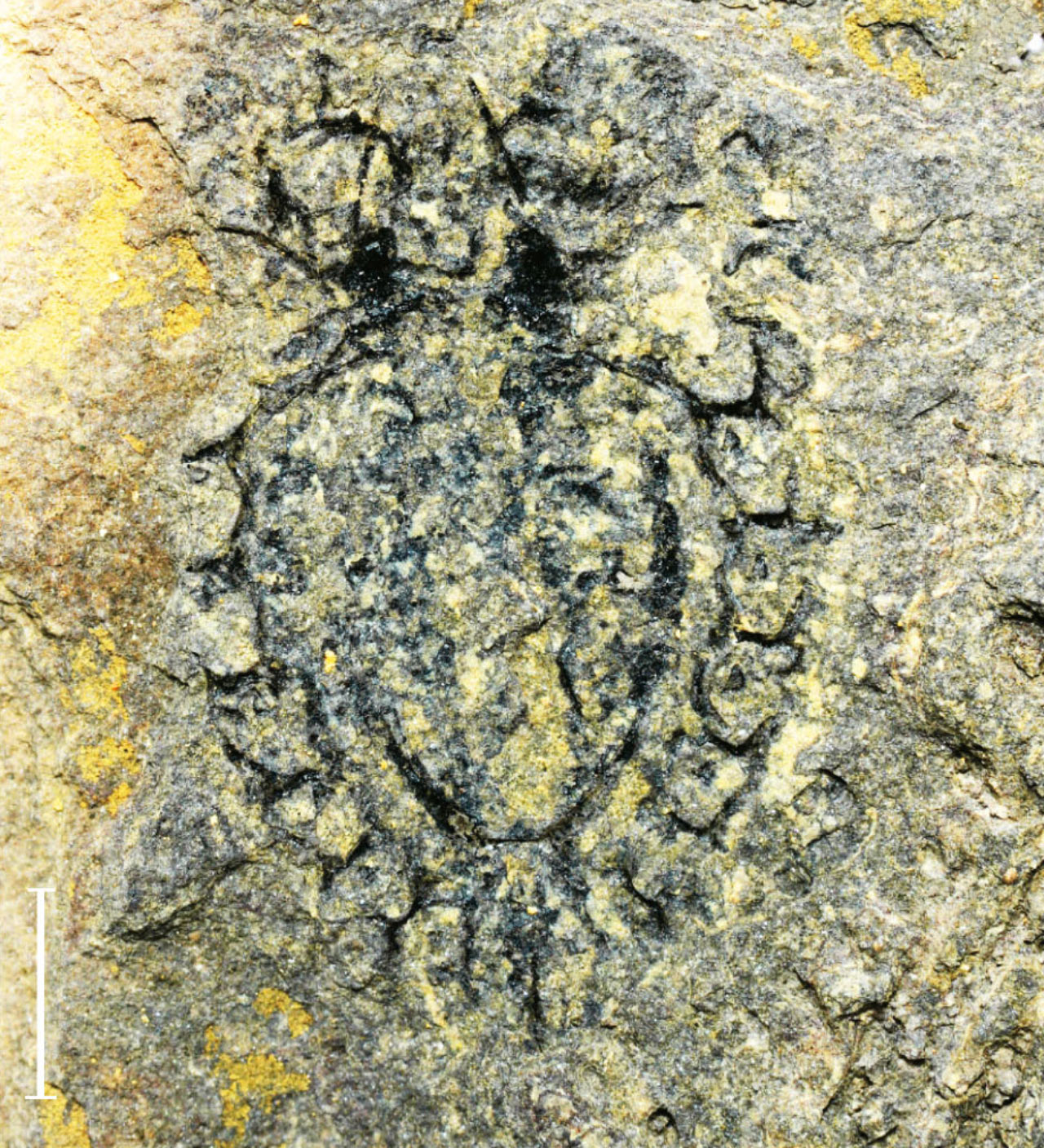
Holotype of Yunnanocyclus fortis. Scale bar – 2 mm. Image credit: Sun et al., doi: 10.1002/spp2.70052.
The discovery expands the known geographic range of Early Triassic cyclidans.
Previously, fossils from this time period had been documented mainly in Madagascar and parts of Europe.
The new species represents the oldest cyclidan record from the eastern Tethys region.
“Our discovery of new species from China expands the known paleogeographic distribution of Early Triassic cyclidans,” the researchers said.
“Early Triassic cyclidans are most widely distributed in Madagascar, Europe and China.”
“By the Late Triassic, they were recorded only in Europe.”
The fossils also shed light on how these enigmatic animals evolved through deep time.
By analyzing morphological data from Yunnanocyclus fortis and other cyclidan species, the scientists reconstructed the group’s morphospace, a method used to examine the diversity of body forms.
The results suggest that cyclidans experienced their greatest diversification early in their history, during the Carboniferous period, followed by a gradual decline in disparity through later eras.
This pattern supports what evolutionary biologists call the ‘early burst’ model, in which a group rapidly diversifies soon after it appears and then undergoes slower evolutionary change afterward.
The findings also contribute to understanding ecosystems in the wake of the Permian-Triassic mass extinction, which eliminated more than 80% of marine species.
Fossil discoveries from the Guiyang biota and other Early Triassic sites suggest that complex marine communities may have re-established earlier than once thought.
By revealing new anatomical details and extending the geographic record of cyclidans, Yunnanocyclus fortis offers another glimpse into the recovery and evolution of marine life during one of the most turbulent intervals in Earth’s history.
“With the addition of a new species and a revision of the Triassic paleogeography of Cyclida in terms of age, we find that Early Triassic cyclidans were the most widely distributed, with a gradual decrease in distribution thereafter,” the authors concluded.
“This phenomenon is similar to the global distributed ammonoid and other marine invertebrate species in the Early Triassic, and may be related to the decreased environmental gradients in different latitudinal zones after the Permian-Triassic mass extinction.”
The discovery of Yunnanocyclus fortis is reported in a paper in the journal Papers in Palaeontology.
_____
Xiaoyuan Sun et al. 2025. A new Induan (Early Triassic, Dienerian) cyclidan crustacean from the Guiyang biota. Papers in Palaeontology 11 (6): e70052; doi: 10.1002/spp2.70052