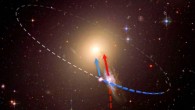
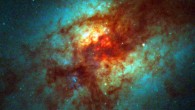
Dr Igor Chilingarian of Harvard-Smithsonian Center for Astrophysics and his colleague, Dr Ivan Zolotukhin of the L’Institut de Recherche en Astrophysique...
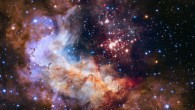
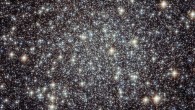
To commemorate the NASA/ESA Hubble Space Telescope’s 25 years of success, astronomers have captured a stunning new image of a distant star cluster known...
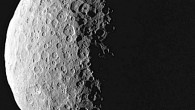
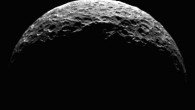
The two bright spots on Ceres are back in view in the new image from NASA’s Dawn space probe.
The two mysterious bright spots are located in a crater...
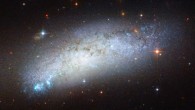
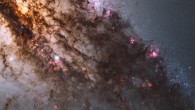
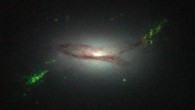
Using the Advanced Camera for Surveys on the NASA/ESA Hubble Space Telescope, astronomers have taken a stunning image of the galaxy ESO 162-17.
This image...
A new study in the journal Science has revealed that 3 billion years after the Big Bang, elliptical galaxies still made stars on their outskirts, but no...
NASA’s Dawn spacecraft has returned stunning new images of the sunlit north pole of the dwarf planet Ceres, the largest object in the main asteroid belt.
This...
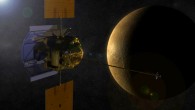
NASA’s MESSENGER (MErcury Surface, Space ENvironment, GEochemistry, and Ranging) probe will crash into the planet at 8,750 miles per hour (3.91 km/sec),...
The Ralph color imager on NASA’s New Horizons spacecraft has captured a low-resolution color image of Pluto and its largest moon, Charon.
This image...
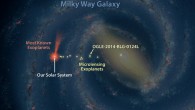
Astronomers using NASA’s Spitzer Space Telescope and the Polish Optical Gravitational Lensing Experiment (OGLE) telescope at the Las Campanas Observatory...
Astronomers led by Roger Griffith of the Pennsylvania State University say they have found no evidence of so-called Type III Kardashev super-civilizations...
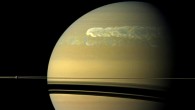
Planetary researchers studying data from NASA’s Cassini spacecraft have found the solution to the mystery of why Saturn seethes with massive storms every...
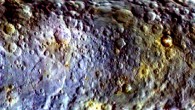
NASA scientists using the framing camera aboard the Dawn spacecraft have created the first color map of the dwarf planet Ceres.
This color map of Ceres...
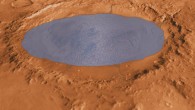
An international team of scientists, led by Dr Javier Martin-Torres of the Spanish Research Council in Spain and the Lulea University of Technology in...
According to NASA chief scientist Dr Ellen Stofan, in the next twenty years, scientists may very well finally answer whether we are alone in the Solar...
This newly released Hubble image shows Messier 22, the brightest globular cluster visible from the northern hemisphere.
This is a close-up of the central...
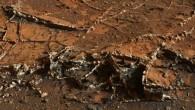
This March 18, 2015, view from the Mast Camera (Mastcam) on NASA’s Curiosity rover shows a network of two-tone mineral veins at an area called Garden...
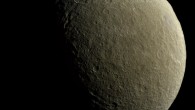
The NASA/ESA/ASI Cassini-Huygens spacecraft has captured the best images so far of Rhea, the fourteenth of Saturn’s known moons.
This mosaic image from...
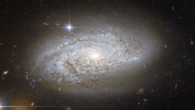
Astronomers using the Advanced Camera for Surveys (ACS) on the NASA/ESA Hubble Space Telescope have captured a stunning new image of the spiral galaxy...
An international team of astronomers led by Dr David Harvey of the Observatory of Sauverny in Switzerland and the University of Edinburgh, UK, has studied...