Cranial fossils of a nodosaurid ankylosaur unearthed more than two decades ago on the Japanese island of Hokkaido have been recognized as belonging to a new genus and species.
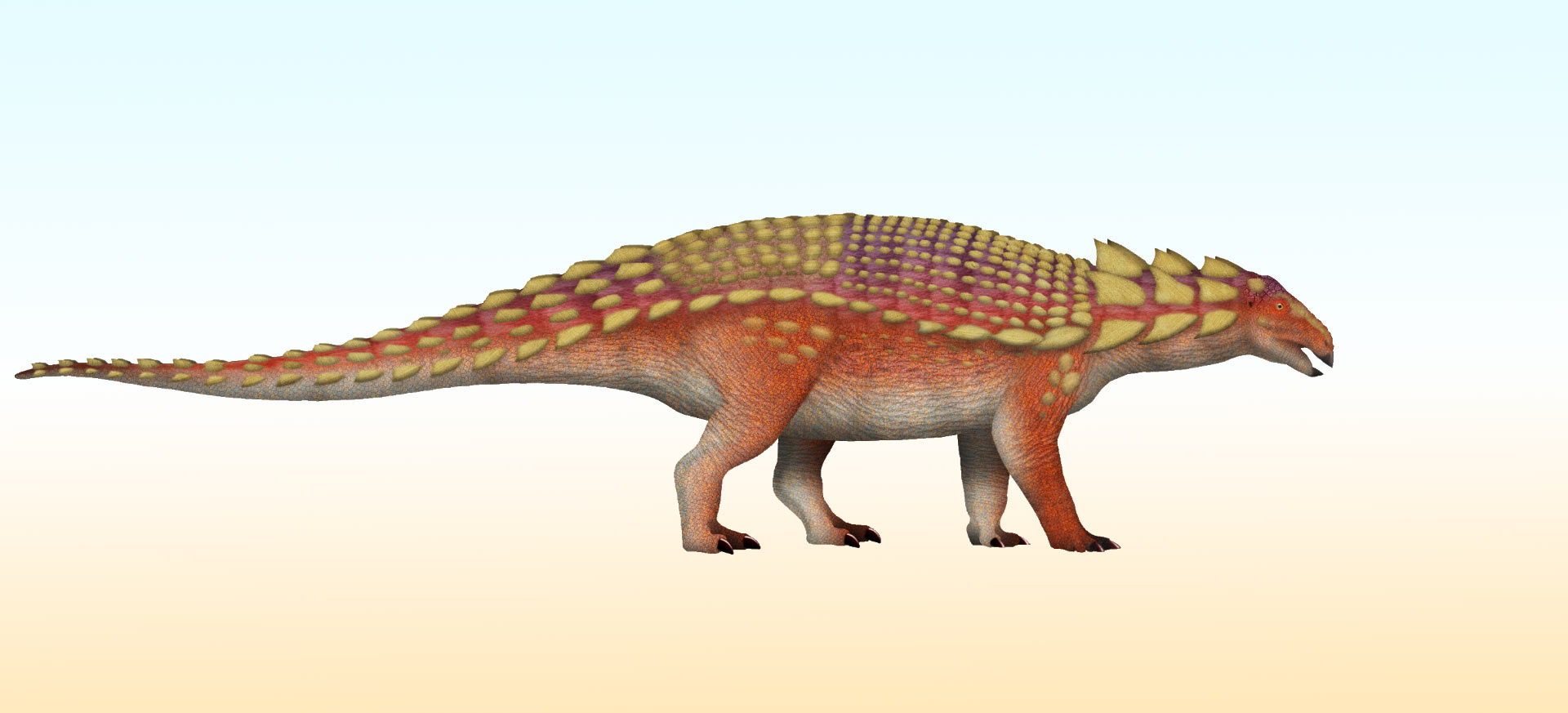
Nipponopelta yezoensis. Image credit: TotalDino / CC BY 4.0.
The newly identified dinosaur species roamed Earth during the Late Cretaceous epoch, between 96 and 94 million years ago.
Named Nipponopelta yezoensis, it is the first ankylosaur ever formally described from Japan, and only the second Asian member of its subfamily, the nodosaurids, known from skull material rather than bones from the body alone.
“The traditionally known ankylosaurs (now Euankylosauria) are divided in two major clades, nodosaurids and ankylosaurids, among the most widely discovered dinosaurs from Cretaceous deposits,” said Hokkaido University paleontologist Shumpei Oyabu and his colleagues.
“The geographic distribution of nodosaurids, defined by the largest clade containing Nodosaurus textilis but not Ankylosaurus magniventris, extends to five major continents, including North America, South America, Asia, Europe, and Antarctica.”
“Importantly, nodosaurids are more commonly found in marine deposits compared to ankylosaurids.”
“This distribution pattern may be partially attributed to the limited presence of ankylosaurids in North America.”
“Nevertheless, several studies suggest that nodosaurids were more adapted to coastal and estuarine environments.”
“In Asia, nodosaurids are mainly found in the mid-Cretaceous deposits in Japan and China. Their abundance is much smaller than that of North American and European nodosaurids.”
A partial skull, a cranial vertebra and several teeth from Nipponopelta yezoensis were discovered in the 2000s in a concretion from the upper part of the Hikagenosawa Formation in Yubari city, Hokkaido, Japan.
The fossils were initially identified as a nodosaurid; however, its taxonomic status remained unresolved.
Oyabu and co-authors from Japan, Canada and the United States revisited the specimens in the new study.
Using three-dimensional CT scanning, they were able to digitally reconstruct parts of the skull that had never been visible before, including a section of the lower jaw, two intact teeth, and, notably, the dinosaur’s left inner ear.
The scans also exposed a distinctive combination of features at the back of the skull.
The team’s phylogenetic analysis indicates that Nipponopelta yezoensis is deeply nested among derived nodosaurids from North America and Europe, such as Pawpawsaurus, Panoplosaurus, Edmontonia and Denversaurus, rather than grouped with the handful of other nodosaurids previously described from Asia.
To explain this pattern, the paleontologists modeled how the dinosaur’s ancestors might have moved across the globe over millions of years.
“Ancestral geographic analysis suggests that Nipponopelta yezoensis and its close relatives originated in Laramidia, Appalachia, and Asia, indicating a wide ancestral area,” they said.
The researchers also traced how ankylosaurs’ preferred habitats changed over time.
Their reconstruction suggests that these dinosaurs in general arose in coastal settings before some branches moved inland, but that nodosaurids, and Nipponopelta yezoensis in particular, retained a preference for marine-influenced habitats.
“Habitat reconstruction reveals that Nipponopelta yezoensis preferred marine influenced environments, likely inhabiting coastal or estuarine areas,” the scientists said.
“This preference for coastal environments played a significant role in its dispersal patterns across different regions.”
The discovery of Nipponopelta yezoensis is described in a paper in the journal Cretaceous Research.
_____
S. Oyabu et al. A new nodosaurid ankylosaur (Dinosauria: Ornithischia) from the Upper Cretaceous Hikagenosawa Formation in Japan reveals dispersal pattern of Asian nodosaurid ankylosaurs. Cretaceous Research, published online August 21, 2026; doi: 10.1016/j.cretres.2026.106477