An enduring debate in paleoanthropology asks what kind of foot the last common ancestor (LCA) of humans and chimpanzees had: one built like a modern ape’s for climbing straight up trees, or one built more like a generalized monkey’s, less suited to vertical climbing. In new research, paleoanthropologists from Dartmouth College and Ohio State University found that vertically-climbing monkeys called sooty mangabeys (Cercocebus atys) can flex their feet nearly as much as chimpanzees while climbing vertical trunks, suggesting that the LCA could have been a tree climber even if it had a more monkey-like anatomy.

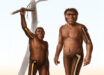
Ardipithecus ramidus, a hominid that lived in Africa more then 4 million years ago. Illustration by Arturo Asensio, via Quo.es.
“People are making behavioral inferences from fossils, and some say a monkey can’t vertically climb as well as an ape can,” said Ohio State’s Dr. Luke Fannin.
“We’re saying there’s a functional equivalence here. So you can’t rule out vertical climbing just because something doesn’t have a chimpanzee-like foot.”
“Identifying the last common ancestor is considered key to helping us understand what led to bipedalism, which is done habitually only by humans.”
“We know we’re apes, but this study makes the point that even if the ancestor had a more monkey-like foot morphology, it could still climb like an ape.”
“Part of paleoanthropology is understanding how our evolution happened, and it’s often through the hallmark of how we move because modern humans move quite differently than our cousins, the chimpanzees, do, and they’re the living primate we’re most closely related to. And we’re trying to understand why that is.”
Dr. Fannin and colleagues spent time in Ivory Coast’s Taï National Park filming the sooty mangabey, a species of large, forest-dwelling African monkey that is a terrestrial forager and climber of vertical trunks.
Using video captured at 30 frames per second, the researchers measured how far the primates bent their ankles and their midfeet during climbing.
Chimpanzees and other African apes climb by hyperextending their ankles more than 45 degrees, a maneuver that keeps their center of mass close to the tree and reduces the risk of tipping backward. Monkeys, by contrast, lack the ankle anatomy to pull off that same trick.
What the scientists found is that mangabeys compensate with an entirely different joint: rather than bending sharply at the ankle, they bend sharply at the midfoot, the flexible region between the heel and the toes sometimes called a midfoot break.
Mangabeys flexed their midfeet by an average of nearly 46 degrees while climbing — almost identical to the degree of ankle flexion recorded in climbing chimpanzees, and even slightly greater than the ankle flexion measured in Twa hunter-gatherers, a Central African population known for climbing trees to harvest honey.
Meanwhile, the mangabeys’ own ankles barely moved by comparison, flexing roughly 23 degrees on average — far less than either the chimpanzees or the Twa climbers.
In other words, two very different joints, in two very different feet, were producing strikingly similar climbing performance.

Sooty mangabeys (Cercocebus atys). Image credit: Luke Fannin, Dartmouth College.
The finding matters because it undercuts one of the pillars of the ‘monkey-footed LCA’ argument: the idea that a monkey-like midfoot would have made vertical climbing difficult, or even off the table, for early members of the human lineage.
If a flexible midfoot can substitute for a flexible ankle as effectively as the mangabey data suggest, then an ancestor with a more monkey-like foot could still have climbed trees safely and often.
The authors note that their results don’t settle which foot the common ancestor actually had. What they do show is that either version — ape-like or monkey-like — could have supported a life that regularly included climbing trees.
“What’s neat about this paper is it adds clarity, but it also makes the broader picture more fuzzy,” said Ohio State’s Professor W. Scott McGraw.
“Because this notion that you have to have a foot like an advanced ape to vertically climb, which is a difficult task, is not true.”
“You’ve got a bunch of monkeys that aren’t extinct — and which can be filmed — that are very competent at performing a biomechanically challenging behavior right now in a forest in West Africa.”
“Arboreality is fundamental to understanding primates — including ourselves — because it has shaped our body to a large degree: hands and feet, wrists and ankles, nails instead of claws, etc.”
“Regardless of where you’re starting from, which we don’t know yet, vertical climbing is universal and the anatomy is going to perform that behavior,” Dr. Fannin added.
“So I think that to get at the question of a monkey-like or ape-like last common ancestor, we need more fossils.”
The findings were published this month in the Proceedings of the National Academy of Sciences.
_____
Luke D. Fannin et al. 2026. A kinematic convergence in ape and monkey vertical climbing informs debates on early hominin arborealism. PNAS 123 (35): e2608183123; doi: 10.1073/pnas.2608183123