Astronomers using the NASA/ESA/CSA James Webb Space Telescope have revealed a surprisingly large population of faint, low-mass stars in distant galaxies, suggesting some of the early Universe’s biggest galaxies may contain up to four times more stellar mass than previously estimated.
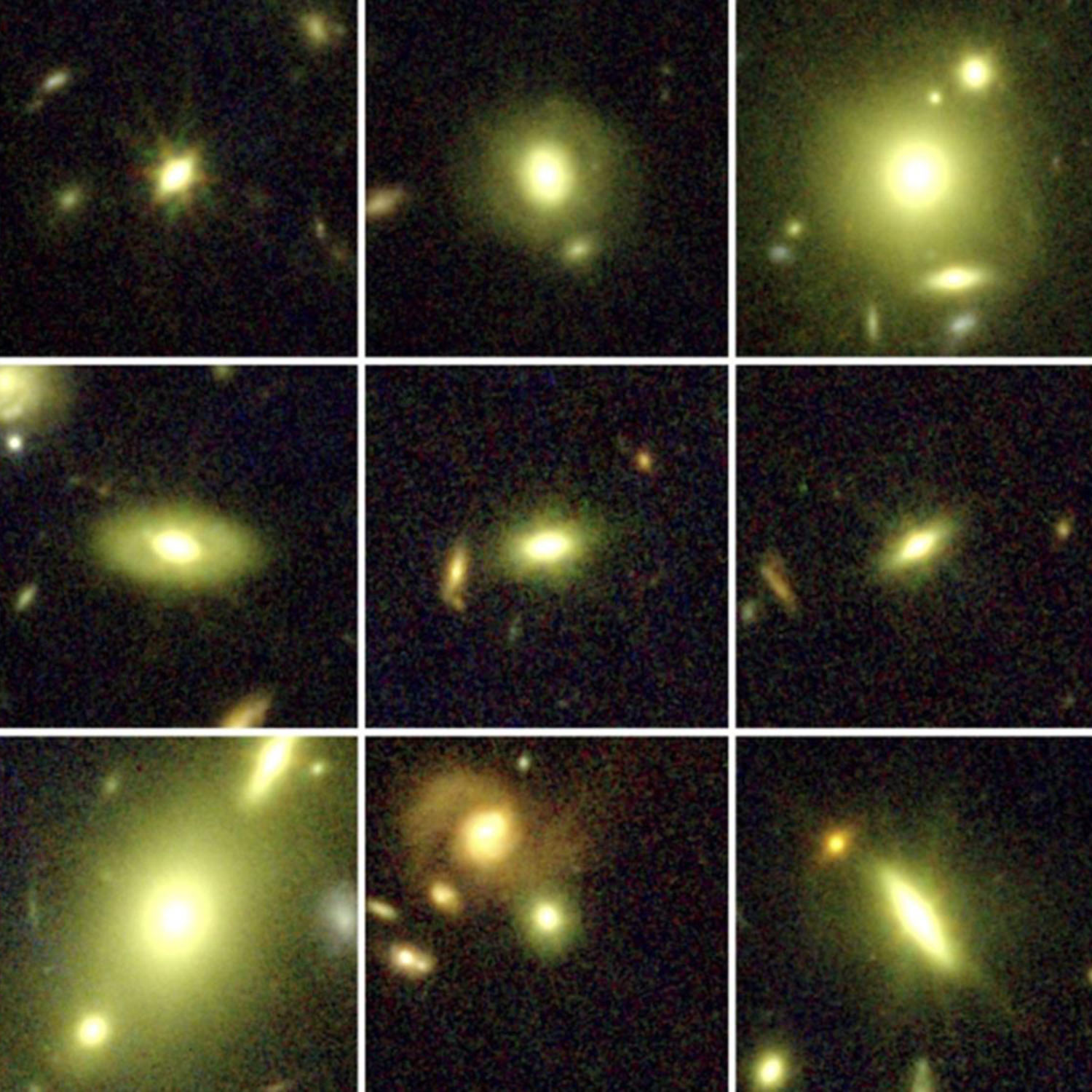
These Webb images show massive galaxies studied by Cheng et al. Image credit: Chloe Cheng.
“These galaxies are different,” said study co-author Dr. Joel Leja, an astronomer at Penn State.
“They’re different in the way that is really challenging to understand, because they are more massive than we expected — like a lot more massive, they have three or four times more mass than we expected.”
In the study, Dr. Leja and colleagues analyzed detailed spectra of nine massive, mature galaxies that ceased forming stars billions of years ago in the early Universe.
They found these galaxies hide a far larger population of small, faint, low-mass stars than assumed, meaning the systems are actually 3-4 times more massive than previous estimates suggested.
This overturns the standard assumption that stars form in similar size distributions everywhere, and it deepens the puzzle of how such enormous galaxies assembled so quickly after the Big Bang.
It also hints that more low-mass stars — and potentially more planets — may have formed in the early cosmos than thought.
“If a galaxy were a city, the brightest stars would be the skyscrapers that immediately catch your eye from afar,” said study lead author Chloe Cheng, a doctoral graduate at Leiden University.
“Our models demonstrate that a far more numerous population of low-mass stars is concealed by those rare, bright stars, like houses hidden between skyscrapers.”
“As a result, this galaxy turns out to be much more massive than previous estimates suggested.”
“Until recently, measurements like these were simply impossible,” said study co-author Martje Slob, a doctoral candidate at Leiden University.
“We needed not only a telescope capable of magnifying very distant galaxies, but also spectra of exceptional quality and new analysis techniques to reliably detect the subtle signatures of faint, low-mass stars hidden within these cosmic titans.”
According to the team, this discovery has crucial implications for our understanding of the early Universe.
“This result shows that much more mass than previously thought is hidden in low-mass stars,” said Leiden Observatory’s Professor Mariska Kriek, co-author of the study.
“That has consequences for many areas of astronomy. For example, as many planets orbit low-mass stars, this could even indicate that more planets formed in the early Universe than we had previously assumed.”
A paper on the findings was published August 18 in the journal Nature Astronomy.
_____
C.M. Cheng et al. Hidden mass in early galaxies revealed by bottom-heavy initial mass functions. Nat Astron, published online August 18, 2026; doi: 10.1038/s41550-026-02932-4