Analyzing data from several telescopes, including NASA’s Chandra X-ray Observatory, an international team of astronomers has discovered a massive black hole ejected from its host galaxy.
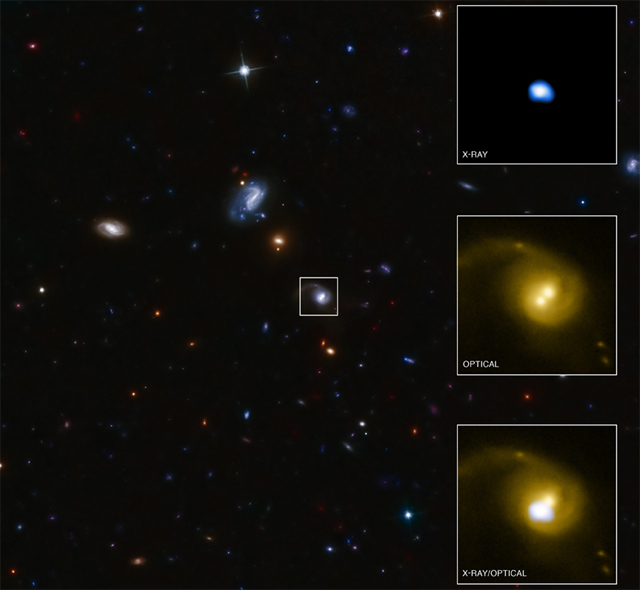
CID 42: giant black hole kicked out of host galaxy (X-ray: NASA / CXC / SAO / F.Civano et al; Optical: NASA / STScI; Optical, wide field: CFHT / NASA / STScI)
This galaxy is called CID-42 and is located about 4 billion light years from Earth. The researchers think that CID-42, also known as CXOC J100043.1+020637, contains a massive black hole being ejected from its host galaxy at several million miles per hour.
The main panel is a wide-field image of CID-42 and its surroundings taken by the Canada-French-Hawaii Telescope and the Hubble Space Telescope in optical light.
The outlined box on the main panel represents the more localized view of CID-42 that is shown in the three separate boxes on the right-hand side of the graphic. At the top is an image from the Chandra X-ray Observatory. The X-ray emission is concentrated in a single source, corresponding to one of the two sources seen in deep observations by Hubble, which is shown in the middle inset box. The bottom inset shows how the X-rays align with the optical data in the two insets above.
The precise location of this source was recently obtained using Chandra’s High Resolution Camera, giving an important clue in telling astronomers what is happening within this galaxy.
Previous Chandra observations had detected a bright X-ray source likely caused by super-heated material around one or more supermassive black holes. However, they could not distinguish if the X-rays came from one or both of the optical sources because Chandra was not pointed directly at CID-42, giving an X-ray source that was less sharp than usual.
The new results, which will be detailed in the Astrophysical Journal (paper1) and Monthly Notices of the Royal Astronomical Society (paper2), help to clarify the situation. Researchers think that CID-42 is the byproduct of two galaxies that have collided, producing the distinctive tail seen in the upper part of the optical image inset.
_______
Bibliographic information:
Civano F. et al. 2012. Chandra High resolution Observations of CID-42, a candidate recoiling SMBH. Accepted for publication in ApJ. ArXiv:1205.0815v1
Blecha L., Civano F., Elvis M., Loeb A. 2012. Constraints on the Nature of CID-42: Recoil Kick or Supermassive Black Hole Pair? To be published in Mon. Not. R. Astron. Soc. ArXiv:1205.6202v2