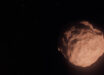
After a century of speculation, astronomers using ESO’s Very Large Telescope (VLT) have captured the clearest evidence yet that the red supergiant Betelgeuse is orbited by a faint companion star.
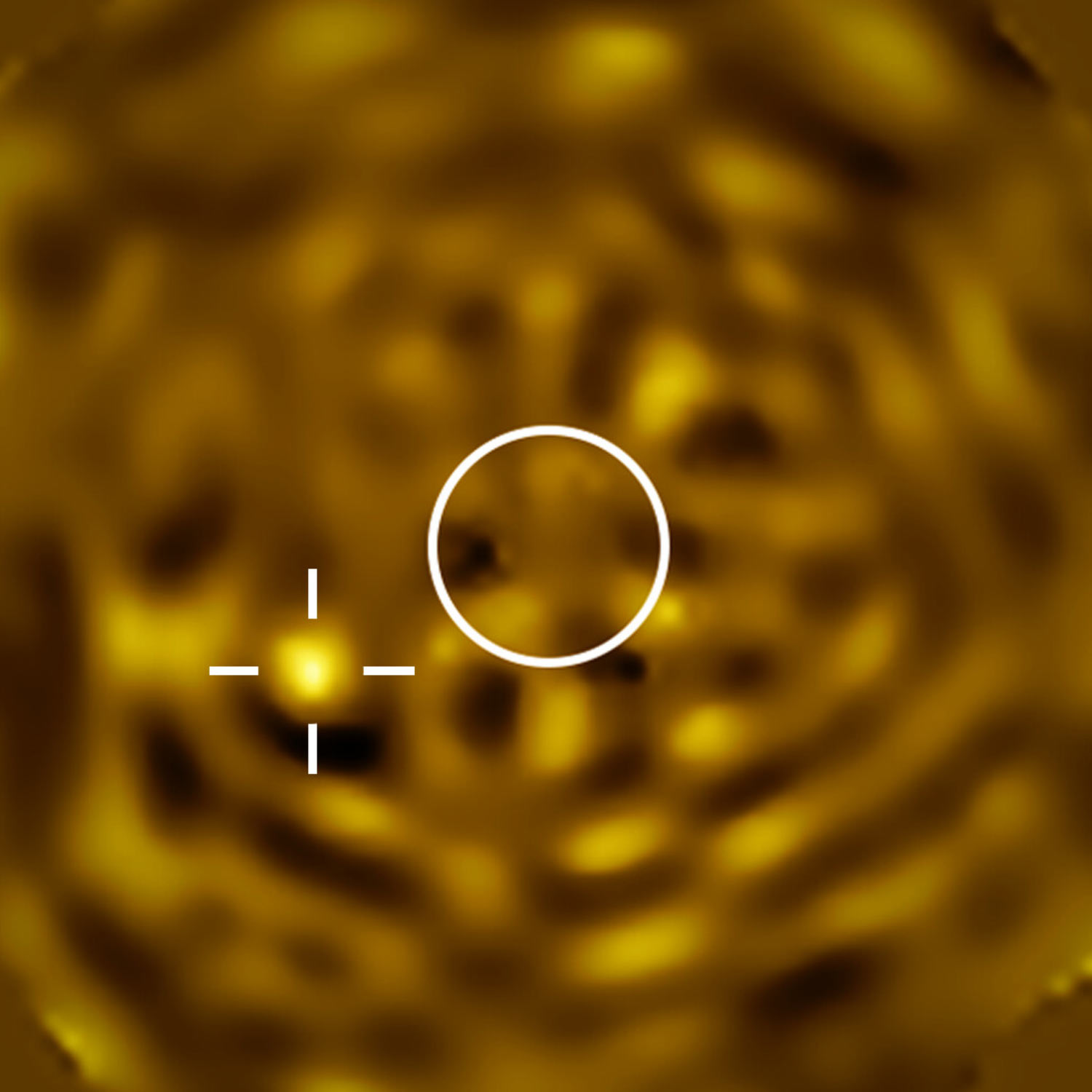
This VLT/SPHERE image shows the clearest image ever of what likely is Betelgeuse B. Image credit: ESO / Montargès et al.
Betelgeuse, the second brightest star in the constellation Orion, is an 8-million-year-old red supergiant located approximately 724 light-years away from Earth.
With a radius around 1,400 times larger than the Sun’s, Betelgeuse is one of the biggest stars known.
Also known as Alpha Orionis or Alpha Ori, it is also one of the most luminous stars known, emitting more light than 100,000 Suns.
The star is nearing the end of its life span, and when it explodes, the event will be bright enough to see during the day for weeks.
“We have shown that Betelgeuse is not single, it is accompanied by a faint stellar companion,” said Dr. Miguel Montargès, an astronomer at the Observatoire de Paris.
Dr. Montargès and colleagues detected a faint point of light near Betelgeuse using the SPHERE-ZIMPOL instrument, an extreme adaptive optics system designed for high-contrast imaging.
The observations were taken on December 3 and 6, 2024, timed to coincide with the predicted point of maximum separation between Betelgeuse and a hypothetical companion, dubbed Betelgeuse B.
“It is remarkable to see how SPHERE and advanced post-processing techniques, originally developed to find exoplanets, also excel at detecting a companion around a massive, evolved star like Betelgeuse,” said Dr. Anthony Boccaletti, an astronomer at the Observatoire de Paris.
“To be certain that the companion is really there, we still need to observe it in one year on the other side of the star, but there is very little space left for doubt,” Dr. Montargès added.
The newly imaged source sat about 52 milliarcseconds from Betelgeuse, corresponding to a projected distance of roughly 8.8 AU (astronomical units).
That places the companion’s orbit in a range consistent with the 5.5-to-6-year periods estimated by earlier orbital models.
The astronomers estimate Betelgeuse B is a young star of about 2.6 to 3.1 solar masses.
The absence of hydrogen-alpha emission, ultraviolet light, or X-rays from the object fits with it being an ordinary young main-sequence star rather than an even younger, more active protostar.
“Honestly, I thought we did not have the sensitivity to detect Betelgeuse B as it was predicted. Because it is more massive than predicted, we see it,” Dr. Montargès said.
“The fact that we can still discover a nearby companion, more massive and brighter than the Sun, around such a well-studied star is remarkable.”
“These are among the best moments in science: seeing something new, unexpected.”
The team’s results appear in the journal Astronomy & Astrophysics.
_____
M. Montargès et al. 2026. VLT/SPHERE images of the candidate companion of Betelgeuse. A&A 711, L12; doi: 10.1051/0004-6361/202661023