A set of 1.43-million-year-old fossil footprints preserved along the margin of an ancient lake in northern Kenya is offering paleoanthropologists new evidence about the size, gait and social lives of the beings who made them and reopening questions about which species they belonged to.
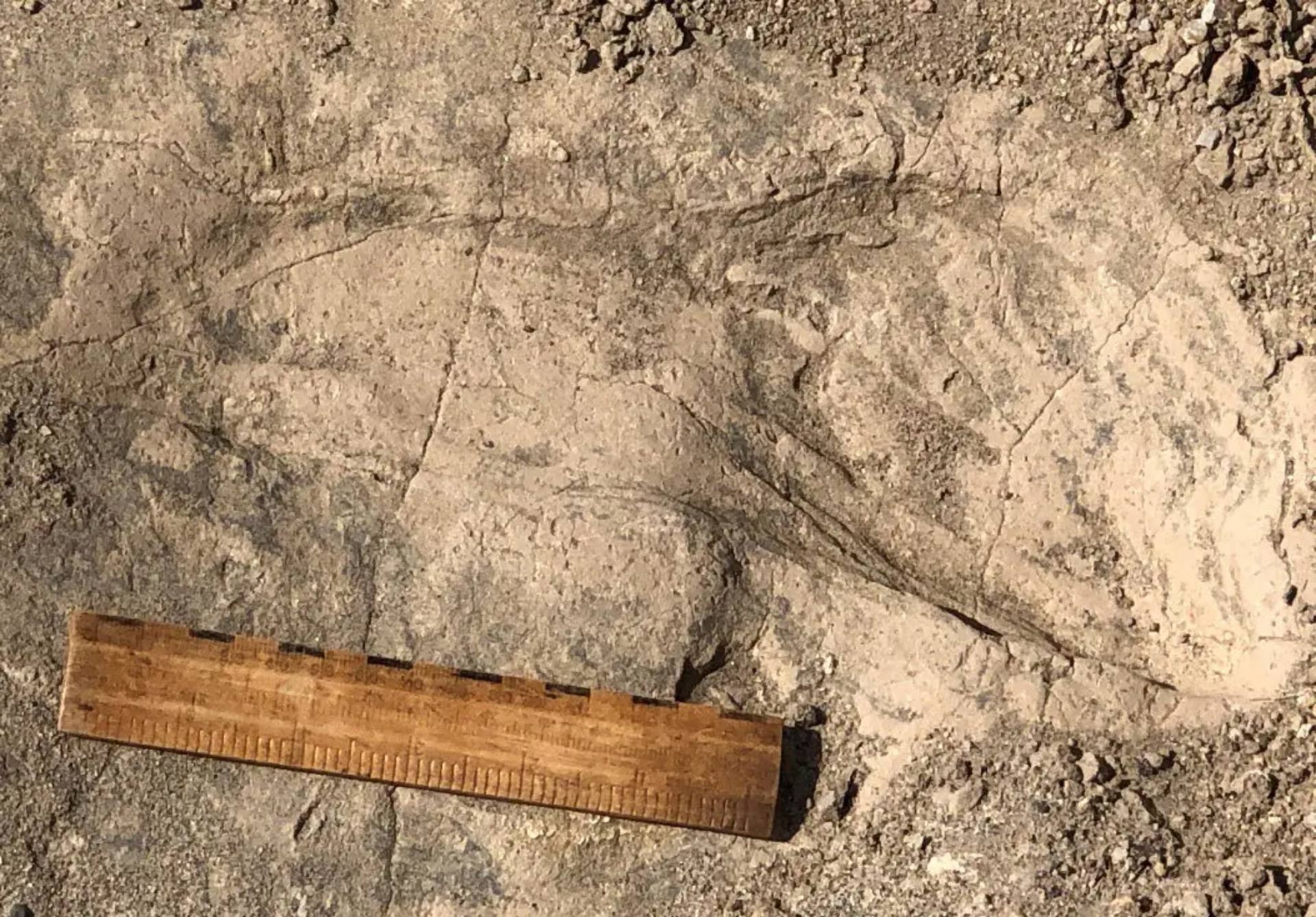
One of 1.43-million-year-old footprints found at the GaJi10 site in the Koobi Fora Formation in northern Kenya; a 15-cm (6-inch) ruler is shown for scale. Image credit: Kay Behrensmeyer.
“The sizes of the footprints indicate human-like body sizes — up to 1.8 m (5.9 feet) tall and around 75 kg,” said Dr. Kevin Hatala, a researcher at Chatham University and the Max Planck Institute for Evolutionary Anthropology.
In their research, Dr. Hatala and his colleagues analyzed 21 hominin tracks uncovered at the site of GaJi10 in the Koobi Fora Formation in the Turkana Basin.
The site was first discovered in 1978 but was substantially expanded in 2016 and again in 2023, revealing far more tracks than previously known.
The tracks record at least eight individuals who crossed a shallow lakeshore, leaving behind evidence of their anatomy, walking style and possible behavior.
“One trackway is oriented to the east while all other tracks and trackways are oriented toward the west,” the researchers noted.
“It is possible that the east-bound individual is also sampled in the west-bound tracks, but evidence to make that determination is lacking.”
The footprints preserve the internal architecture of ancient feet in enough detail to compare them with tracks already attributed to two hominin species known to have lived in the region at the time: Homo erectus and Paranthropus boisei.

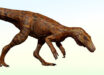
Paranthropus boisei. Image credit: © Roman Yevseyev.
The internal foot mechanics recorded in the new tracks closely resemble those previously linked to Paranthropus boisei, showing flatter arches and more mobile big toes than in modern humans — traits also seen in far older footprints from Laetoli, Tanzania, attributed to Australopithecus afarensis.
But the size of the footprints complicates the picture: estimates of stature and body mass drawn from the tracks are, for most of the individuals, larger than nearly all previously known skeletal estimates for Paranthropus boisei, and in some cases closer to what would be expected for Homo erectus.
This leaves two possibilities: either Paranthropus boisei grew considerably larger, and varied in size more, than fossils have previously suggested, or the tracks belong to Homo erectus individuals whose foot anatomy and walking mechanics varied far more than anything documented in modern humans.
Regardless of which species made the tracks, the scientists argue that several of the individuals were probably large adult males walking in the same direction at roughly the same time.
That pattern provides rare direct evidence of social behavior in the fossil record, where such interactions are usually inferred only indirectly from bones and stone tools.

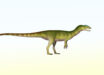
Homo erectus. Image credit: Yale University.
“The fact that eight, mostly adult male, Paranthropus boisei individuals seemingly traveled together as a group, without females or children, hints at a complex social structure in this species,” said Dr. Neil Roach, researcher at Harvard University.
“They may have lived in large groups, where males competed for mates, but also tolerated each other at times for safety in a dangerous environment.”
“The discovery of these fossil footprints along the margins of Lake Turkana reinforces the region’s global importance in understanding human evolution, preserving remarkable evidence of how our ancient relatives lived 1.4 million years ago,” said Dr. Purity Kiura, a researcher at the National Museums of Kenya.
“It further strengthens Kenya’s position as one of the world’s leading paleoanthropological landscapes and highlights our responsibility to protect this irreplaceable heritage.”
The study was published this week in the Proceedings of the National Academy of Sciences.
_____
Kevin G. Hatala et al. 2026. Insights into hominin body size, locomotion, and behavior from Early Pleistocene trackways in northern Kenya. PNAS 123 (31): e2530996123; doi: 10.1073/pnas.2530996123