Euclid, built and operated by ESA, with contributions from NASA, will observe billions of galaxies out to 10 billion light-years to create the largest, most accurate 3D map of the Universe, with the third dimension representing time itself.

This image was taken during commissioning of Euclid to check that the focused NISP instrument worked as expected. Image credit: ESA / Euclid / Euclid Consortium / NASA.
Launched on July 1, 2023, Euclid is equipped with a 1.2-m reflecting telescope that feeds the two innovative scientific instruments: the Near-Infrared Spectrometer and Photometer (NISP) and the VISible instrument (VIS).
NISP has a double role: imaging galaxies in infrared light and measuring the amount of light that galaxies emit at various wavelengths.
“By combining distance information with that on galaxy shapes measured by VIS, we will be able to map how galaxies are distributed throughout the Universe, and how this distribution changes over time,” members of the Euclid team said.
“Ultimately, this 3D map will teach us about dark matter and dark energy.”
“In the image below, before reaching the NISP detector the light from Euclid’s telescope has passed through a filter that measures the brightness at a specific infrared wavelength.”
In this image, the light from Euclid’s telescope had passed through a ‘grism’ before it reached the detector.
This device splits light from every star and galaxy by wavelength, so each vertical streak of light in the image is one star or galaxy.
This special way of looking at the Universe allows us to determine what each galaxy is made of, which allows us to evaluate its distance from Earth.
“We’ve seen simulated images, we’ve seen laboratory test images — it’s still hard for me to grasp these images are now the real Universe. So detailed, just amazing,” said NISP instrument scientist Knud Jahnke.
“Each new image we uncover leaves me utterly amazed,” added NISP instrument scientist William Gillard.
“And I admit that I enjoy listening to the expressions of awe from others in the room when they look at these data.”
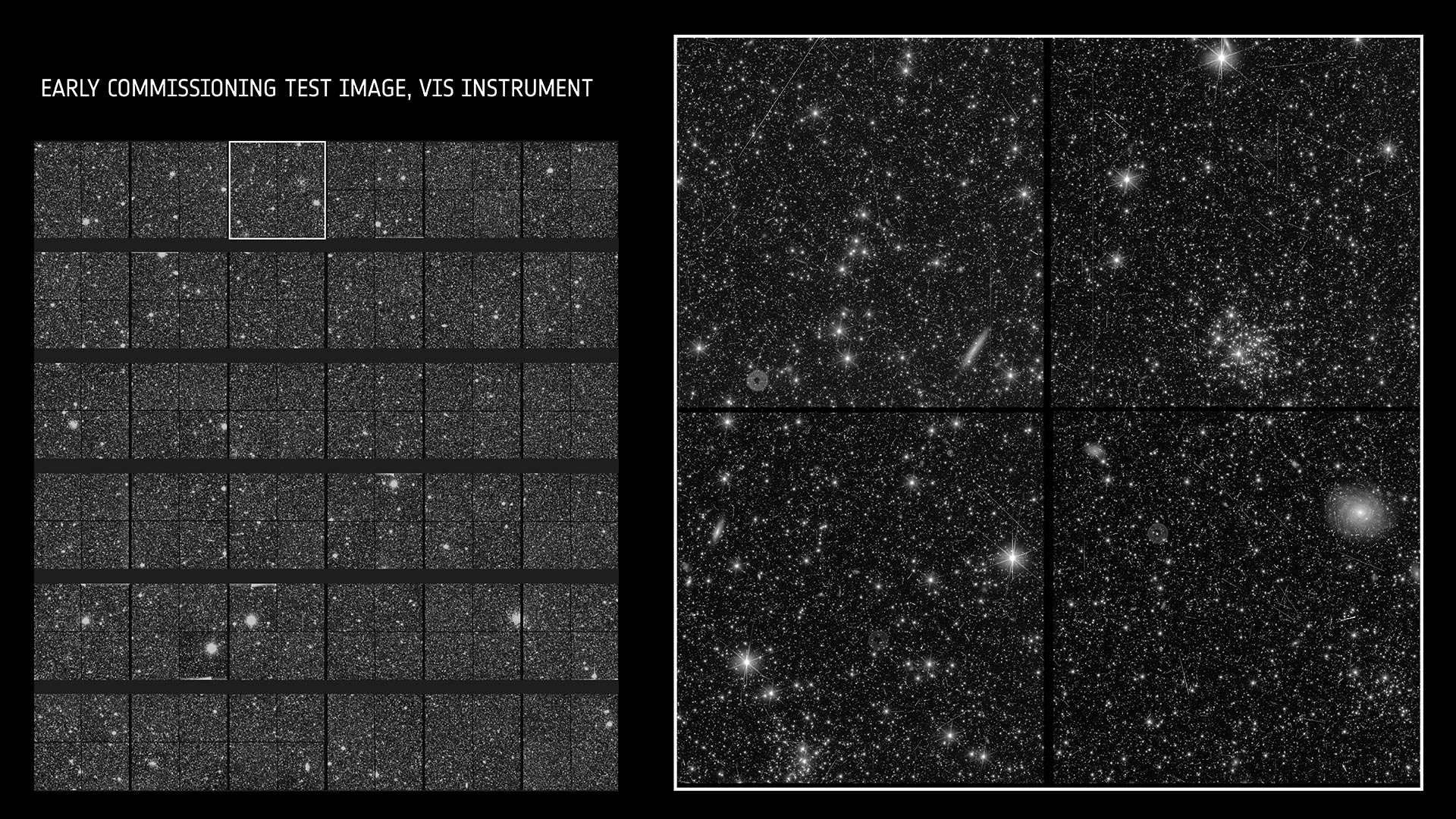
This image was taken during commissioning of Euclid to check that the focused VIS instrument worked as expected. Image credit: ESA / Euclid / Euclid Consortium / NASA.
The VIS instrument will take super sharp images of billions of galaxies to measure their shapes.
Looking closely at this image, we already get a glimpse of the bounty that VIS will bring; whilst a few galaxies are very easy to spot, many more are fuzzy blobs hidden amongst the stars, waiting to be unveiled by Euclid in the future.
Though the image is full of detail, the area of sky that it covers is actually only about a quarter of the width and height of the full Moon.
“I’m thrilled by the beauty of these images and the abundance of information contained within them,” said Dr. Mark Cropper from University College London.
“I’m so proud of what the VIS team has achieved and grateful to all of those who have enabled this capability.”
“VIS images will be available for all to use, whether for scientific or other purposes. They will belong to everybody.”