Astronomers using the NASA/ESA/CSA James Webb Space Telescope have analyzed the atmosphere of a massive exoplanet orbiting the white dwarf WD 1856+534. Their results provide a window into the ultimate fate of giant planets orbiting stars with masses similar to our Sun.
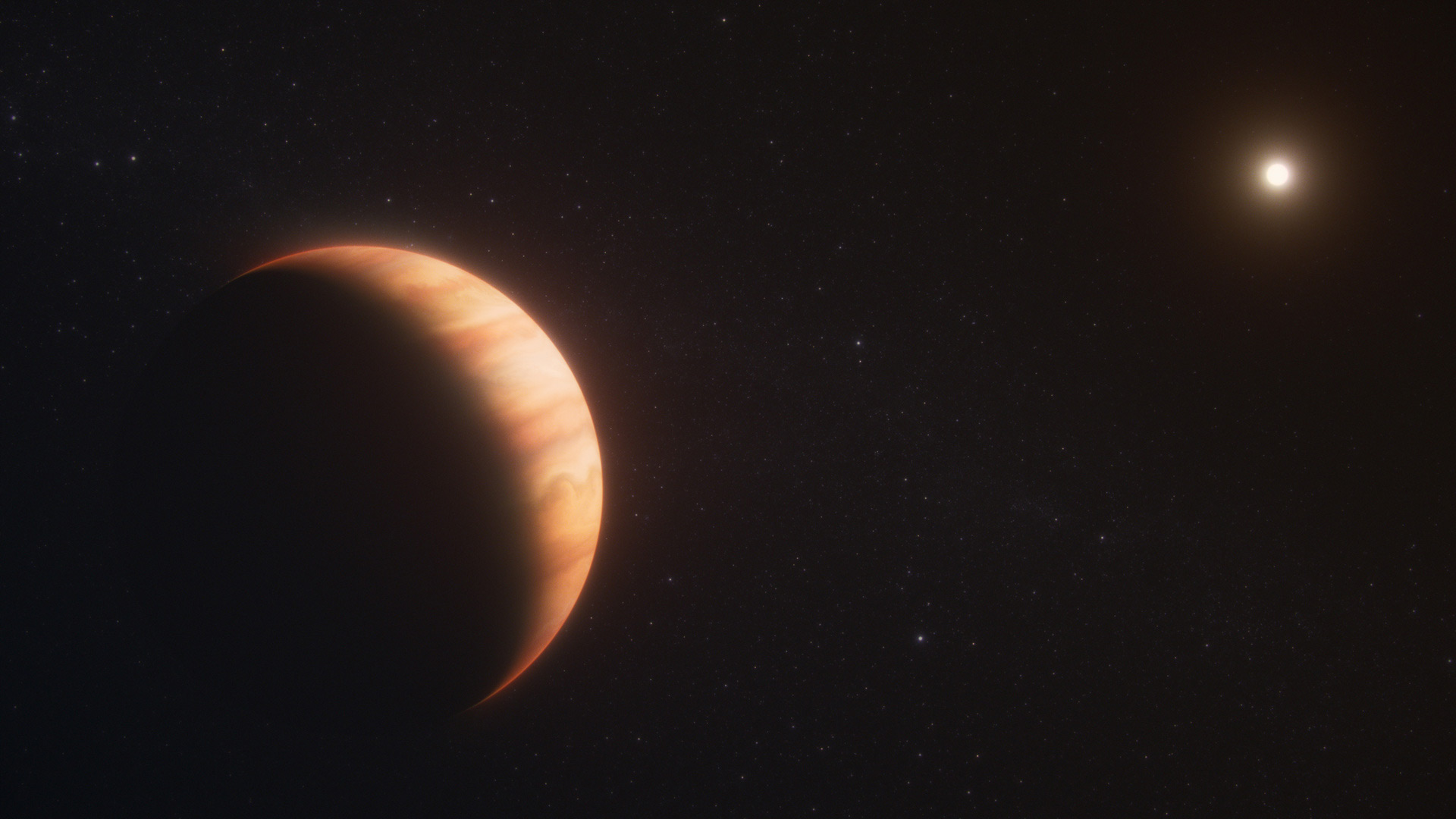
WD 1856b is a gas giant that orbits its star at a distance 50 times closer than Earth orbits the Sun. Image credit: NASA / ESA / CSA / Ralf Crawford, STScI.
“Most stars, including our Sun, will eventually die leaving behind a white dwarf,” said Dr. Ryan MacDonald, an astronomer at the University of St. Andrews, and his colleagues.
“How this stellar evolution process might affect the planets orbiting these stars is not fully understood.”
“Some planet candidates have been found orbiting white dwarfs, indicating that planets can survive the phase where stars evolve into red giants before becoming a white dwarf.”
“However, little is known about the atmospheric composition of such planets.”
In the new research, Dr. MacDonald and colleagues focused on WD 1856b, a white dwarf planet discovered in 2020 by astronomers using NASA’s TESS and Spitzer space telescopes.
This world has a radius of 0.9 Jupiter radii and a mass between 4.3 and 10.9 Jupiter masses.
It orbits WD 1856+534, a 10-billion-year-old white dwarf located 80 light-years away in the constellation of Draco.
“The planet is about the size of Jupiter, but the white dwarf it orbits is the size of Earth, so the planet is seven times larger than its star,” Dr. MacDonald noted.
Using Webb’s Near-Infrared Spectrograph (NIRSpec), the astronomers detected hydrocarbons, including methane, and aerosols in the atmosphere of WD 1856b.
They also detected thermal emission from the planet’s nightside.
“We saw the telltale signatures of small cloud particles and hydrocarbons, most likely methane, which is the first time we have seen an atmosphere on a planet transiting a dead star,” said Dr. Victoria Boehm, an astronomer at Cornell University.
“We recently observed four more transits of WD 1856b with Webb to take a deeper look into its atmospheric chemistry and can’t wait to see the results.”
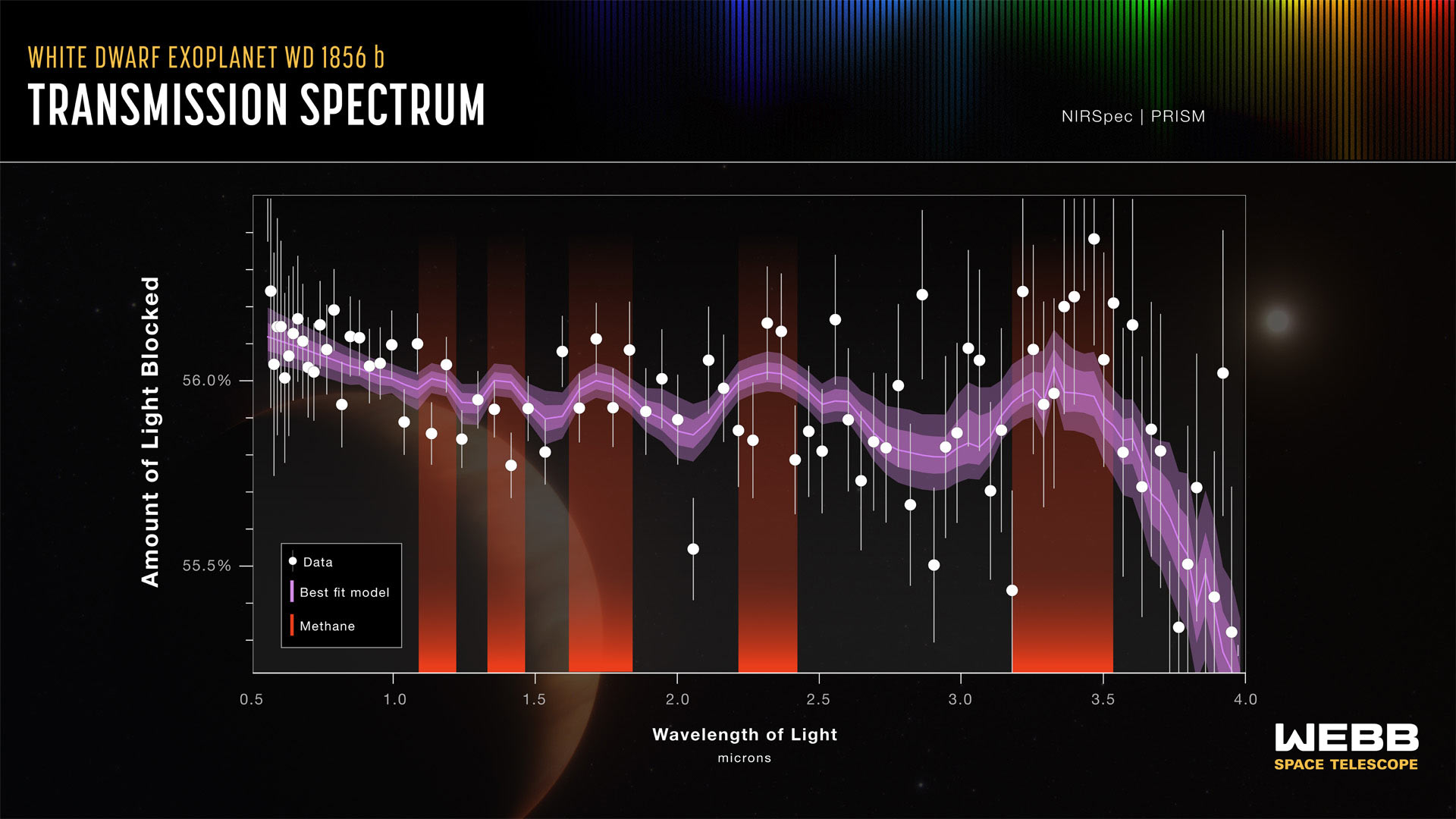
Webb measured the constituents of WD 1856b as it passed in front of its star, finding signs of methane. Image credit: NASA / ESA / CSA / Joseph Olmsted, STScI.
The researchers estimate the temperature of the planet’s atmosphere to be around 390-412 K, which exceeds temperatures expected for giant planets (160 K).
The heating most likely happened between 3 and 5.5 billion years after the star became a white dwarf.
In this scenario, the planet was on a wide orbit that kept it safe from the star during its destructive red giant phase, and only migrated to its present location later on.
“As the planet moved inward, its interactions with the strong gravity of the white dwarf will have caused it to warm up considerably, and it has been cooling ever since,” said Dr. Christopher O’Connor, an astronomer at Northwestern University.
“The big question is how WD 1856b ended up where it is today, and there are two theories.”
“One is that the planet was swallowed by the host star as it was dying, and managed to survive on the inside.”
“The other is that migration took place due to the gravitational effect of other objects in the system.”
“The white dwarf is part of a triple star system, and the companion stars could have influenced WD 1856b’s orbit.”
In approximately five billion years, the Sun will run out of hydrogen fuel in its core and swell up more than 100 times larger than it is now into a red giant star.
It will then shed its outer layers and end its life as a white dwarf star.
Mercury, Venus, and possibly the Earth will be destroyed by the red giant.
However, the fate of the more distant planets, particularly the gas giants, is unclear.
“We’re used to looking back in time when we use telescopes, but this is the first time we have been able to look forward to what might happen to the outer planets around the remnant of a Sun-like star,” Dr. MacDonald said.
“It’s like using a time machine to peer into the distant future of our Solar System.”
The findings appear this week in the journal Nature.
_____
R.J. MacDonald et al. 2026. Aerosols and hydrocarbons in the atmosphere of a white dwarf planet. Nature 655, 76-80; doi: 10.1038/s41586-026-10514-7