Several billion years ago, a short gamma-ray burst unleashed more energy in a half-second than our Sun will produce over its entire 10-billion-year lifetime. In May 2020, light from the event, dubbed GRB 200522A, finally reached Earth and was first detected by NASA’s Neil Gehrels Swift Observatory. The NASA/ESA Hubble Space Telescope quickly captured the glow within just three days after GRB 200522A and determined its near-infrared emission was 10 times brighter than predicted, defying conventional models.

This image shows the glow from the GRB 200522A kilonova caused by the merger of two neutron stars. Image credit: NASA / ESA / W. Fong, Northwestern University / T. Laskar, University of Bath.
Lasting less than two seconds, short gamma-ray bursts are among the most energetic, explosive events know in the Universe.
Astronomers think these events caused by the merger of two neutron stars.
Such mergers are very rare and extremely important because scientists think they are one of the main sources of heavy elements in the Universe, such as gold and uranium.
Along with a short gamma-ray burst, astronomers expect to see a kilonova whose peak brightness typically reaches 1,000 times that of a classical nova.
Kilonovae are an optical and infrared glow from the radioactive decay of heavy elements and are unique to the merger of two neutron stars, or the merger of a neutron star and a black hole.
“It’s amazing to me that after 10 years of studying the same type of phenomenon, we can discover unprecedented behavior like this,” said Dr. Wen-fai Fong, an astronomer at Northwestern University.
“It just reveals the diversity of explosions that the Universe is capable of producing, which is very exciting.”
“These observations do not fit traditional explanations for short gamma-ray bursts,” she added.
“Given what we know about the radio and X-rays from this blast, it just doesn’t match up. The near-infrared emission that we’re finding with Hubble is way too bright.”

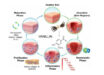
This illustration shows the sequence for forming a magnetar-powered kilonova, whose peak brightness reaches up to 10,000 times that of a classical nova: (i) two orbiting neutron stars spiral closer and closer together; (ii) they collide and merge, triggering an explosion that unleashes more energy in a half-second than the Sun will produce over its entire 10-billion-year lifetime; (iii) the merger forms an even more massive neutron star called a magnetar, which has an extraordinarily powerful magnetic field; (iv) the magnetar deposits energy into the ejected material, causing it to glow unexpectedly bright at infrared wavelengths. Image credit: NASA / ESA / D. Player, STScI.
To pinpoint the precise distance of GRB 200522A’s host galaxy, Dr. Fong and colleagues used the Low Resolution Imaging Spectrometer (LRIS) and DEep Imaging and Multi-Object Spectrograph (DEIMOS) instruments installed on telescopes at the W. M. Keck Observatory.
They determined the burst came from a young, star-forming galaxy located at a distance of 5.5 billion light-years.
They also analyzed GRB 200522A’s afterglow in X-ray with Swift Observatory, optical and near-infrared with Las Cumbres Observatory Global Telescope, Hubble, and in radio wavelengths with the Very Large Array.
But what the researchers saw was too bright to be explained even by a traditional kilonova.
“As the data were coming in, we were forming a picture of the mechanism that was producing the light we were seeing,” said co-author Dr. Tanmoy Laskar, an astronomer at the University of Bath.
“As we got the Hubble observations, we had to completely change our thought process, because the information that Hubble added made us realize that we had to discard our conventional thinking, and that there was a new phenomenon going on.”
“Then we had to figure out what that meant for the physics behind these extremely energetic explosions.”
The scientists provide one possible explanation for the unusually bright blast: while most short gamma-ray bursts probably result in a black hole, the neutron star merger in this case may have instead formed a magnetar, a supermassive neutron star with a very powerful magnetic field; the magnetar deposited a large amount of energy into the ejected material of the kilonova, causing it to glow even brighter.
“What we detected even outshines the one confirmed kilonova discovered in 2017,” said co-author Jillian Rastinejad, a graduate student at Northwestern University.
“As a first-year graduate student working with real-time data for the first time when this burst happened, it’s remarkable to see our discovery motivate a new and exciting magnetar-boosted model.”
With such an event, the team expects the ejecta from the burst to produce light at radio wavelengths in the next few years.
“Follow-up radio observations may ultimately prove the origin of the burst was indeed a magnetar,” the authors said.
Their paper will be published in the Astrophysical Journal.
_____
W. Fong et al. 2020. The Broad-band Counterpart of the Short GRB 200522A at z=0.5536: A Luminous Kilonova or a Collimated Outflow with a Reverse Shock? AJ, in press; arXiv: 2008.08593