Two newly discovered exoplanets, TOI-791b and TOI-791c, are as large as Jupiter but have densities lower than cotton candy, giving astronomers a rare glimpse into how bloated gas giants form and evolve.
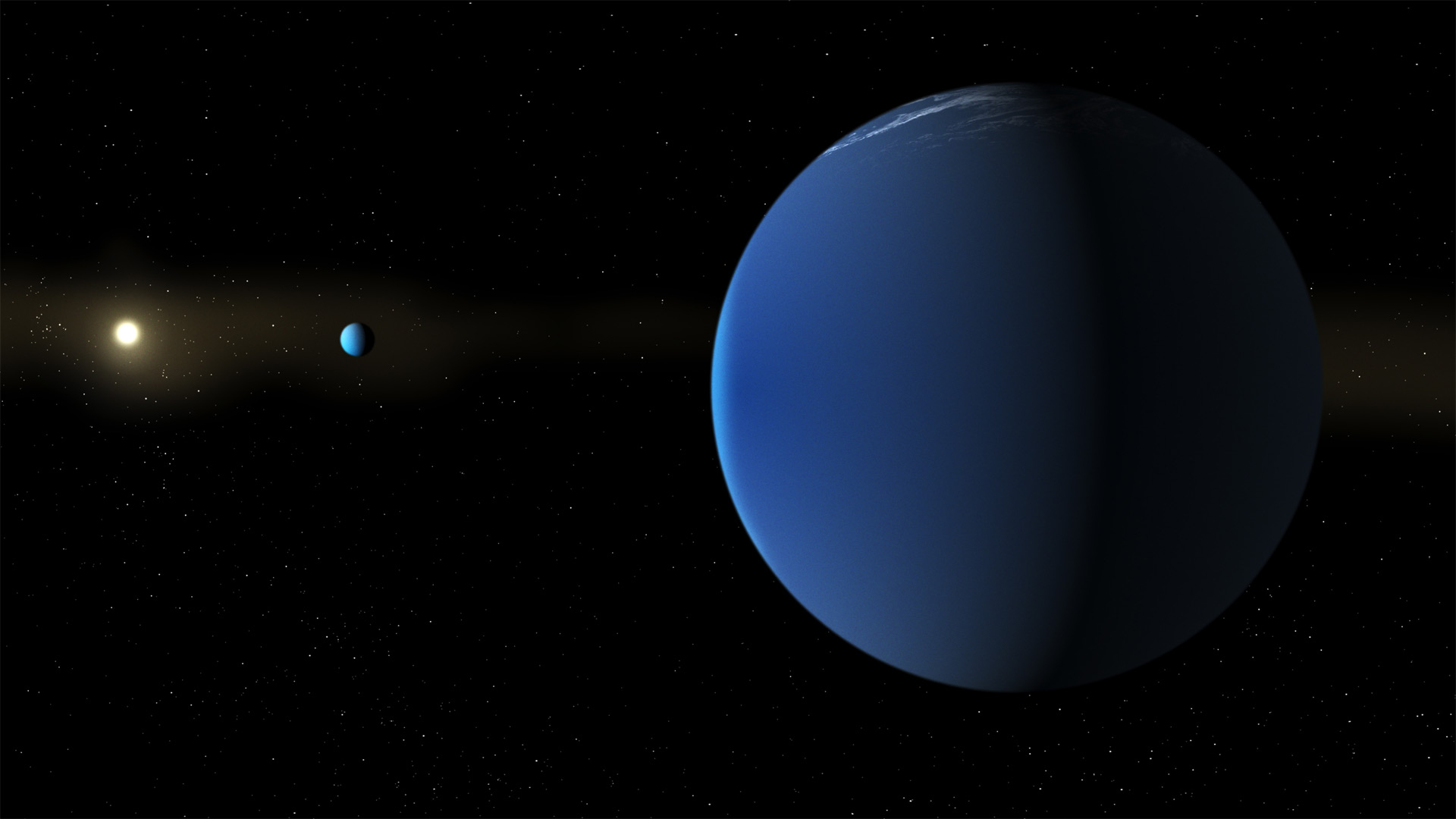
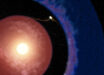
This illustration depicts TOI-791b and TOI-791c planets and their parent star. Image credit: NASA / Daniel Rutter.
TOI-791b is nearly the same size as Jupiter but contains just 3% of Jupiter’s mass, while TOI-791c is even larger than Jupiter yet holds only 5.9% of its mass.
They orbit TOI-791, a Sun-like star located approximately 1,113 light years away in the constellation of Volans.
“The main reason these planets are interesting to study is that we didn’t expect to see them at all,” said Dr. Jon Jenkins, a researcher at NASA’s Ames Research Center.
“They represent a puzzle for us to solve about how giant planets like Jupiter and the super-puffs form.”
NASA’s TESS mission detected these exoplanets by watching for repeated dips in the brightness of the star — a sign that a planet is transiting, or crossing in front of, its star.
Because they have unusually long orbital periods (139 days for TOI-791b and 232 days for TOI-791c), TESS needed to accumulate 1,122 days of observations over seven years to capture and confirm their properties.
“This system offers a unique laboratory for understanding how super-puff planets form and evolve,” said University of Birmingham’s Professor Amaury Triaud.
“We propose to carry out space-based observations using the NASA/ESA/CSA James Webb Space Telescope to assess if the puffy atmosphere contains carbon-, nitrogen-, and oxygen-bearing species, revealing new insight into how these unusual planets formed.”
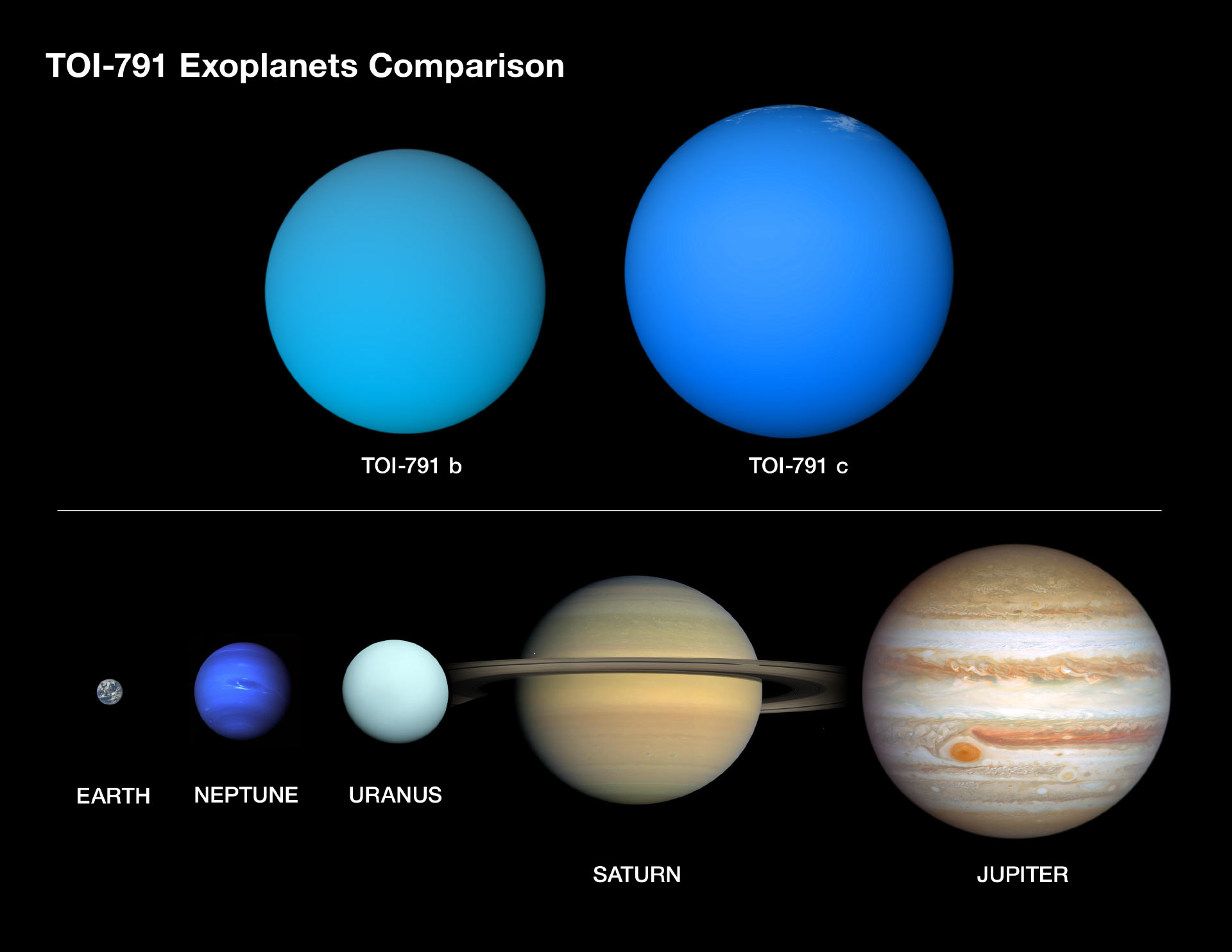
This graphic depicts TOI-791b and TOI-791c as compared to some of the planets in our Solar System. Image credit: NASA / Daniel Rutter.
TOI-791b and TOI-791c are locked in an orbital pattern that causes them to gravitationally tug on each other, subtly altering the timing of their transits.
The astronomers measured those timing variations to calculate the planets’ masses, confirming their extraordinarily low densities.
“Only a handful of these super-puffy planets are known, and it is even rarer to find two in the same system,” said University of Oxford’ Dr. George Dansfield.
“Their extremely low densities make them fascinating targets for understanding how planetary systems form and evolve.”
“Large planet formation is believed to drive the evolution of a planetary system, so further study of these Jupiter-size, but far less than Jupiter-mass, planets is of high value,” said Steve Howell, a researcher at NASA’s Ames Research Center.
“These multi-planetary systems are complex, with gravitational interactions between the planets that evolve over very long periods, tens of years or more,” said Professor Tristan Guillot, an astronomer at the Université Côte d’Azur.
The discovery is reported in a paper published today in the Monthly Notices of the Royal Astronomical Society.
_____
Georgina Dransfield et al. 2026. ASTEP confirmation of a pair of long-period Jupiter-sized planets with extremely low densities transiting TOI-791. MNRAS 549 (4): stag864; doi: 10.1093/mnras/stag864