A new look at more than two decades’ worth of archival data from NASA’s Spirit mission suggests that the Martian soil may hold iron-bearing minerals — hematite and altered magnetite — that were too faint for scientists to detect in real time during the mission.
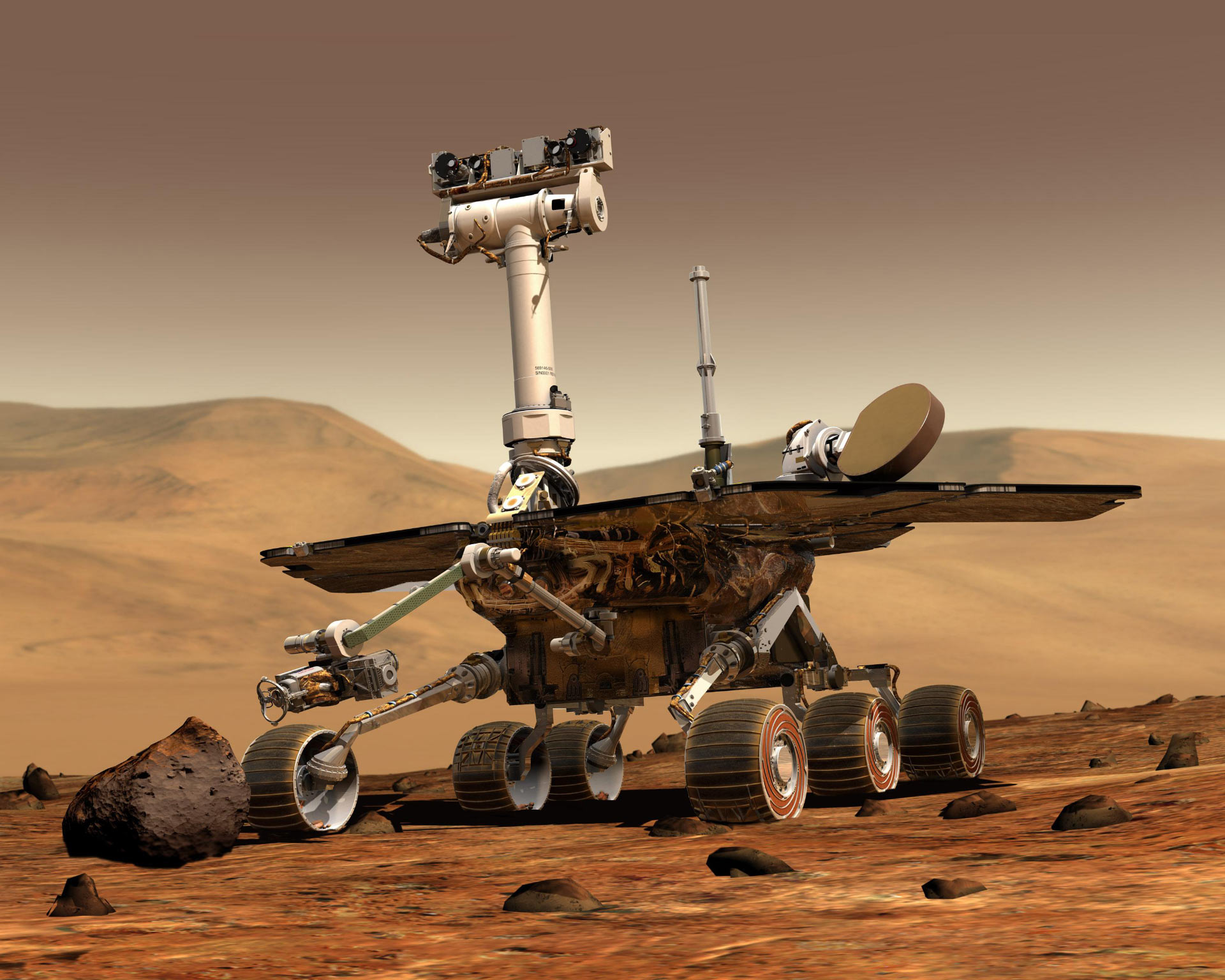
NASA’s Spirit rover on Mars. Image credit: NASA.
“From early 2004, Spirit Rover explored the surface of Gusev crater on Mars carrying a suite of scientific instruments to perform geological and mineralogical analysis on soils, rocks, meteorites, and dust collected by magnets,” said Professor Paulo de Souza, a researcher at Edith Cowan University.
“Among these instruments, a miniaturized Mössbauer spectrometer named MIMOS II was extensively used.”
“During the next 2062 sols, NASA’s Mars Exploration Rovers traversed the surface of the Red Planet with the objective of determining if Mars was once wet.”
In a new study, Professor de Souza revisited data collected by the MIMOS II spectrometer, which can identify iron-bearing minerals by measuring how iron atoms in a sample absorb gamma rays.
Because the Spirit rover had to share limited time, power and memory among a full suite of science instruments, individual Mössbauer measurements on Mars were often brief, producing spectra with relatively poor statistics.
This made it difficult to spot minor iron phases that made up only a small fraction of a soil sample’s mineral content.
To work around that limitation, Professor de Souza combined readings from 32 undisturbed soil targets that Spirit examined at Gusev crater over the course of 2,062 Martian days, spanning temperatures from 180 to 300 K.
Because temperature swings within about a 10-K range don’t meaningfully distort the spectra of basaltic material, the researcher merged data across those windows first, then combined all the temperature ranges into one composite spectrum.
The result was roughly six days worth of equivalent measurement time packed into a single dataset.
The consolidated spectrum pointed to the presence of common Martian soil minerals such as olivine and pyroxene, along with a poorly crystalline, paramagnetic iron-bearing phase.
But it also revealed clearer signatures of magnetite and crystalline hematite than earlier single-experiment analyses were able to pick out.
“One of the most important discoveries was finding crystalline hematite in ordinary Martian soil,” Professor de Souza said.
“This mineral’s widespread presence suggests not only that water was present, but that significant areas of Mars may have once been covered by water.”
The study was published in the journal Interactions.
_____
P. de Souza. 2026. A consolidated Mössbauer spectrum for undisturbed soils from Gusev Crater, Mars. Interactions 247, 278; doi: 10.1007/s10751-026-02625-4