An international team of paleontologists has identified a new species of early sauropodomorph dinosaur in Zimbabwe, adding to growing evidence that southern Africa hosted a richer diversity of dinosaurs during the Late Triassic epoch than previously recognized.
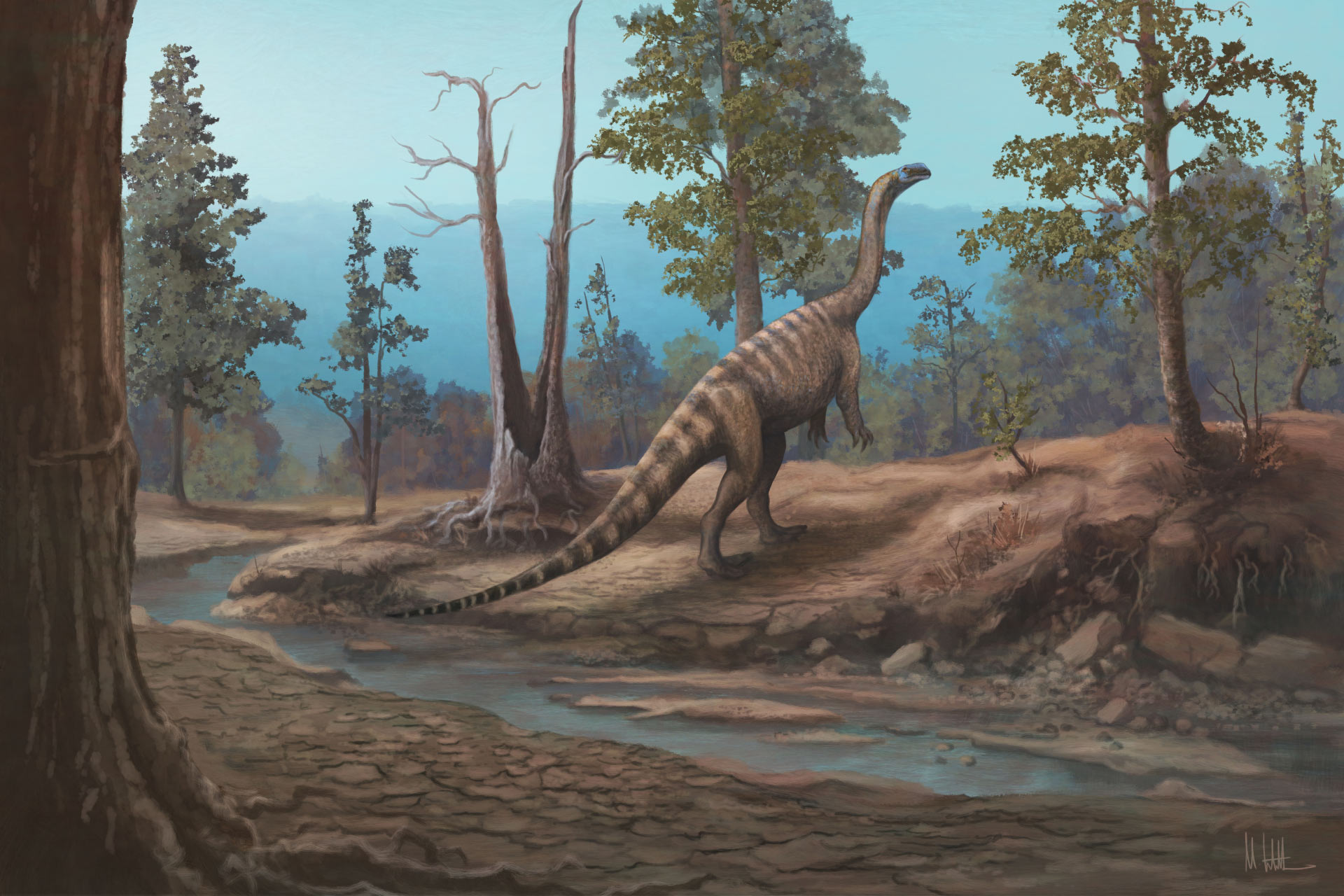
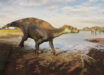
Life reconstruction of Musango matusadonaensis. Image credit: Mark Witton.
The newly described dinosaur species lived in what is now Zimbabwe during the latest Triassic, roughly 210 million years ago.
Named Musango matusadonaensis, the animal is the fifth dinosaur species named from this country.
“Until recently, it was assumed that the dinosaurs living across southern Africa were largely the same,” Professor Paul Barrett, a paleontologist at the Natural History Museum, London.
“However, these discoveries are showing that this part of the ancient supercontinent Gondwana was actually made of a series of smaller ecosystems — each with a different cast of characters.”
The partial skeleton of Musango matusadonaensis was excavated in 2018 from the Pebbly Arkose Formation near Musango Island, on the margin of Lake Kariba.
The specimen includes the dinosaur’s vertebrae, limb bones, and pieces of its hip and shoulder girdles.
Professor Barrett and his colleagues estimate the animal measured 4.5 m (15 feet) in length and weighed around 222 kg.
“New dinosaur species like Musango matusadonaensis show the value of doing paleontological fieldwork in remote, and often scenically beautiful, places,” said Professor Jonah Choiniere, a paleontologist at Johannesburg’s Evolutionary Studies Institute.
According to the team, Musango matusadonaensis belonged to a group of early sauropodomorphs — the lineage that would eventually give rise to giant long-necked sauropods — called Unaysauridae.
Their analysis places the new species as a close relative of Musankwa sanyatiensis, another dinosaur previously found in the very same rock formation.
Despite living side by side, the two ancient creatures were clearly distinct species, differing in hip and limb anatomy and in body size. Musankwa sanyatiensis is estimated to have weighed more than twice as much.
“The discovery suggests that what we’ve found so far is only the tip of the iceberg,” Professor Barrett said.
“We’ve already got one other new species that we’ve yet to describe, while our team has been told about other fossils from the region that we’ve yet to look at.”
“I think it’s likely there are even more dinosaurs still to be found there.”
The discovery of Musango matusadonaensis is described in a paper published July 28, 2026 in the Journal of Systematic Palaeontology.
_____
Paul M. Barrett et al. 2026. A new sauropodomorph dinosaur from the Pebbly Arkose Formation (Upper Triassic: Norian) of Kariba, Zimbabwe. Journal of Systematic Palaeontology 24 (2); doi: 10.1080/14772019.2026.2678610