Astronomers have discovered a dormant supermassive black hole 30,000 light-years from the center of WISEA J014656.04-152214.7 — a massive galaxy located about 750 million light-years away in the constellation of Cetus — after it briefly lit up by tearing apart a star.
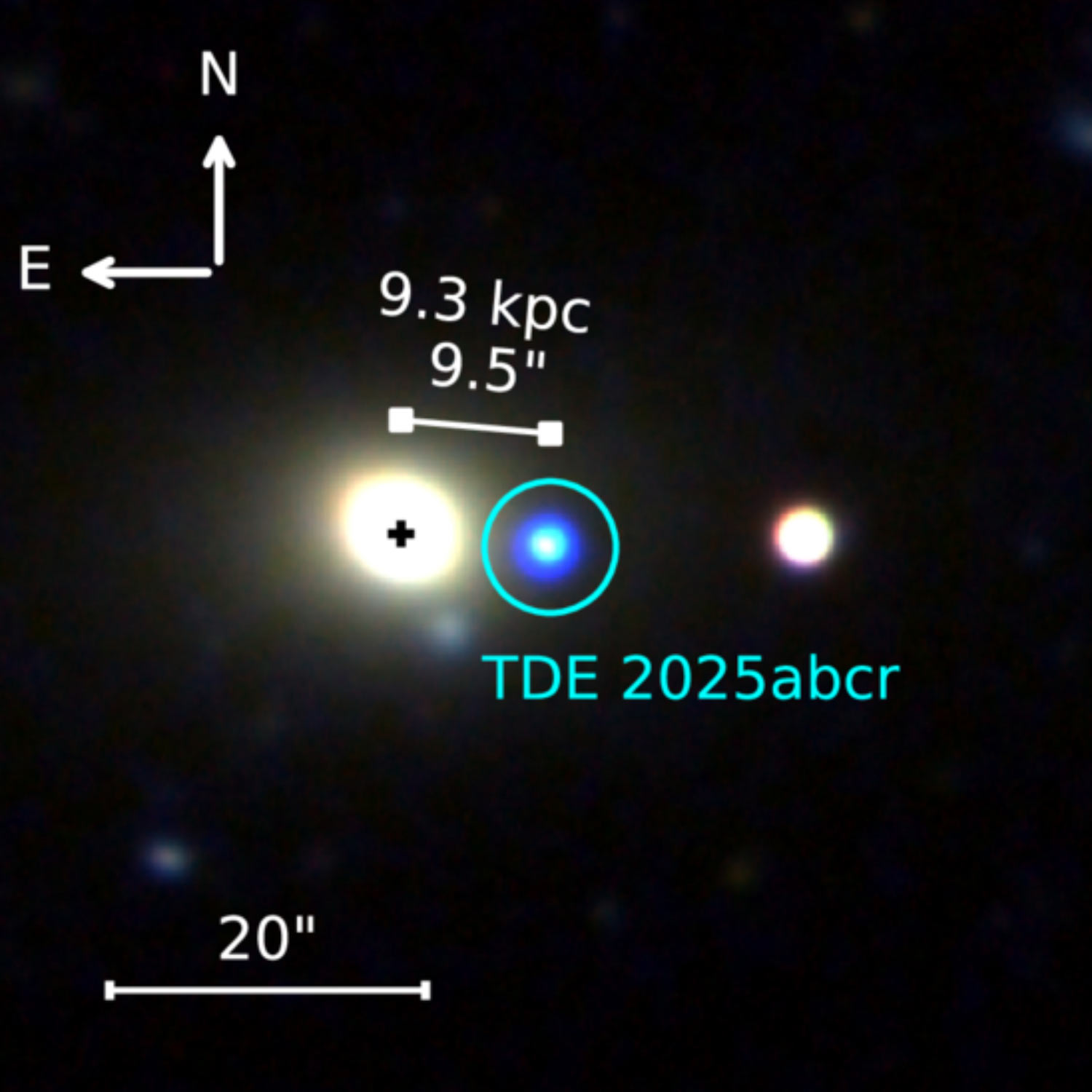
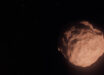
TDE 2025abcr. Image credit: Stein et al., doi: 10.3847/2041-8213/ae77f3.
Theorists have predicted that wandering black holes would roam the outskirts of galaxies as galaxies collide and merge.
But because many of these black holes are quiescent — meaning they aren’t swallowing material or emitting light — they tiptoe around undetected by earthly sensors.
“This is a novel result. What’s new is that, until now, we’ve started with the assumption that supermassive black holes reside in the centers of massive galaxies,” said Dr. Suvi Gezari, an astronomer at the University of Maryland.
“This discovery will have a huge impact. It means that we’re going to find many more examples of wandering black holes, and we can understand how galaxies and their black holes merge and build up over time.”
“The quiescent black hole described in this study was first detected through the Zwicky Transient Facility (ZTF), which ‘searches the whole Universe’,” added Dr. Robert David Stein, an astronomer at the Joint Space-Science Institute.
ZTF scans the entire northern sky every two days using two telescopes based at the Palomar Observatory.
It’s impossible to check for black holes in each of the hundreds of thousands of celestial events that ZTF documents each night.
So, the researchers developed an artificial intelligence (AI) program that identifies a characteristic light pattern that occurs when a black hole shreds a star, an astronomical phenomenon called a tidal disruption event.
“Tidal disruption events anywhere in a galaxy are rare, occurring on average once every 100,000 years,” the astronomers explained.
“While astronomers have identified more than a hundred of these events over the past decade, nearly all have been found at the centers of galaxies, where scientists expect the largest black holes to reside.”
“But the newly discovered event, dubbed TDE 2025abcr, was different.”
They detected TDE 2025abcr approximately 30,000 light-years from the center of WISEA J014656.04-152214.7, a massive galaxy some 750 million light-years away in the constellation of Cetus.
The supermassive black hole that caused the event has about the same mass as the black hole at the center of our Milky Way Galaxy.
“But surprisingly, it has no observable galaxy swirling around it,” said University of Maryland’s Professor Sylvain Veilleux.
“To have such a big black hole outside of a galaxy is surprising to me. There should be a Milky Way-like object around it — and that’s definitely not the case.”
This black hole likely originated from two colliding galaxies.
One possibility is that a larger galaxy cannibalized a smaller one and then slowly stripped away its stars until only the core remained.
A second possibility is that one galaxy already had two black holes orbiting closely at its center.
If a third black hole from another merger enters the mix, complex three-body interactions would kick the smallest one out.
Continued observations of this tidal disruption event could favor one of these two theories over the other.
“Further discoveries could reveal the origin of this apparent ‘orphan’ black hole,” Dr. Stein said.
“The key science question we want to answer is: How common are wandering black holes?”
The discovery is reported in a paper in the Astrophysical Journal Letters.
_____
Robert Stein et al. 2026. TDE 2025abcr: A Tidal Disruption Event in the Outskirts of a Massive Galaxy. ApJL 1006, L57; doi: 10.3847/2041-8213/ae77f3