By combining infrared observations from the NASA/ESA/CSA James Webb Space Telescope with visible-light imagery from the NASA/ESA Hubble Space Telescope, astronomers have produced new views of Saturn, revealing atmospheric bands, storms and brilliantly reflective rings.
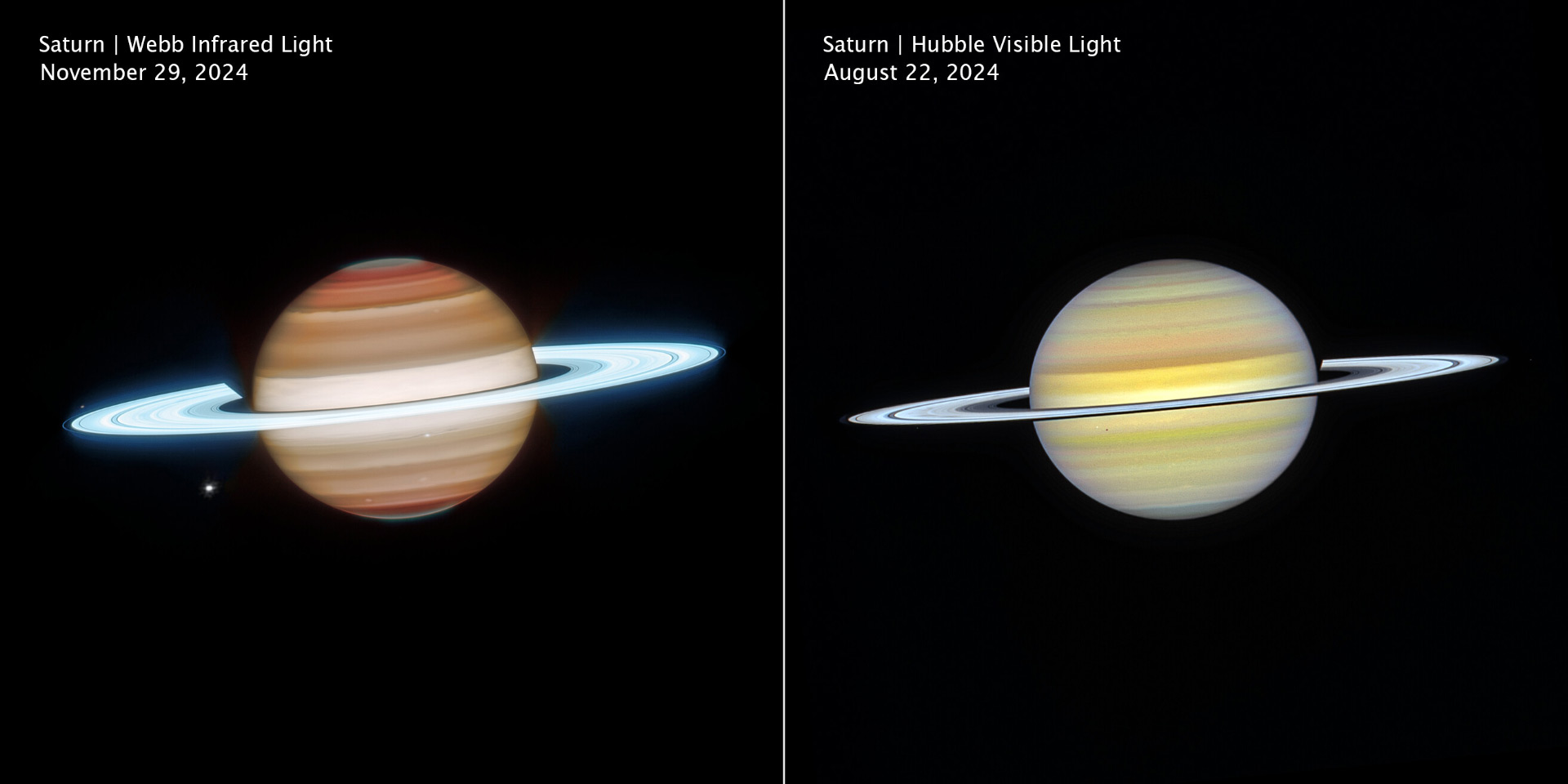
These Webb (left) and Hubble (right) images reveal Saturn in infrared and visible light. Image credit: NASA / ESA / CSA / STScI / A. Simon, NASA-GSFC / M. Wong, University of California / J. DePasquale, STScI.
The newly-released images of Saturn highlight features from the gas giant’s busy atmosphere.
In the Webb image, a long-lived jet stream known as the ‘ribbon wave’ meanders across the northern mid-latitudes, influenced by otherwise undetectable atmospheric waves.
Just below that, a small spot represents a lingering remnant from the ‘great springtime storm’ of 2011 to 2012.
Several other storms dotting the southern hemisphere of Saturn are visible in the Webb image, as well.
“All these features are shaped by powerful winds and waves beneath the visible cloud deck, making Saturn a natural laboratory for studying fluid dynamics under extreme conditions,” the astronomers said in a statement.
“Several of the pointed edges of Saturn’s iconic hexagon-shaped jet stream at its north pole, discovered by NASA’s Voyager spacecraft in 1981, are also faintly visible in both images.”
“It remains one of the Solar System’s most intriguing weather patterns.”
“Its persistence over decades highlights the stability of certain large-scale atmospheric processes on giant planets.”
“These are likely the last high-resolution looks we’ll see of the famous hexagon until the 2040s, as the northern pole enters winter and will shift into darkness for 15 years.”
In the new Webb observations, Saturn’s poles appear distinctly gray-green, indicating light emitting at wavelengths around 4.3 microns.
“This distinct feature could come from a layer of high-altitude aerosols in Saturn’s atmosphere that scatters light differently at those latitudes,” the researchers said.
“Another possible explanation is auroral activity, as charged molecules interacting with the planet’s magnetic field can produce glowing emissions near the poles.”
In the Webb image, the Saturn’s rings are extremely bright because they are made of highly reflective water ice.
“In both images, we’re seeing the sunlit face of the rings, a little less so in the Hubble image, hence the shadows visible underneath on the planet,” the scientists said.
“There are also subtle ring features such as spokes and structure in the B ring (the thick central region of the rings) that appear differently between the two observatories.”
“The F ring, the outermost ring, looks thin and crisp in the Webb image, while it only slightly glows in the Hubble image.”
“Saturn’s orbit around the Sun, combined with the position of Earth in its annual orbit, determines our changing viewing angle of Saturn’s face and ring.”
“These 2024 observations, taken 14 weeks apart, show the planet moving from northern summer toward the 2025 equinox.”
“As Saturn transitions into southern spring, and later southern summer in the 2030s, Hubble and Webb will have progressively better views of that hemisphere.”