The NASA/ESA/CSA James Webb Space Telescope conducted a clockwise scan around the entire limb of Jupiter, chasing aurora as it rotated into view. This dynamic phenomenon is a result of charged particles traveling down magnetic field lines, crashing into the planet’s ionosphere and causing it to glow. During the scan, Webb’s Near-Infrared Spectrograph (NIRSpec) captured an extraordinary aspect of Jupiter’s aurora, known as auroral footprints, which are bright emission patterns produced as a result of the interaction between Jupiter’s Galilean moons and the space environment surrounding the giant planet. Using the NIRSpec data, planetary scientists measured the physical properties of the auroral footprints of Jupiter’s two innermost Galilean moons, Io and Europa, including the local temperature and ionospheric density, in the near-infrared. They discovered a never-seen-before low temperature structure centered on Io’s bright spot of emission, possessing extremely high densities; this is likely driven by extreme changes in the flow of electrons crashing into the upper atmosphere.
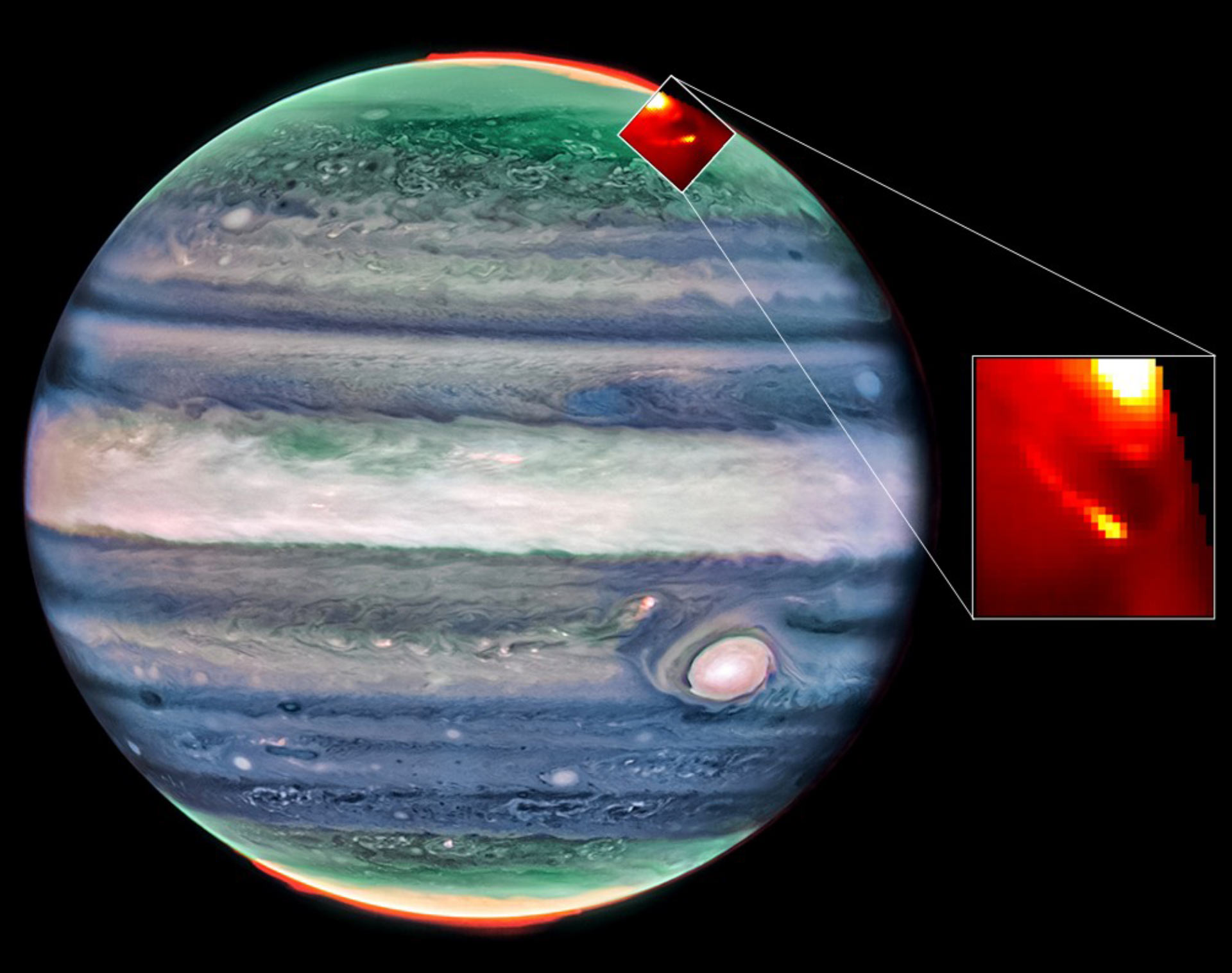
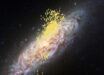
Webb captured the auroral footprints of Io and Europa, providing spectral measurements for the first time, and revealing extreme changes in the physical properties within Io’s auroral footprint that are likely linked to the electrons crashing into the top of Jupiter’s atmosphere. Image credit: NASA / ESA / CSA / Webb / NIRCam / Jupiter ERS Team / Judy Schmidt / Katie L. Knowles, Northumbria University.
“These emissions have been measured before at ultraviolet and infrared wavelengths, but only how brightly they shine,” said lead author Katie Knowles, a Ph.D. student at Northumbria University.
“For the first time, we’ve now been able to describe the physical properties of the auroral footprints — the temperature of the upper atmosphere and the ion density, which has never been reported on before.”
Unlike Earth’s northern lights, which are primarily driven by the solar wind, Jupiter’s aurora includes the impact of its four large Galilean moons — Io, Europa, Ganymede, and Callisto — which create their own ‘mini aurora’ on the planet.
Jupiter’s powerful magnetic field rotates approximately once every 10 hours along with the planet itself, carrying charged particles with it.
But its moons orbit much more slowly — Io, the innermost moon, takes around 42.5 hours to complete one orbit.
“The moons constantly interact with the magnetic field and plasma surrounding the planet, and that interaction leads to highly energetic particles travelling down magnetic field lines and then crashing into the planet’s atmosphere, creating the auroral footprints that map to where the moons orbit around Jupiter,” Knowles said.
“Jupiter’s aurora is the most powerful and constant of any aurora in the Solar System.”
“What we’re seeing with Webb gives us an unprecedented window into how Jupiter’s moons directly affect the top of the planet’s atmosphere.”
During a 22-hour window of observation time which took place in September 2023, Webb scanned around the edge of Jupiter, chasing the northern lights as they rotated into view.
It was during this observation that they also happened to capture the auroral footprints.
However, the footprints created by Io and Europa, did not have the characteristics expected from Jupiter’s main aurora, which is relatively hot and contains a lot of material.
Instead, in one snapshot, they discovered a cold spot within Io’s auroral footprint that registered temperatures much lower than expected with extraordinarily high densities.
Io is the most volcanically active body in our Solar System, with its volcanoes ejecting about 1,000 kilograms of material into space every second, feeding the dense plasma surrounding Jupiter.
This material becomes ionized and forms a doughnut-shaped cloud around Jupiter called the Io plasma torus.
As Io moves through this environment, it generates powerful electrical currents that create the brightest spots in Jupiter’s aurora.
The researchers found that these auroral footprints contain trihydrogen cation densities three times higher than those found in Jupiter’s main aurora, with some regions showing density variations of up to 45 times within the same small area.
“We found extreme variability in both temperature and density within Io’s auroral footprint that happened on the timescale of minutes,” Knowles said.
“This tells us that the flow of high-energy electrons crashing into Jupiter’s atmosphere is changing incredibly rapidly.”
“The cold spot registered temperatures of just 538 K (265 degrees Celsius or 509 degrees Fahrenheit) compared to 766 K (493 degrees Celsius or 919 degrees Fahrenheit) in the rest of Jupiter’s aurora.”
“The cold spot also contained material three times denser than Jupiter’s main aurora.”
The findings could extend far beyond Jupiter and open questions about other planetary systems.
Saturn’s moon, Enceladus, also creates an auroral footprint on the planet, and scientists wonder whether similar phenomena occur there.
“This work opens up entirely new ways of studying not just Jupiter and its other Galilean moons, but potentially other giant planets and their moon systems,” Knowles said.
“We’re seeing Jupiter’s atmosphere respond to its moons in real-time, which gives us insights into processes that occur throughout our Solar System and perhaps further afar.”
“We only saw this phenomenon in one of our five snapshots which leave us with questions. How often does this occur? Does it switch on and off? How does it change with different conditions?”
The study appears in the journal Geophysical Research Letters.
_____
Katie L. Knowles et al. 2026. Short-Term Variability of Jupiter’s Satellite Footprints as Spotted by JWST. Geophysical Research Letters 53 (5): e2025GL118553; doi: 10.1029/2025GL118553