Using powerful X-ray beams, automated robotics and AI, entomologists have created interactive digital images representing 212 genera and 792 species of ants.
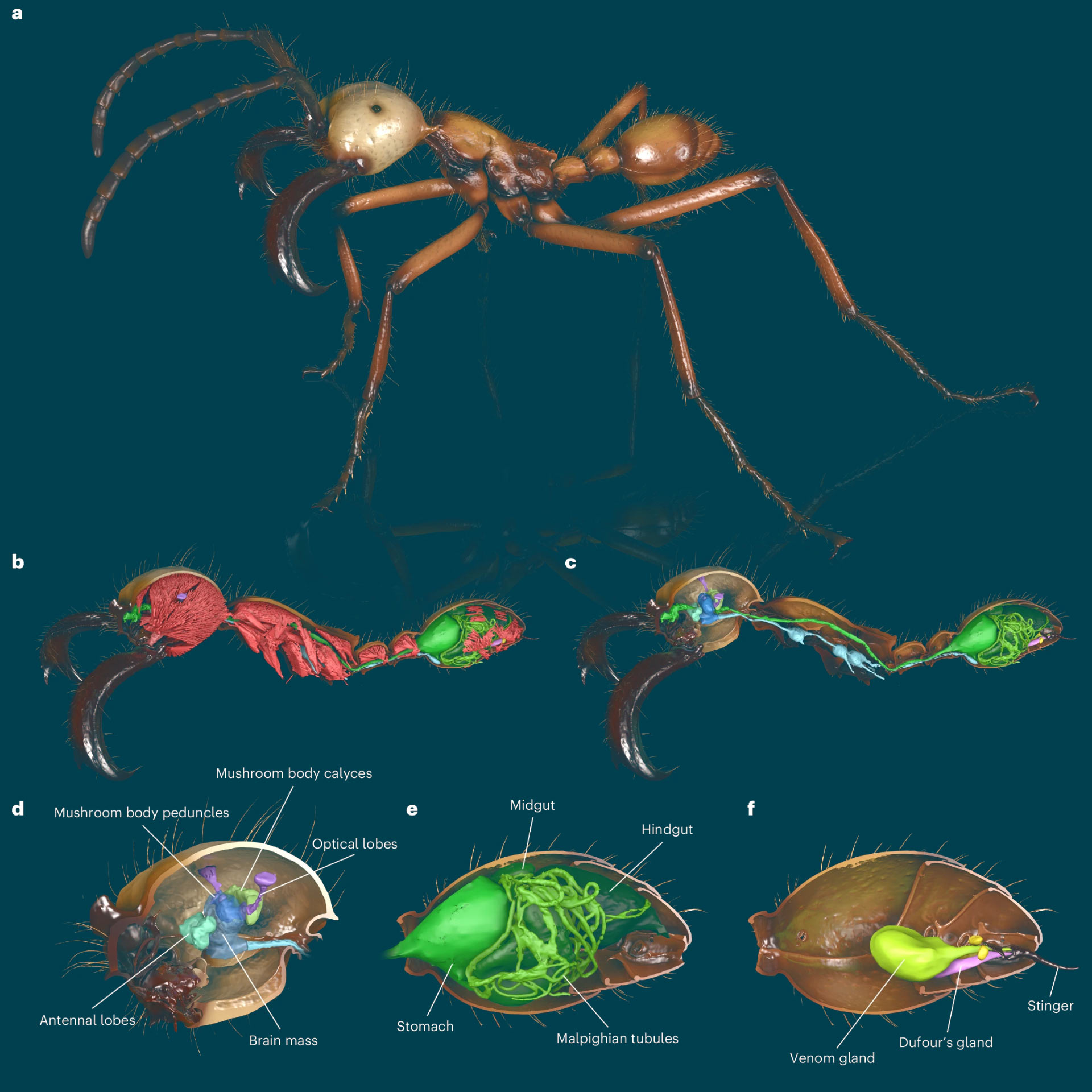
Renderings of an exemplary Antscan specimen: subsoldier of Eciton hamatum. Image credit: Katzke et al., doi: 10.1038/s41592-026-03005-0.
To build such an expansive digital library, Okinawa Institute of Science and Technology researcher Julian Katzke and colleagues sourced ethanol-preserved ant specimens from partner institutions, museum collections and experts around the world.
After the researchers sorted the specimens by species and caste, they brought them to the Karlsruhe Institute of Technology (KIT) in Germany for high-throughput X-ray micro-CT scanning, which is comparable to medical CT scans but in much higher magnification.
A synchrotron particle accelerator produced a high-intensity X-ray beam to rapidly scan a huge number of specimens, and a robotic sample changer rotated and swapped out the specimens every 30 seconds.
This enabled the creation of 2D image stacks that could then be used to construct 3D models.
While useful, the raw image files depicted ant specimens in contorted poses — a far cry from the lifelike models that the scientists hoped to build.
The 3D images reveal internal structures like muscles, nervous systems, digestive systems and stingers at micrometer resolution.
The models can easily be animated or incorporated into virtual reality worlds for research, education or entertainment.
“We’ve estimated that if we were to carry out this project with a lab-based CT scanner, it would take six years of continuous operation,” Dr. Katzke said.
“With the setup at KIT, we scanned 2,000 specimens in a single week.”
“To do this manually would have taken years, so without these computational tools it basically would never have been done,” added Professor Evan Economo, a researcher at the Okinawa Institute of Science and Technology and the University of Maryland.
Dubbed Antscan, this project could serve as a blueprint for future digitization efforts — not just for ants, but for a wide variety of species.
“The value of this study is not only about ants — it’s much broader,” Professor Economo said.
“When specimens are digitized, we can build libraries of organisms that can streamline their use from scientific laboratories to classrooms to Hollywood studios.”
The team’s work was published today in the journal Nature Methods.
_____
J. Katzke et al. High-throughput phenomics of global ant biodiversity. Nat Methods, published online March 5, 2026; doi: 10.1038/s41592-026-03005-0