A protist species called Stentor coeruleus appears to navigate by sensing physical shapes — a discovery that suggests even the simplest life forms can exploit geometry to survive.
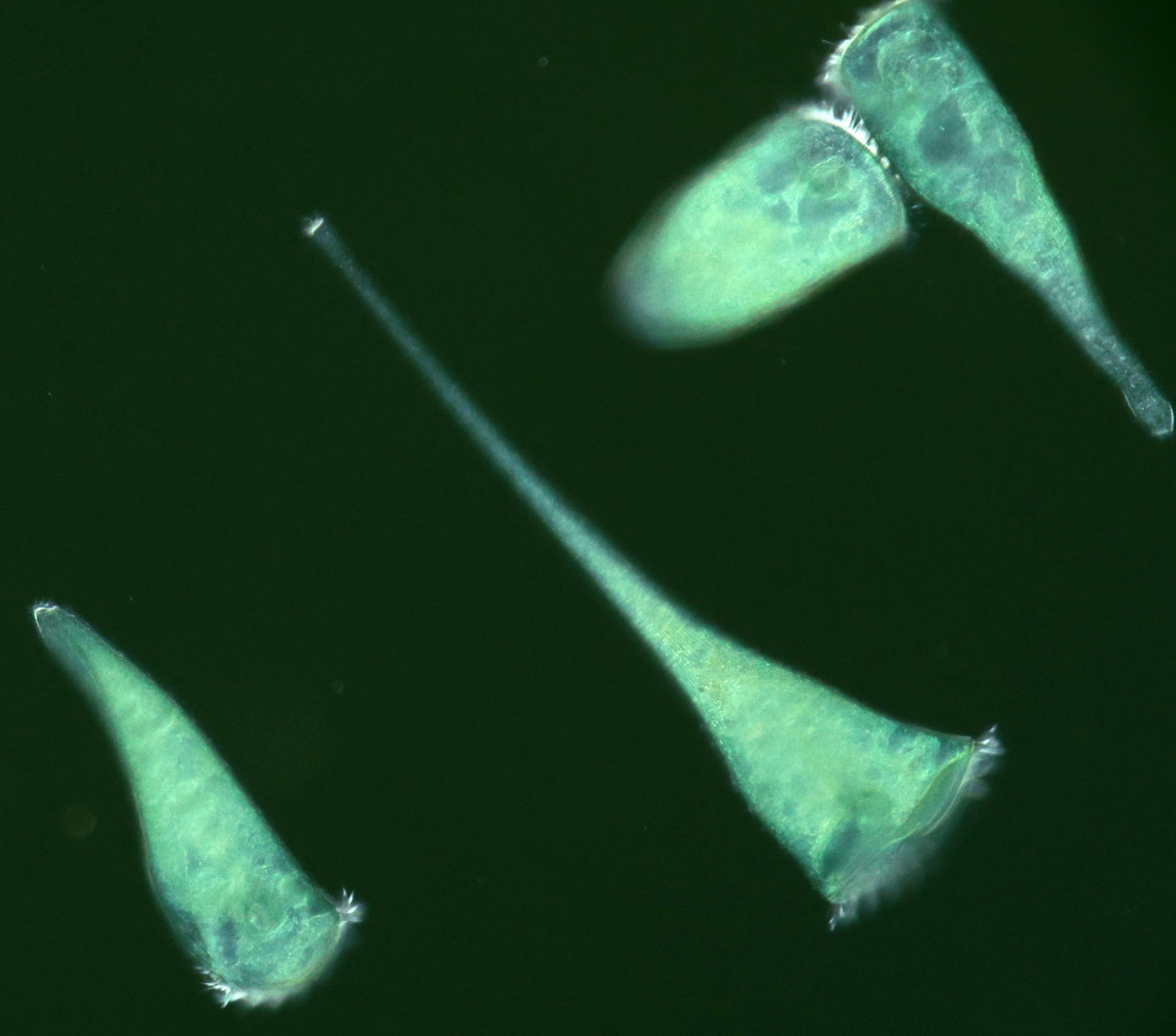
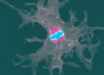
Stentor coeruleus. Image credit: Laboratory of Physical Ethology, Hokkaido University.
Just one mm long, Stentor coeruleus is a species of protist in the family Stentoridae.
“Stentor coeruleus exhibits complex behavior that switches between free-swimming and anchoring to a substrate,” said Hokkaido University’s Dr. Syun Echigoya, first author of the study.
“In the swimming state, Stentor coeruleus generates propulsive force primarily through hair-like organelles, termed membranellar band, located around the anterior.”
“The cell explores a space with its trajectory varying in response to light and chemical cues.”
“During swimming, Stentor coeruleus gradually elongates into a trumpet shape and adheres to a substrate via an anchoring organ at its posterior end.”
“Anchored Stentor coeruleus also generates external vortical flows through membranellar band, forming an oral apparatus for capturing bacteria and small ciliates as food.”
“At the same time, attachment may increase the risk of predation,” they added.
“Thus, selecting anchoring sites in heterogeneous environments may represent an essential behavior in Stentor coeruleus.”
For their research, Dr. Echigoya and colleagues designed tiny chambers with precisely controlled shapes, mimicking the kinds of structures that microorganisms encounter in natural aquatic environments.
Some chambers had smooth, flat surfaces, while others featured edges, angles, and tight spaces resembling corners.
“We systematically changed geometric features, such as corner angle and depth, to create distinct anchoring-site options,” Dr. Echigoya said.
“We then did a quantitative behavioral analysis using video recordings of the microbes, complemented by numerical simulations.”
What the researchers observed was far from random movement.
At first, the cells swam freely, exploring their surroundings. But as they approached a surface, their behavior changed.
Their bodies subtly shifted into an asymmetric shape, and they began gliding along the walls, using the coordinated beating of hair-like structures called cilia.
Gradually, they steered themselves toward tighter, corner-like spaces. Once there, they attached themselves firmly to the surface.
“We were surprised by how effective this minimal strategy is,” Dr. Echigoya said.
“Stentor coeruleus does not need to recognize structures in a cognitive sense.”
“With a simple shift in body shape, it can physically interact with surfaces to find suitable corner spaces to attach.”
“These findings suggest that even subtle physical features in natural environments can have a big impact on where microorganisms live and how they spread,” said Hokkaido University’s Dr. Yukinori Nishigami, senior author of the study.
“At the microscopic scale, landscapes are filled with small crevices and sheltered spaces.”
“The ability to locate and settle into these protected niches may help explain how microorganisms survive, move, and form communities.”
The findings were published in the Proceedings of the National Academy of Sciences.
_____
Syun Echigoya et al. 2026. Geometrical preference of anchoring sites in the unicellular organism Stentor coeruleus. PNAS 123 (9): e2518816123; doi: 10.1073/pnas.2518816123