Researchers who analyzed dozens of spontaneous performances by a captive male chimpanzee named Ayumu say the animal’s steady rhythms and expressive ‘play face’ hint at how early humans may have transformed vocal emotion into instrumental sound.
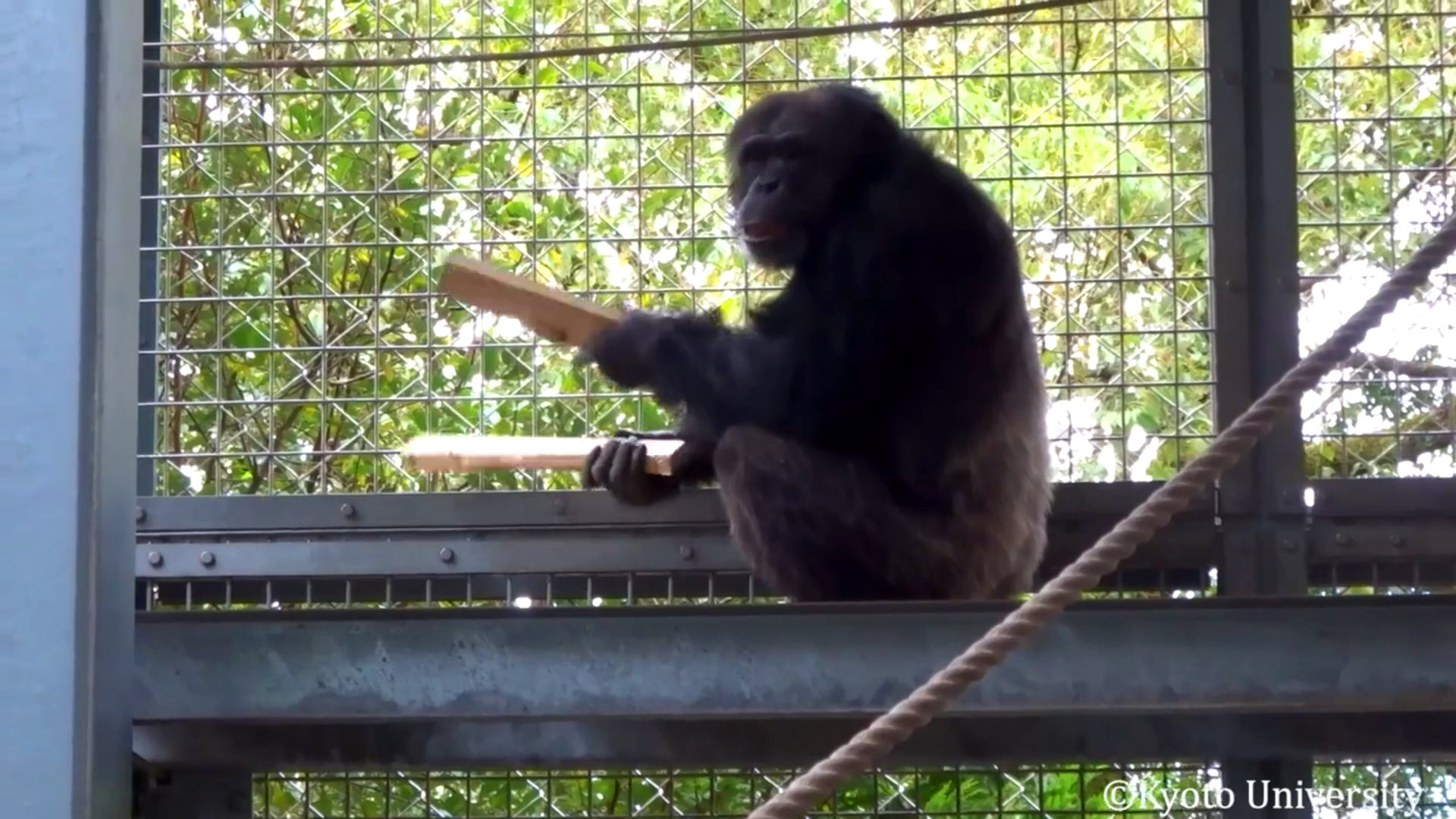
Ayumu the chimpanzee spontaneously produced long, multicomponent instrumental displays by drumming, dragging, and throwing self-detached objects. Transition and rhythm analyses revealed non-random sequencing partially resembling pant-hoot structure, predominantly isochronous timing, and a more stable tempo when using tools than with the body. Accompanying play-face and silent bared teeth expressions suggest high arousal and positive affect, supporting the idea that affective vocal expression can be externalized through instrumental sound. Image credit: Hattori et al., doi: 10.1111/nyas.70239.
In February 2023, Ayumu — a 26-year-old male chimpanzee at Kyoto University’s Center for the Evolutionary Origins of Human Behavior — treated researchers to a spontaneous musical performance.
He removed floorboards from a walkway and used them to drum, producing complex, structured sounds resembling vocal expressions.
“Ayumu’s drumming is nothing new,” said Dr. Yuko Hattori and colleagues from Kyoto University.
“Chimpanzees are well known for their instrumental behaviors, and are particularly adept at drumming.”
“But on this occasion, Ayumu’s combination of drumming and vocalization — exhibiting multiple rhythmic components — was a completely novel case.”
Between February 2023 and March 2025, the authors recorded a total of 89 spontaneous performances by Ayumu.
The recordings documented how he removed floorboards from a walkway and used them as tools to make music.
“It was fascinating for me to see how the chimpanzee used tools to produce various sounds while also expressing a vocal display,” Dr. Hattori said.
Using Ayumu’s performances, the researchers examined whether vocal expression could transition into instrumental sound.
They began by assessing his behavior and breaking it down into elements such as striking, dragging and throwing.
They then evaluated the connections between these elements using transition analysis, determining which transitions occurred by chance and which were deliberate.
Finally, they analyzed the intervals between strikes and compared the rhythmic stability of tool use with that of drumming performed using the hands or feet.
The analysis revealed that the sequence of sounds produced with the tools was not random, and that the intervals between strikes were isochronous — maintaining a constant tempo, like a metronome.
In fact, tool use produced a more stable rhythm than the hands or feet alone.
The scientists also observed facial expressions such as the ‘play face,’ typically associated with play, indicating positive emotions.
Such expressions are not typically reported in vocal displays, suggesting that emotional signals once conveyed vocally may have been externalized and developed into tool-based sounds.
“Ayumu’s performances prove that non-human primates also possess the ability to externalize vocal-like expressions with instruments,” the authors said.
“Next, we are interested in analyzing the reactions of other chimpanzees, and the impact Ayumu’s display has within his social group.”
The study was published in the Annals of the New York Academy of Sciences.
_____
Yuko Hattori et al. 2026. Combinatorial Instrumental Sound-Making in a Captive Chimpanzee: Evolution of Vocal Externalization. Annals of the New York Academy of Sciences 1557 (1): e70239; doi: 10.1111/nyas.70239