Honeybees (Apis mellifera) are important ecological and agricultural pollinators. In the United States, beekeepers experience substantial annual colony losses, largely driven by parasites such as the mite Varroa destructor. In new research, scientists studied a hybrid honeybee population in Southern California, a genetic mix of Western European, Eastern European, Middle Eastern, and African lineages. They found that these honeybees can suppress Varroa parasite levels without chemical use, hinting at new strategies to protect pollinators under global strain.

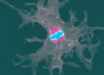
In this electron micrograph, Varroa destructor (arrow) is wedged between the abdominal plates of a honey bee’s exoskeleton. Image credit: UMD / USDA / PNAS.
Varroa mites feed on honeybees’ fat body tissue, which weakens their immune systems, reduces their body weight, and shortens their lives.
The fat body is an organ in bees that, if you were comparing it to human biology, performs the functions of the liver, pancreas, and immune system.
The mites also act as vectors for deadly viruses like deformed wing virus and acute bee paralysis virus, which they transmit directly into a bee’s bloodstream.
Beekeepers rely on chemical treatments for suppression that can lose effectiveness over time.
“We kept hearing anecdotally that Californian honeybees were surviving with way fewer treatments,” said University of California graduate student Genesis Chong-Echavez.
“I wanted to test them rigorously and understand the driving force behind what the beekeepers were seeing.”
In the study, Chong-Echavez and University of California’s Professor Boris Baer monitored 236 honeybee colonies in Southern California between 2019 and 2022.
The Californian bees were not entirely immune to the mites. However, colonies headed by locally raised Californian hybrid honeybee queens had about 68% fewer Varroa mites on average than colonies headed by commercial honeybee queens.
They were also more than five times less likely to cross the threshold at which chemical treatments become necessary.
To more fully understand the bees’ resistance to the mites, the researchers also ran laboratory experiments with developing honeybee larvae.
Varroa mites must enter brood cells to reproduce, so the scientists tested whether mites were equally drawn to larvae from commercial and Californian hybrid honeybee colonies. They were not.
Mites were less attracted to the Californian hybrid honeybee larvae, especially at seven days old, the stage when mites are normally most likely to invade.
The finding suggests the bees’ secret to fending off mites lies in early development, before any adult worker behaviors might come into play.
“What surprised me most was the differences showed up even at the larval stage,” Chong-Echavez said.
“This suggests the resistance mechanism may go deeper than some kind of behavior and may be genetically built into the bees themselves.”
The results appear in the journal Scientific Reports.
_____
G. Chong-Echavez & B. Baer. 2026. Varroa mite resistance in a hybrid honey bee (Apis mellifera) population in Southern California. Sci Rep 16, 10952; doi: 10.1038/s41598-026-45759-9