Deep in the mountains of northern Taiwan, a towering Taiwania cryptomerioides — a large coniferous tree in the cypress family Cupressaceae whose ancestors date back 100 million years — has been confirmed as the tallest known tree in East Asia.
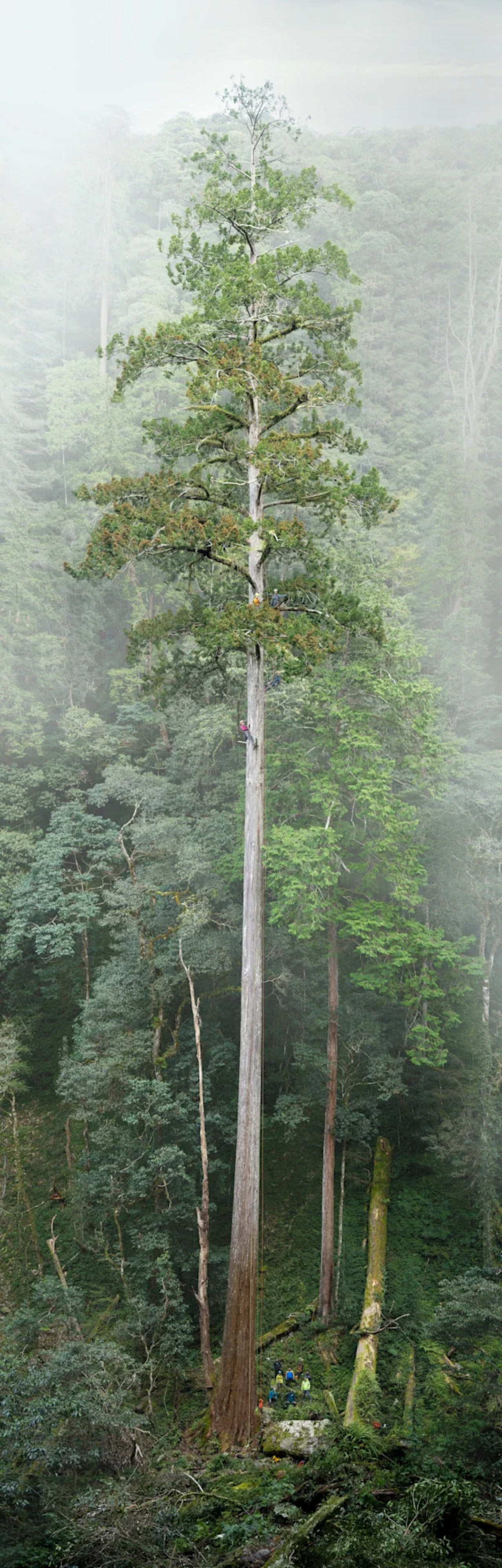
The Heaven Sword tree. Image credit: Chia-Chun Hsu et al., doi: 10.3389/ffgc.2026.1746112.
Nicknamed the Heaven Sword, the tree stands 84.1 m tall in the Sheshan range in northern Taiwan.
The finding was verified in 2023 by a climber who scaled its trunk and dropped a tape measure from the crown.
“Taiwan, historically known as Formosa, holds a secret deep within its rugged interior: it is one of the rare locations on our planet capable of supporting ‘giant’ trees — specimens that tower over 80 m in height,” said Dr. Rebecca Chia-Chun Hsu from the Taiwan Forestry Research Institute and colleagues.
“Since 2014, our dedicated group, the ‘Taiwan tree seekers,’ has been on a mission to locate and document these sky-piercing giants.”
“The team is a unique blend of professional tree climbers, ecologists, geologists, and remote sensing specialists.”
“In 2023, this persistence paid off: we located the reigning champion of the island’s forests: an 84.1-m-tall Taiwania cryptomerioides.”
“This massive tree currently holds the title of the tallest tree in all of East Asia.”
“To the Indigenous Rukai people, these gargantuan firs are known by a much more poetic name, ‘The tree that hits the Moon’.”
As part of their project, the researchers first built a national canopy map using airborne laser scanning data, initially flagging 57,065 candidate trees.
Steep cliffs caused rampant false positives: in one striking example, a tree barely 25 m tall registered as 90 m because it sat atop a sheer cliff face.
To sort through tens of thousands of candidates, they did something unusual: they asked the public for help.
Some 372 online volunteers examined laser-scan profile images of trees, winnowing the list down to 4,736 serious candidates, eliminating 92% of the manual verification work that would otherwise have fallen to specialists.
The final tally mapped 941 giant trees across the island, all taller than 65 m, clustered in montane cloud forests at elevations between 1,500 and 2,500 m.
Nine of the ten tallest exceeded 70 m, and all were Taiwania cryptomerioides.
The scientists warn that climate change is pushing cloud bases higher in Taiwan’s mountains, threatening forests that giant trees depend on for moisture.
Typhoon intensity hitting the island has risen 35% over the past four decades, and storm-driven floods and landslides pose an acute threat to trees that grow precisely in steep river valleys.
Illegal logging of old-growth trees was also discovered during the expeditions, even within protected areas.
“Large, old trees play a disproportionately significant role in forest ecosystems,” the authors said.
“They are massive carbon stores; a single giant tree can sequester an amount of carbon equivalent to an entire stand of mid-sized trees.”
“They also provide critical, irreplaceable habitats and alter microclimates, thereby supporting forest biodiversity.”
“Despite their size, these giants are uniquely vulnerable to climate change,” they said.
“Direct human activity also remains a threat. Although over 95% of the identified giant trees fall within protected areas, their remote locations make them difficult to monitor.”
“During our ground expeditions, we discovered several cases of illegal poaching of old-growth trees.”
“This highlights that official protection, while essential, is insufficient without broader community vigilance.”
The team’s paper appears in the journal Frontiers in Forests and Global Change.
_____
Rebecca Chia-Chun Hsu et al. 2026. The journey of finding the tallest tree in Formosa Taiwan. Front. For. Glob. Change 9; doi: 10.3389/ffgc.2026.1746112