After a 50-year search, astronomers have uncovered evidence that Sagittarius A* — the 4.3-million-solar-mass black hole that resides at the center of our Milky Way Galaxy — is blowing a hot cosmic wind into its surroundings, carving out a giant cavity near the Galaxy’s heart.
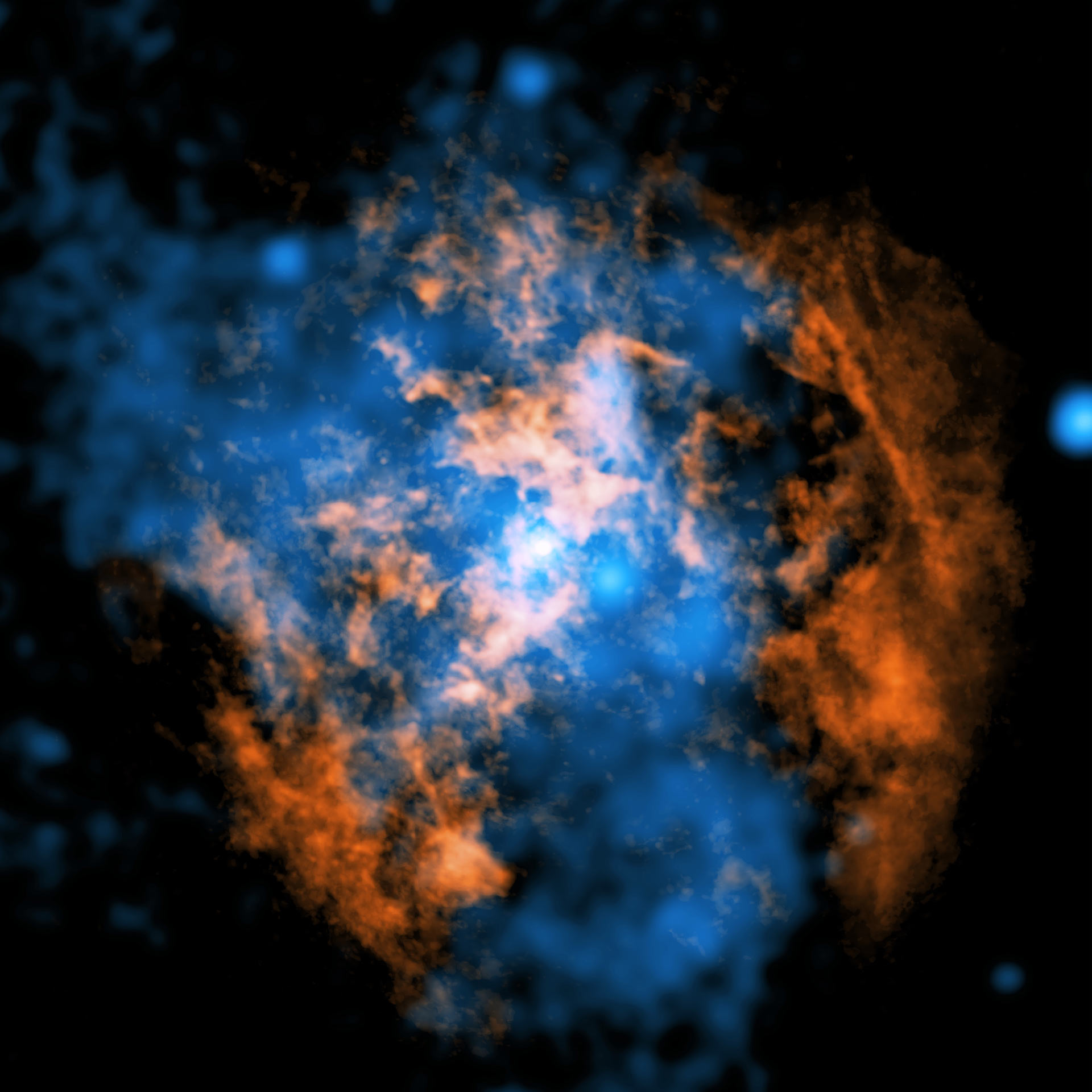
This image shows the evidence for the wind blowing away from Sagittarius A*: the white dot in the center of the image shows the supermassive black hole; in orange is data from ALMA, mapping the location of cold gas composed of carbon monoxide in the image; in blue is X-ray data from Chandra; a large cone-shaped cavity, visible as an absence of cold gas in the ALMA data, is filled by hot X-ray-emitting gas in the Chandra data. Image credit: NASA / CXC / UMass / Wang et al. / ALMA / ESO / NAOJ / NRAO / Longmore et al. / Minniti et al.
According to theoretical physics and a long-accepted understanding of galaxies evolution, as black holes consume materials, they should produce wind or jets.
Even a small amount of gas falling into a black hole should generate enough energy to push material outwards.
Until now, the wind coming from our own Galaxy’s black hole, Sagittarius A*, had never been seen clearly.
Using several years of highly detailed observations from the Atacama Large Millimeter/submillimeter Array (ALMA), astronomers mapped cold gas within just a few light‑years of the black hole.
After carefully removing the black hole’s bright radio glow, they uncovered a giant, cone‑shaped hole in the cold gas, pointing straight at the black hole — the unmistakable imprint of a large, hot, active wind launched from Sagittarius A*.
“Unless a black hole exists in a perfect vacuum, it must blow a wind somehow,” said Northwestern University astronomer Dr. Mark Gorski.
“And there is no perfect vacuum in the Universe.”
“With new observations, this is the first time we’ve had a clean enough view to see the wind’s imprint.”
“We looked at the data and said, ‘There it is. There is the thing that everybody’s been looking for for 50 years’.”
Over five years of ALMA observations, Dr. Gorski and his colleague, Dr. Lena Murchikova, mapped emission from carbon monoxide molecules, a classic tracer of cold molecular gas, within only about one parsec (or three light‑years) of Sagittarius A*.
By carefully modeling and subtracting the black hole’s own rapidly varying radio emission, they were able to reveal extremely faint, intricate structures in the surrounding gas.
“We were the first to show that molecular gas very, very close to the black hole is feeding it,” said Dr. Murchikova, also of Northwestern University.
“The wind is not powerful, and its direction probably wanders with time.”
“It shows that our black hole is not unique, and our place in the Universe is not unique.”
Data from NASA’s Chandra X-Ray Observatory show hot gas filling the same region, confirming that this is a black hole-powered outflow, not something caused by nearby stars.
“Exceptional claims require exceptional evidence,” Dr. Gorski said.
“We wanted to make sure that we weren’t just looking at some sort of imaging artifact. Then, the X-ray image from Chandra just slotted in perfectly. The molecular features lined up.”
The ALMA map is about 100 times deeper and 80 times sharper than previous carbon monoxide images of the region, making it the most sensitive, highest‑resolution map of cold gas within one parsec of Sagittarius A* ever obtained.
The team estimates this wind has been blowing for at least 20,000 years, but it’s relatively gentle compared to the dramatic jets seen in other galaxies.
“The majority of other galaxies spend most of their lives in a state where they are not particularly active,” Dr. Murchikova said
“But we can only see them when they are in a fireworks stage.”
“It is very attractive to study black holes when they are in the fireworks stage, but that’s not actually their dominant state.”
“Sagittarius A* finally gives us a window into the life of a black hole in this quiet state.”
The team’s results appear in the Astrophysical Journal Letters.
_____
Mark D. Gorski & Lena Murchikova. 2026. The Discovery of an Active Wind from the Milky Way’s Central Black Hole. ApJL 1004, L7; doi: 10.3847/2041-8213/ae63cf