Astronomy News

Oct 21, 2024 by Enrico de Lazaro

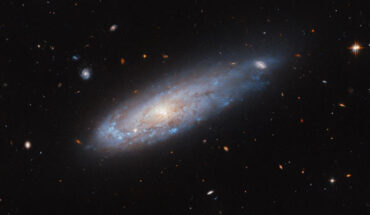
Early galaxies are dominated by bright clumps, which are larger and more massive than in the local Universe. The star formation activity is strongly influenced and can be even halted by a number of processes, some of which are directly related to the environment in which the galaxy resides. Ram pressure stripping, i.e. the removal of interstellar gas from the disk of star forming galaxies due to the hydrodynamical interaction with the hot intergalactic...
Oct 17, 2024 by News Staff

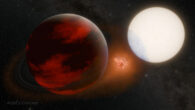
Gliese 229B was the first known brown dwarf, discovered in 1995. In new research, astronomers observed Gliese 229 B with the GRAVITY interferometer...

Oct 16, 2024 by News Staff

New research shows that approximately 70% of meteorites originate from at least three recent break-ups of massive asteroids. This is an artist’s...

Oct 16, 2024 by News Staff

The TRAPPIST-1 system is a compact system of at least seven exoplanets with sizes similar to Earth. Penn State and SETI Institute astronomers spent 28...

Oct 16, 2024 by News Staff

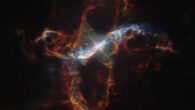
Astronomers using the NASA/ESA Hubble Space Telescope have made a unique timelapse of R Aquarii’s dynamic behavior from observations spanning from 2014...

Oct 16, 2024 by News Staff

ESA astronomers have released a 208-gigapixel mosaic of images taken by Euclid, a mission launched in 2023 to study why the Universe is expanding at an...

Oct 15, 2024 by Enrico de Lazaro

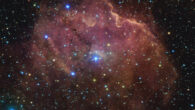
Gum 39 is one of several nebulae in a vast stellar nursery called the Running Chicken Nebula (IC 2944), which is located about 6,500 light-years away in...

Oct 15, 2024 by Enrico de Lazaro

A bright comet from the Oort cloud named C/2023 A3 (Tsuchinshan-ATLAS) is passing by Earth and will be visible through the second half of October 2024. This...

Oct 14, 2024 by News Staff

Astronomers using the NASA/ESA Hubble Space Telescope observed Jupiter’s most distinctive feature, the Great Red Spot, with on eight dates over a single,...

Oct 14, 2024 by News Staff

Using the ESPRESSO instrument on ESO’s Very Large Telescope and the HARPS instrument at ESO’s La Silla 3.6-m telescope, astronomers have detected a...

Oct 14, 2024 by Enrico de Lazaro

Astronomers using the NASA/ESA Hubble Space Telescope have obtained a remarkable new view of the intermediate spiral galaxy Messier 90. This Hubble image...

Oct 10, 2024 by News Staff

In a new study, astronomers compared high-resolution images of Uranus from the NASA/ESA Hubble Space Telescope to the more-distant view from NASA’s New...

Oct 9, 2024 by News Staff

Astronomers using the Zwicky Transient Facility (ZTF) have investigated the Taurid resonant swarm, a large interplanetary system that contains comet 2P/Encke,...

Oct 8, 2024 by News Staff

REBELS-25 existed as early as 700 million years after Big Bang, according to a paper published in the Monthly Notices of the Royal Astronomical Society. This...

Oct 7, 2024 by Enrico de Lazaro

Hubble’s Wide Field Camera 3 (WFC3) has taken a striking new image of the grand design spiral galaxy NGC 5248. This Hubble image shows NGC 5248, a grand...

Oct 3, 2024 by News Staff

Centaurs are former trans-Neptunian objects that have been moved inside Neptune’s orbit by subtle gravitational influences of the planets in the last...

Oct 2, 2024 by News Staff

TIC 290061484 contains a pair of stars orbiting each other every 1.8 days, and a third star that circles the pair in just 25 days. The discovery smashes...

Oct 1, 2024 by Enrico de Lazaro

Using data from the Near-Infrared Spectrograph (NIRSpec) onboard the NASA/ESA/CSA James Webb Space Telescope, astronomers have detected carbon dioxide...

Oct 1, 2024 by News Staff

The new image of the Rosette Nebula was taken by the Dark Energy Camera (DECam), mounted on NSF’s Víctor M. Blanco 4-m telescope at Cerro Tololo Inter-American...

Oct 1, 2024 by News Staff

An exoplanet at least half the mass of Venus orbits Barnard’s star, the closest single star to the Sun, once every 3.15 days. An artist’s impression...