Biology News

Dec 27, 2017 by News Staff

An international team of ornithologists has revealed that a rare Amazonian bird called the golden-crowned manakin (Lepidothrix vilasboasi) — first discovered in Brazil in 1957 but not seen again until 2002 — is in fact a hybrid of two parental species: the snow-capped (Lepidothrix nattereri) and opal-crowned (Lepidothrix iris) manakins. This hybrid has a unique golden-colored crown patch used for display, which differs from the brilliant...

Dec 26, 2017 by News Staff

An international team of marine biologists has described a new species of intertidal spider from tropical Queensland, Australia, and named it after the...

Dec 21, 2017 by News Staff

An international team led by University of York researchers has directly observed microbial activity in Antarctic and Arctic snow — an environment...

Dec 20, 2017 by News Staff

A wide range of flowers produce not just signals that we can see and smell, but also ones that are invisible such as heat. According to new research from...

Dec 19, 2017 by News Staff

Viruses can transfer genes to organisms they are not known to infect, including organisms in different domains (superkingdoms) of life, according to a...

Dec 15, 2017 by Enrico de Lazaro

A distinctive new species of antbird has been discovered in the humid montane forests of the San Martin region in north-central Peru. The Cordillera Azul...

Dec 14, 2017 by News Staff

A team of scientists from the University of California and the Massachusetts Institute of Technology (MIT) has found a way to infuse plants with the luminescence...

Dec 12, 2017 by Natali Anderson

The silky anteater (Cyclopes didactylus) has previously been recognized to be a single species divided into several sub-species. But a new genetic analysis,...

Dec 10, 2017 by News Staff

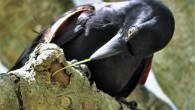
A team of researchers at the University of St Andrews has discovered how New Caledonian crows (Corvus moneduloides) make one of their most sophisticated...

Dec 8, 2017 by Natali Anderson

The microbial community composition on the International Space Station (ISS) is more similar to home surfaces than to the human microbiome samples, according...

Dec 6, 2017 by News Staff

Pigeons can discriminate the abstract concepts of space and time — and seem to use a different region of the brain than humans and primates to do...

Dec 5, 2017 by News Staff

Gorillas can spontaneously clean their food before eating it, without first watching another animal to learn from them, an international team of researchers...

Dec 1, 2017 by News Staff

An international group of biologists from Israel and Sweden has obtained a detailed view of a scallop’s visual system — an arrangement of up to...

Nov 30, 2017 by News Staff

An international team of scientists from Brazil and the United Kingdom has analyzed mouth-licking behavior of domestic dogs, and found that this behavior...

Nov 30, 2017 by News Staff

The Yeti, a mysterious ‘hominid’-like creature said to inhabit the high mountains of Asia, looms large in the mythology of Nepal and Tibet. Now, a...

Nov 29, 2017 by News Staff

In the frigid darkness of the Mariana Trench swims the world’s deepest-living fish — the Mariana snailfish (Pseudoliparis swirei). The Mariana...

Nov 27, 2017 by Natali Anderson

A new species of seahorse has been discovered in the northern Pacific Ocean, near Japan and the Korean Peninsula. Coloration of fresh specimens: Hippocampus...

Nov 26, 2017 by News Staff

A team of researchers from the Australian National University has solved the mystery of how crested pigeons (Ochyphaps lophotes) create an alarm without...

Nov 24, 2017 by News Staff

A detailed comparative analysis of adult human, chimpanzee, and macaque brains shows that all regions of the human brain have molecular signatures very...

Nov 24, 2017 by News Staff

A team of synthetic biologists from Columbia University has successfully converted an immune system of the gut bacterium Escherichia coli into a microscopic...