For several decades, paleontologists have described Miracinonyx trumani — an extinct species of cheetah-like felid that roamed the North American prairies and steppe terrains more than 13,000 years ago — as North America’s answer to the African cheetah (Acinonyx jubatus). New research led by the University of California, Santa Cruz suggests the picture was largely wrong.
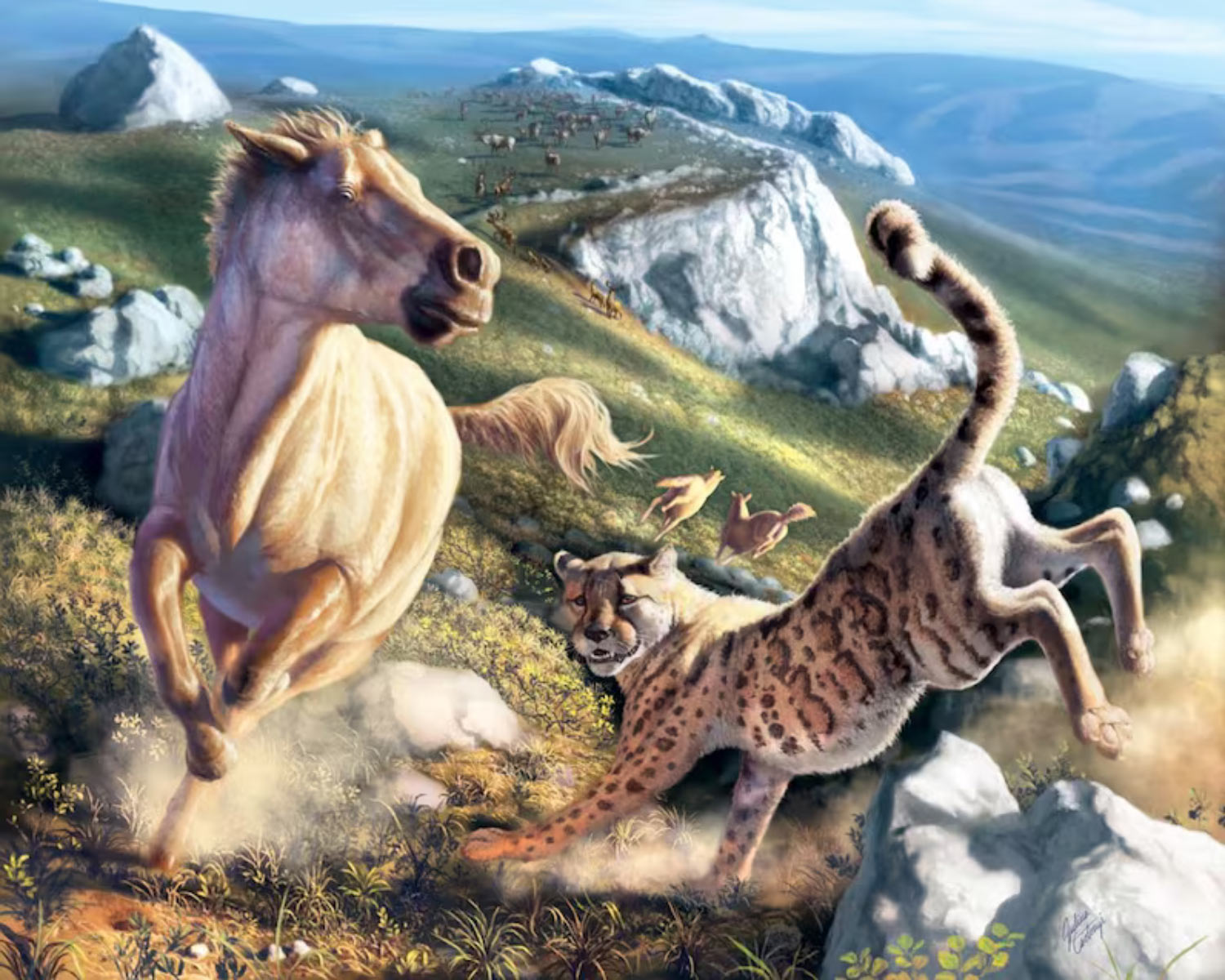
Miracinonyx trumani and the ecosystem this species lived in. Image credit: Julius Csotonyi.
Miracinonyx trumani roamed North America’s open grasslands during the Pleistocene epoch, about 2.5 million to 13,000 years ago.
Based on fossils uncovered to date, the species was 90 cm (3 feet) tall, about 2.5 m (8 feet) long to the tip of its tail, and weighed around 70 kg (150 pounds) on average.
It had a slender body shape, long forelimbs, and large nasal cavities — features that are characteristic of modern fast-running animals such as cheetahs or horses.
Some Miracinonyx trumani fossils have been unearthed alongside those of pronghorns, fast-running animals known colloquially as the ‘American antelope,’ leading researchers to assume that the extinct felid had a similar lifestyle to modern African cheetahs.
“These cats were remarkably flexible, much like pumas are across their range today,” said Molly Cassatt-Johnstone, a Ph.D. candidate at the University of California, Santa Cruz.
“We found loss-of-function mutations in certain genes that regulate circadian rhythms, suggesting they may have adapted to the extreme light cycles of summers and winters in northern latitudes.”
Cassatt-Johnstone and her colleagues used ancient DNA extracted from four Miracinonyx trumani specimens — one from Natural Trap Cave in Wyoming and three from Yukon Territory — to sequence the first high-coverage nuclear genomes of the ancient species.
“It’s very hard to imagine a prehistoric species we’ve never seen without comparing it to something we know,” Cassatt-Johnstone said.
“But this approach can limit our understanding of ancient animals’ complexity, unique evolutionary histories, and behaviors.”
The genetic analysis places the felid as the closest relative of the living puma (Puma concolor), not the cheetah, confirming and extending earlier findings based on more limited mitochondrial DNA.
The two lineages are estimated to have split around 2.6 million years ago, while Miracinonyx trumani’s sleek, cheetah-like build appears to be a case of convergent evolution: similar body shapes arising independently in response to similar open-habitat hunting pressures, rather than shared ancestry with African cheetahs.
The Yukon fossils also push the species’ known range dramatically northward — by more than 20 degrees of latitude — showing that the felid lived in Arctic steppe-tundra environments roughly 31,000 to 34,000 years ago, far beyond the temperate grasslands where most previous fossils had been found.
Two of the Yukon specimens had originally been misidentified as pumas because of their location so far outside Miracinonyx trumani’s expected range.
Chemical signatures in the fossils’ bone collagen point to a striking dietary split between populations.
The Wyoming individual showed isotope values typical of a generalist terrestrial hunter, consistent with the mixed prey base of an open grassland ecosystem.
The Yukon individuals, by contrast, carried nitrogen isotope values roughly six parts per thousand higher than other carnivores in the region, a signature best explained by reliance on salmon and other fish that migrate upriver from the ocean, hundreds of kilometers inland.
The genomes also revealed a handful of disabled genes shared by both populations, including two involved in regulating circadian rhythms, which may reflect relaxed evolutionary pressure on daily light cycles at high latitudes, and a gene tied to sour-taste perception that appears to be broken across cat species generally.
Both populations showed low genetic diversity, comparable to some of today’s most inbred endangered cats, though without evidence of the severe inbreeding bottlenecks seen in species such as the Iberian lynx (Lynx pardinus).
Taken together, the findings suggest Miracinonyx trumani was less a specialized sprinter chasing pronghorn across the plains and more an adaptable predator capable of exploiting very different food sources across a huge range.
“There are probably other extinct species that, unfortunately, have been reduced to fewer dimensions than they deserve,” Cassatt-Johnstone said.
“The Miracinonyx trumani fossils suggest that this ‘American cheetah’ was far more adaptable than its nickname implies.”
“This species of carnivore has this massive range, all the way from the Arctic to the Lower 48,” said University of Alaska Fairbanks Professor Matthew Wooller.
“They’re demonstrating uber-specialization at two ends of their range, while also feeding on two completely different food sources.”
“Low genetic diversity didn’t doom this species by itself,” said University of California, Santa Cruz Professor Beth Shapiro.
“Miracinonyx trumani persisted for a very long time without the signs of inbreeding we’d expect before a collapse.”
“The decline was slow, not sudden, and that may be what left it unable to adapt when the climate shifted.”
A paper on the findings was published today in the journal Current Biology.
_____
Molly Cassatt-Johnstone et al. Range and diet diversity in the Pleistocene American ‘cheetah,’ Miracinonyx trumani. Current Biology, published online September 4, 2026; doi: 10.1016/j.cub.2026.07.072