In a paper published online March 18 in the journal Acta Palaeontologica Polonica, paleontologists described a new species of harvestman found in two pieces of Eocene-aged amber from Ukraine and the Baltic region.
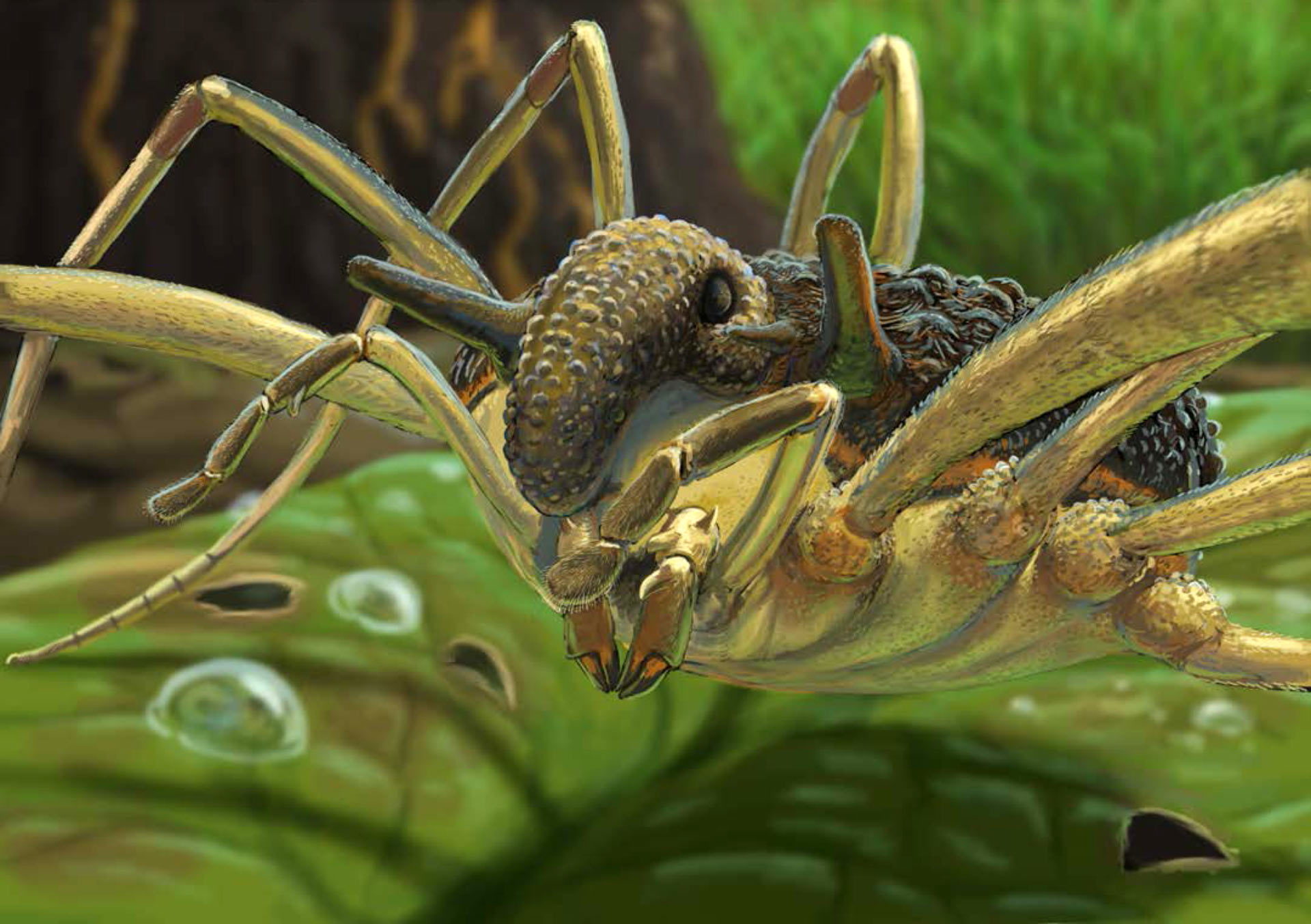
An artist’s reconstruction of Balticolasma wunderlichi male. Image credit: Joshua Knüppe.
The newly-identified harvestman is the first known member of the subfamily Ortholasmatinae ever found in the fossil record.
Named Balticolasma wunderlichi, the species lived in Europe approximately 35 million years ago (Eocene epoch).
Today, these ornate, often heavily sculpted arachnids survive only in parts of East Asia and the Americas.
“The subfamily Ortholasmatinae includes some of the most striking-looking modern harvestmen, as they often bear a very complex and branched ocular tubercle in combination with a unique dorsal micro-sculpture consisting of so-called keel cells,” said Bavarian State Collections of Natural History paleontologist Christian Bartel and his colleagues.
“Seven living genera with 27 described species are currently recognized with a disjunct distribution.”
Balticolasma wunderlichi was identified from two specimens: a likely female found in Rovno amber from northwestern Ukraine and a male preserved in Baltic amber.
The fossils originate from private collections in Germany (Baltic specimen) and Lithuania (Rovno specimen) and are now deposited in the Museum für Naturkunde Berlin.
“The discovery of an ortholasmatine harvestman in European amber deposits surprised us. Harvestmen of this group no longer exist in Europe today,” Dr. Bartel said.
“Relatives of these animals are currently found only in East Asia as well as in North and Central America.”
“Evidently, 35 million years ago, during the Eocene epoch, these harvestmen were much more widely distributed across the northern hemisphere than they are today.”
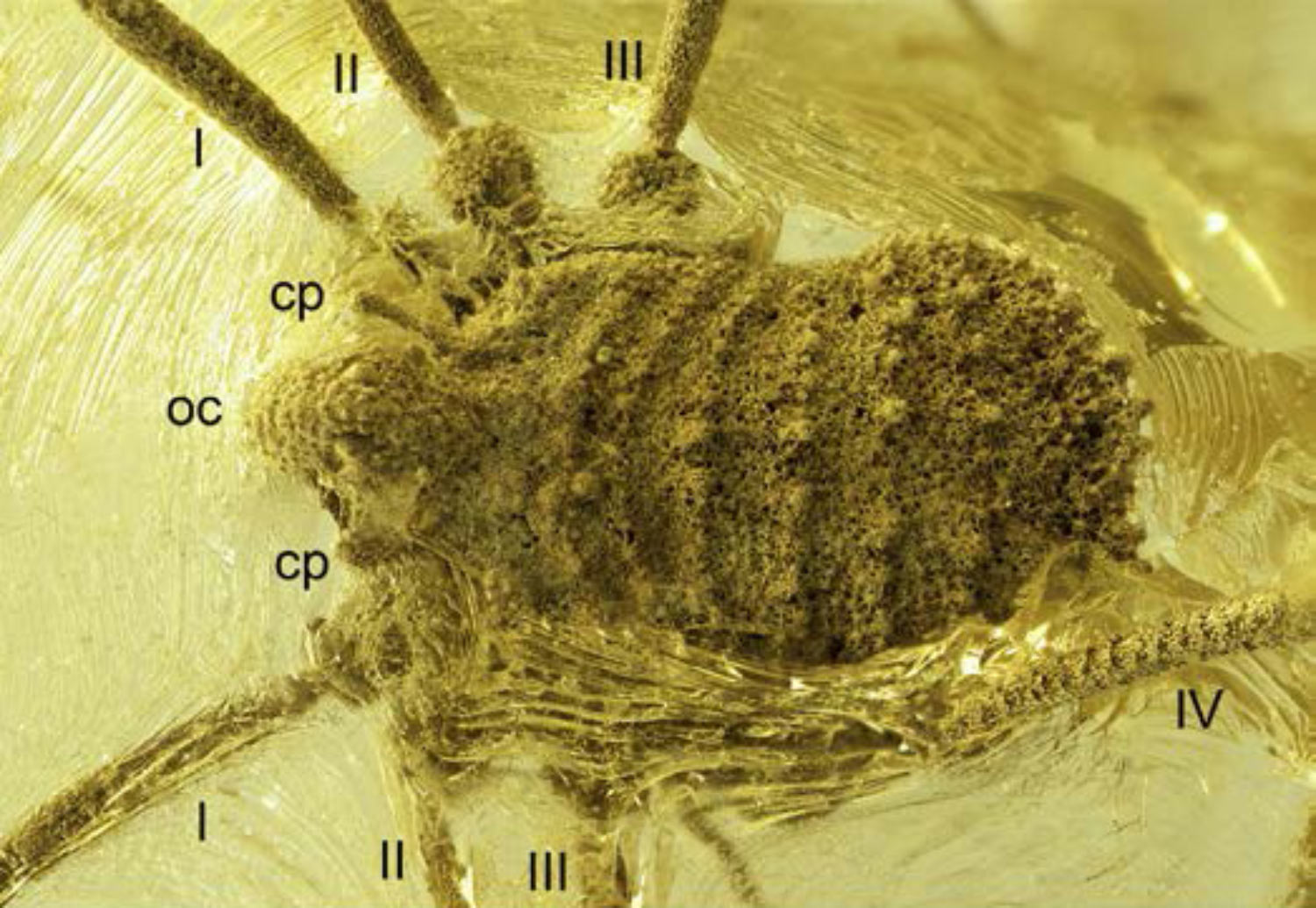
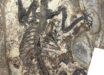
Balticolasma wunderlichi female from Rovno amber. Image credit: Bartel et al., doi: 10.4202/app.01283.2025.
Using high-resolution synchrotron microtomography, the researchers reconstructed the anatomy of Balticolasma wunderlichi in striking detail.
The scans revealed a small, flattened body less than 3 mm long, adorned with rows of tubercles and a distinctive forward-projecting hood-like structure.
“Some of its morphological characters appear to be closer to living Asian genera,” the scientists noted.
The study also highlights the scientific value of amber deposits from the Baltic and Rovno regions.
With this discovery, the number of known harvestman species preserved in these ambers rises, and the fossils provide a new calibration point for reconstructing the evolutionary tree of the group.
“Baltic amber is known for its great diversity of fossils. It continually reveals species that no longer occur in Europe today,” said Dr. Jason Dunlop, a paleontologist at the Museum für Naturkunde in Berlin.
“The fact that the new harvestman species was also found in Ukraine shows once again that the harvestman faunas of both regions were likely similar.”
“With this new addition, the number of known harvestman species from Baltic amber rises to 19, and those from the ancient Ukrainian Rovno amber to seven. Six species are found in both regions.”
_____
C. Bartel et al. 2026. 3D analyses of the first ortholasmatine harvestmen from European Eocene ambers. Acta Palaeontologica Polonica 71 (1): 95-107; doi: 10.4202/app.01283.2025