Fossils of a giant tortoise, a ground sloth, a lion-sized armadillo relative called pampathere, scimitar-toothed cats, horses, camels and mastodons found in Bender’s Cave on the Edwards Plateau of Texas may reveal a previously unknown warm period in the region roughly 100,000 years ago.
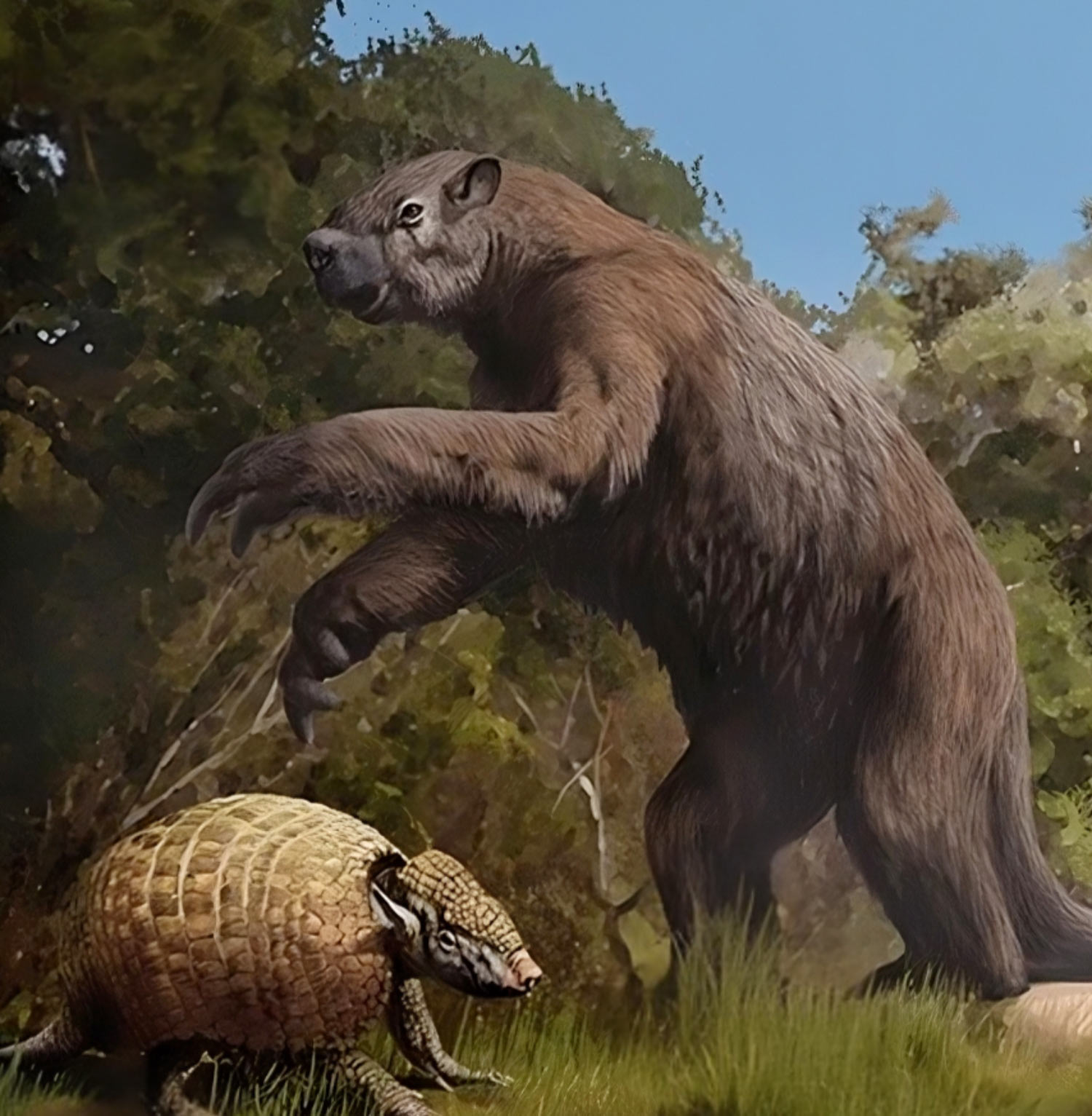
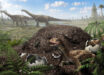
An artist’s interpretation of mammals that lived during the Ice Age: fossils from similar species of an armadillo-like pampathere (bottom left) and giant ground sloth (background) were among those found in a Texas water cave. Image credit: Jaime Chirinos.
Water caves are conduits for underground streams. They are important passageways for groundwater in Central Texas, and have been anecdotally described by cavers as rich in fossils.
“There were fossils everywhere, just everywhere, in a way that I haven’t seen in any other cave. It was just bones all over the floor,” said University of Texas at Austin paleontologist John Moretti.
Bender’s Cave is located on private property in Comal County. The bones entered the cave through sinkholes during erosion and flooding events that happened thousands of years ago, and have remained there ever since.
“There’s evidence that the water cave fossils could be from the last interglacial, a warm period that occurred around 100,000 years ago,” Dr. Moretti said.
“Despite extensive paleontology research in the area dating back almost a century, fossils from this period have not been found before in Central Texas.”
“This site is showing us something different, and that’s really important because of all the work that’s been done in this region.”
“If it is interglacial in age, it’s a new window into the past and into a landscape, environment, and animal community that we haven’t observed in this part of Texas before.”
Dr. Moretti and local caver John Young collected fossils from 21 different zones of Bender’s Cave.
Finding fossils entailed crawling along the streambed with goggles and a snorkel.
Collecting them was as simple as plucking them from the bottom of the stream bed — no excavation from rock required.
Notable finds include the bones from the giant tortoise Hesperotestudo sp., the giant ground sloth Megalonyx jeffersonii, the pampathere Holmesina septentrionalis, the scimitar-toothed cat Homotherium serum, as well as from horses, camels and mastodons.
All the fossils are polished, rounded and have a similar degree of rusty red mineralization, which suggests that they were swept into the cave at about the same time.
“The research shows that even in an area as well documented as Central Texas, there are new things to find,” said St. Edwards University’s Dr. David Ledesma, who was not involved in the study.
The team’s results appear in the journal Quaternary Research.
_____
John A. Moretti & John Young. 2026. Novel occurrences of Late Pleistocene megafauna from Bender’s Cave on the Edwards Plateau of Texas may include evidence of the last interglacial. Quaternary Research 131: 134-160; doi: 10.1017/qua.2025.10071