For decades, scientists treated the yellow-eyed penguin (Megadyptes antipodes) as a single species split into two broad populations. A new genomic study has shattered that picture, revealing three deeply separate lineages that have been isolated from one another for thousands of years — long predating the arrival of humans in New Zealand (Aotearoa).
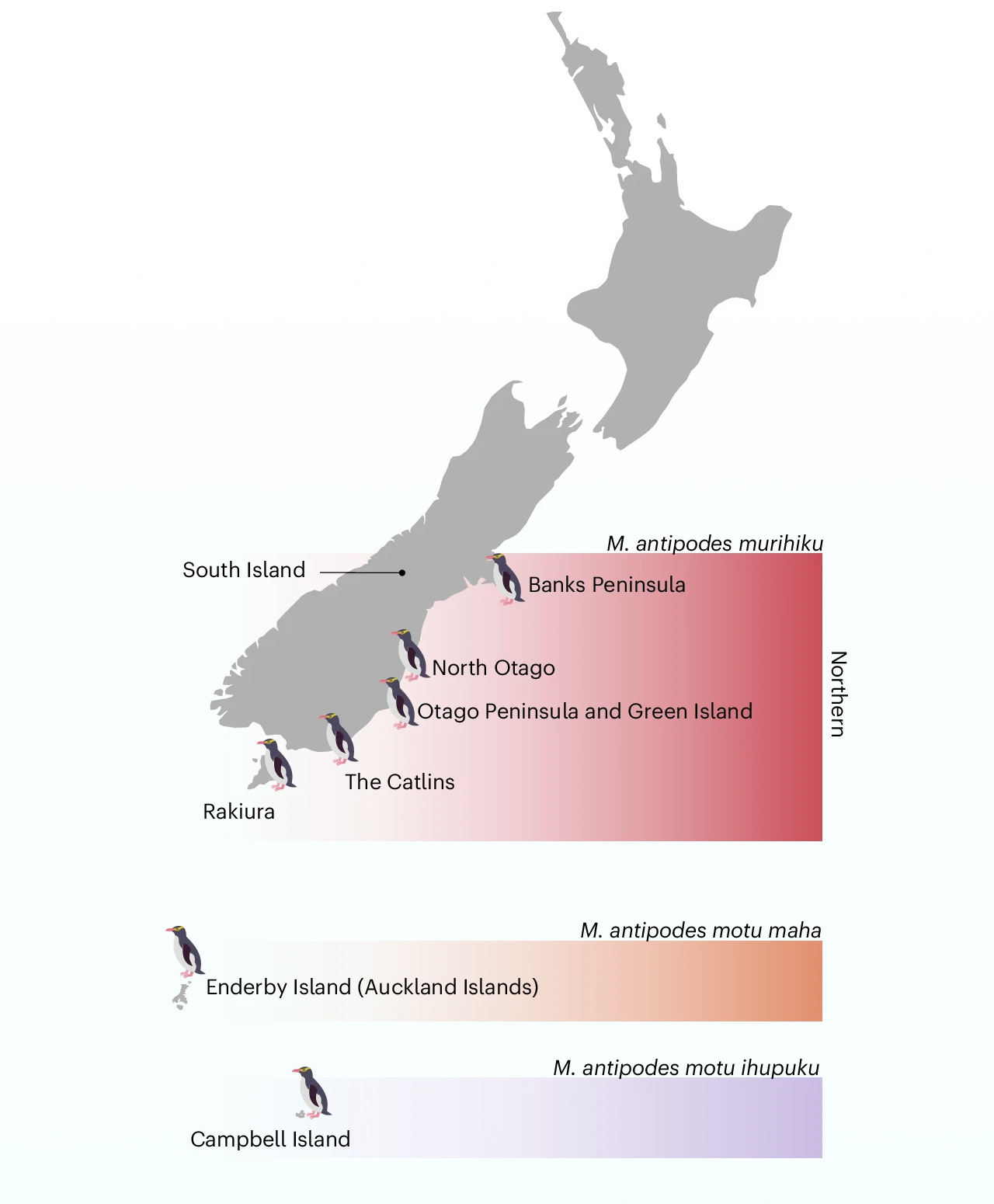
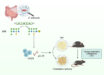
Geographical distribution of yellow-eyed penguins. Image credit: Guhlin et al., doi: 10.1038/s41559-026-03062-w.
First described by Jacques Bernard Hombron and Honoré Jacquinot in 1841, yellow-eyed penguins are an endangered species endemic to New Zealand.
They are regarded as taonga (treasured) by Māori, the Indigenous peoples of New Zealand, who named them hoiho or takaraka.
Since 2019, chicks on the New Zealand mainland have been affected by a deadly neonatal disease, respiratory distress syndrome, contributing to a decline to fewer than 115 breeding pairs.
“As one of the rarest penguin species in the world, yellow-eyed penguins serve as an important indicator of ecosystem health, with their population trajectories reflecting broader ecosystem change,” said senior author Professor Jemma Geoghegan from the University of Otago and colleagues.
“Therefore, protecting yellow-eyed penguins is critical for biodiversity conservation and maintaining the integrity of coastal ecosystems.”
“They are also an icon of the regional wildlife tourism industry, substantially contributing to the local economy.”
“Therefore, their decline represents a biodiversity crisis and a cultural and economic loss.”
In the new study, Professor Geoghegan and co-authors sequenced the complete genomes of 249 yellow-eyed penguins from the New Zealand mainland (northern range), sub-Antarctic Enderby (Auckland Islands) and Campbell Islands (southern range).
They expected to confirm a simple two-population structure. What they found was far more striking.
Using a suite of cutting-edge genomic tools, the researchers identified three genetically distinct groups with virtually no interbreeding between them.
The scale of their genetic differences, the scientists concluded, warrants formally recognizing each as a separate subspecies.
“In this study, we used population genomics to investigate the evolutionary history and disease susceptibility of the endangered yellow-eyed penguin/hoiho, one of the world’s rarest penguin species,” Professor Geoghegan said.
“Funded through Genomics Aotearoa, we generated whole-genome data from 249 penguins across mainland New Zealand and the subantarctic islands to better understand why chicks in the mainland population have been dying from a severe respiratory disease known as respiratory distress syndrome.”
“Unexpectedly, we found that hoiho are made up of three deeply divergent subspecies with no evidence of migration between them.”
“Our analyses suggest these populations have been separated for thousands of years, much earlier than previously thought.”
“This means the critically endangered northern population is not simply a recent extension of the southern populations, but a distinct evolutionary lineage in its own right.”
“We identified candidate genes linked to immune function and respiratory biology that may help explain why the northern population appears uniquely vulnerable to respiratory distress syndrome.”
“These findings provide new insight into the role of host genetics in wildlife disease and have major implications for conservation management.”
After consultation with Ngāi Tahu, the principal iwi (tribe) of the South Island, New Zealand, who are kaitiaki (guardians) for the species, the authors proposed new subspecies names rooted in Māori geography: Megadyptes antipodes murihiku (hoiho murihiku) for the northern population, Megadyptes antipodes motu maha (hoiho motu maha) for Enderby Island within the Auckland Islands, and Megadyptes antipodes motu ihupuku (hoiho motu ihupuku) for Campbell Island.
“Working in partnership with Ngāi Tahu, the kaitiaki of hoiho, we hope this research will support urgent and targeted conservation action for each subspecies, particularly the rapidly declining northern lineage, which now numbers fewer than 115 breeding pairs,” Professor Geoghegan said.
The team’s paper was published in the journal Nature Ecology & Evolution.
_____
J. Guhlin et al. Population genomics of yellow-eyed penguins uncovers subspecies divergence and candidate genes linked to respiratory distress syndrome. Nat Ecol Evol, published online May 12, 2026; doi: 10.1038/s41559-026-03062-w