A study of radiation fog events over Pennsylvania has found that bacteria living inside fog droplets are actively growing and feeding on toxic chemicals like formaldehyde, revealing an unexpected biological force at work in the atmosphere.
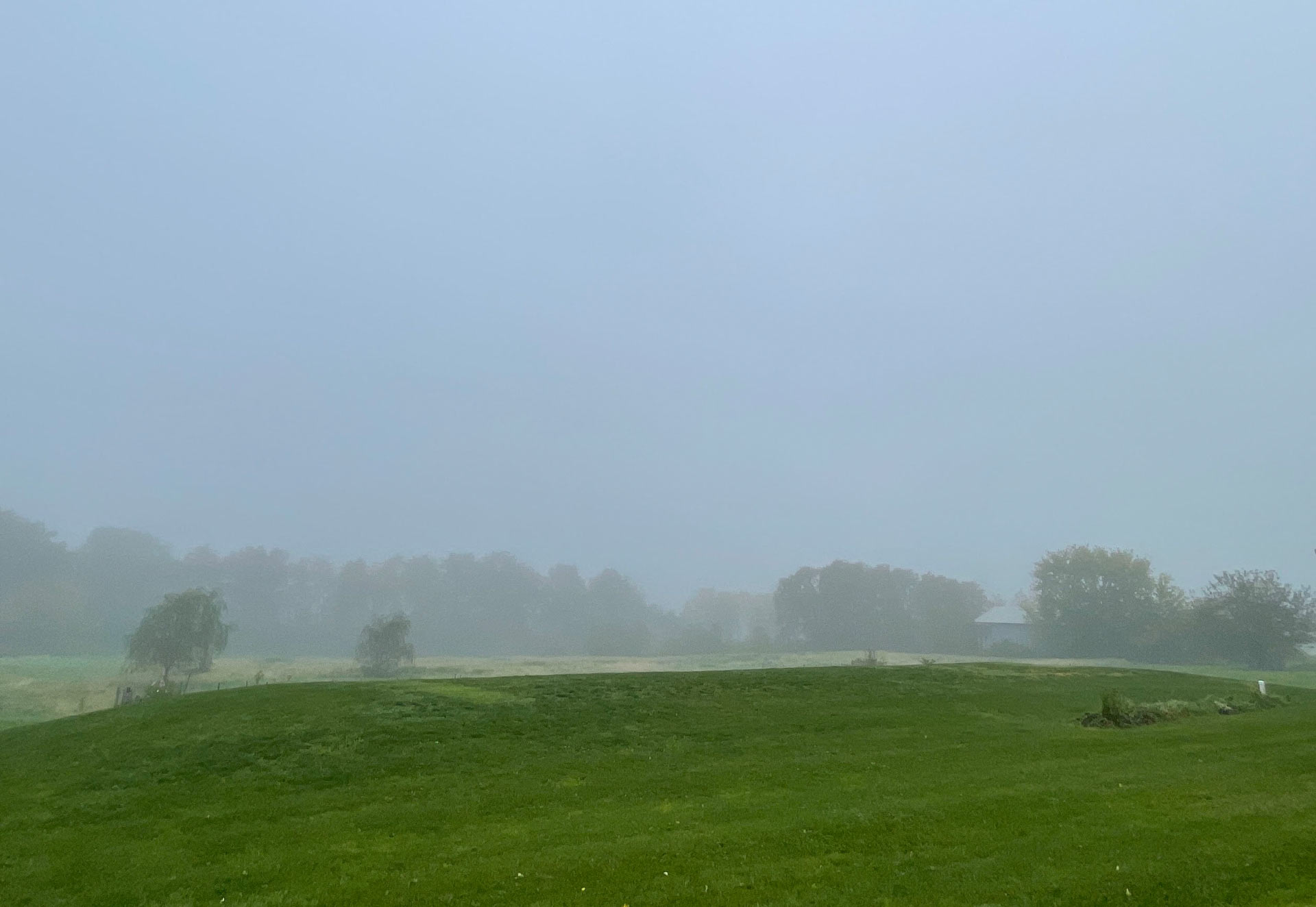
A foggy field in Pennsylvania has a little secret: its suspended water droplets form a habitat for helpful bacteria that eat air toxins. Image credit: Thi Thuong Thuong Cao.
“The atmosphere contains thousands to millions of bacterial cells per cubic meter,” said Thi Thuong Thuong Cao, a Ph.D. student at Arizona State University, and colleagues.
“However, it remains unclear if microbes are at all active or growing in situ or whether they are merely being transported in an inactive state.”
“There’s very limited knowledge about what kinds of bacteria are present in fogs, which are like clouds at the ground level.”
To gain insights into the role of atmospheric droplets as microbial microhabitats, Cao and colleagues conducted an experimental campaign encompassing 32 radiation fog events over central Pennsylvania spanning two years.
They found that fewer than 1% of fog droplets contain bacteria. But averaged together, they represent an astounding amount of life.
“When you take all of the droplets together, the concentration of bacteria is the same as in the ocean,” said Professor Ferran Garcia-Pichel, also of Arizona State University.
“A thimble’s worth of fog water has some 10 million bacteria.”
One group of bacteria stood out: methylobacteria. Samples of dry air collected before fog events contained less of these bacteria than samples collected immediately after. That suggests fog briefly boosts their numbers.
Methylobacteria eat simple carbon compounds, which include nasty chemicals like formaldehyde. Formaldehyde is a common pollutant that adds to ozone smog and harms human health.
“We observed them under the microscope to see that, yes, the bacteria are getting bigger and they’re dividing, so there is growth,” Cao said.
“We also found that they’re using the formaldehyde as food to support their growth.”
In fact, the bacteria cleared such large amounts of formaldehyde so quickly that the researchers suspected they weren’t just eating it.
At high levels, the chemical is toxic to the bacteria, so they break it down into carbon dioxide to keep the levels low. It’s a win-win for microbes and humans alike.
“It’s relatively new that people are starting to look at biological activities in clouds, so there’s still a lot which we don’t understand,” said Arizona State University’s Professor Pierre Herckes.
“At nighttime, for example, there isn’t that much atmospheric chemistry going on. Chemistry is largely driven by the Sun and by light. But if the bacteria are still doing their thing even during the nighttime, they can be important.”
“What’s truly boggling is how much we still don’t know about these miniature worlds in fog and clouds. Are there different bacteria in fog depending on where it forms? What might these other bacteria eat? And how do they affect our air quality?”
“The sky’s the limit, no pun intended,” Professor Garcia-Pichel said.
The results were published this week in the journal mBio.
_____
Thi Thuong Thuong Cao et al. 2026. Growth and formaldehyde degradation of photoheterotrophic Methylobacterium within radiation fogs. mBio 0:e00463-26; doi: 10.1128/mbio.00463-26