A new analysis of 470 flowering plant species finds that whole-genome duplication surged precisely during Earth’s violent environmental crises, suggesting nature keeps a backup plan hidden in plain sight.
Chen et al. constructed a comprehensive genomic dataset of 470 flowering plant species and dated 132 ancient whole-genome duplication (WGD) events that are non-randomly distributed, revealing a clustering around pivotal periods of environmental upheaval and extinction. Image credit: Chen et al., doi: 10.1016/j.cell.2026.04.008.
Most organisms carry two sets of chromosomes, one from each parent. But in flowering plants, many species carry additional sets as a result of random whole-genome duplication.
For example, most cultivated bananas have three sets of chromosomes while wheat plants can have as many as six, a condition known as polyploidy.
Whole-genome duplication occurs relatively frequently in plants, and it can be costly.
Larger genomes require more nutrients to maintain, increase the risk of acquiring harmful mutations, and affect fertility.
For these reasons, only a small fraction of duplicated genomes are retained and passed down through generations in the wild.
On the other hand, genome duplications can increase genetic variations, and genes can evolve new functions.
These changes may help organisms better tolerate stress such as heat or drought.
“Whole-genome duplication is often seen as an evolutionary dead end in stable environments,” said Dr. Yves Van de Peer, a researcher at Ghent University.
“But in harsh situations, it can provide unexpected advantages.”
To understand why some duplicated genomes persist, Dr. Van de Peer and colleagues analyzed the genomes of 470 species of flowering plants, constructing one of the largest datasets of its kind.
They looked for blocks of genes that appear in almost identical pairs — a marker of past whole-genome duplication events.
Then, they compared the data with information from 44 plant fossils to estimate when these duplications occurred.
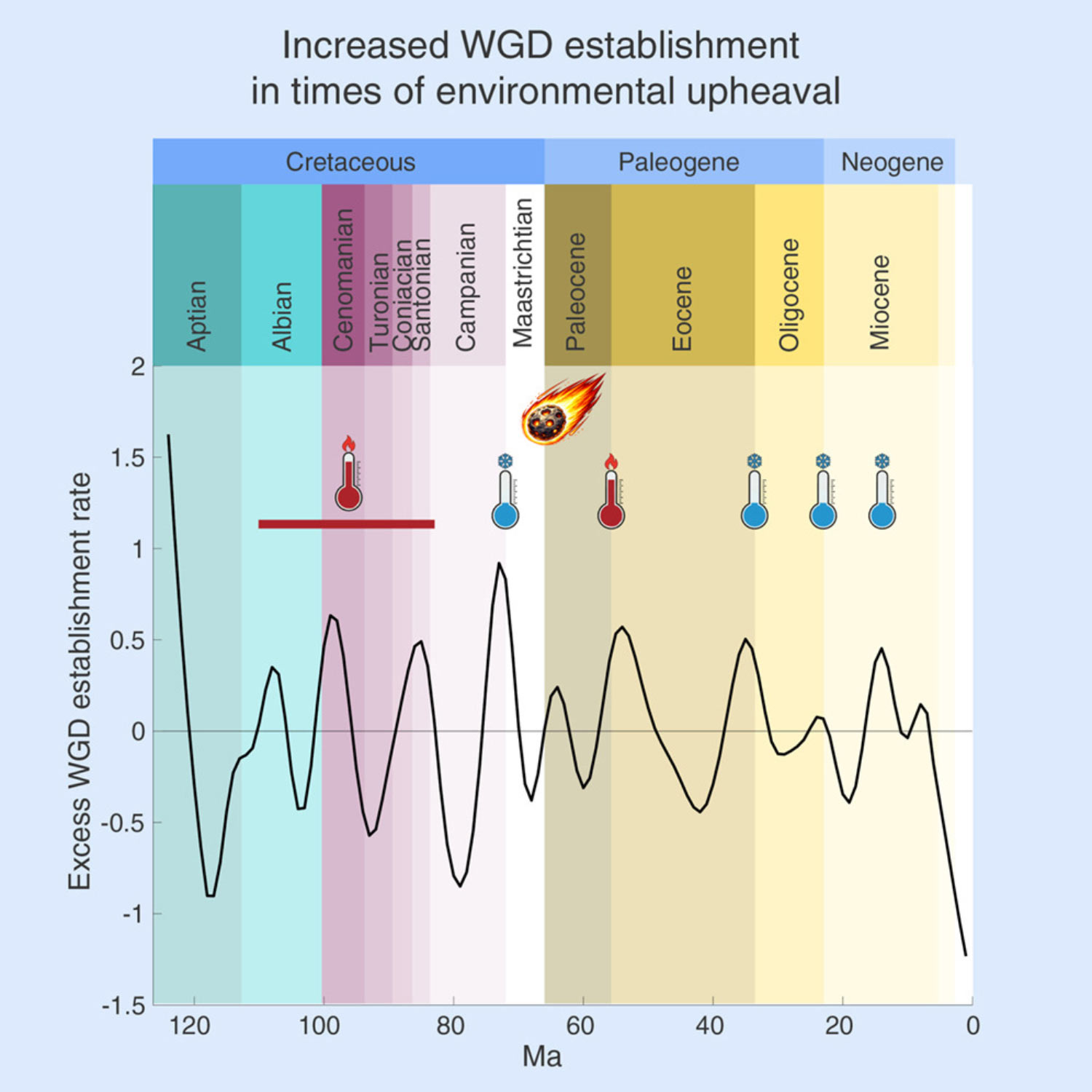
Their analysis revealed a striking pattern: the genes that persist over time tend to originate from whole-genome duplications during major periods of environmental upheaval.
These include the asteroid-triggered mass extinction 66 million years ago, several periods of global cooling when ecosystems collapsed, and the Paleocene-Eocene Thermal Maximum (PETM) about 56 million years ago, a period of rapid global warming.
The findings help explain a long-standing puzzle of why polyploidy is common, but only a few persevere in plant genomes over millions of years.
Under these extreme conditions, polyploid plants might have gained an edge.
Traits that are normally disadvantageous, such as maintaining a larger and more complex genome, can become beneficial, say the researchers.
The study also offers some clues about how plants may respond to climate change today.
During the PETM, global temperatures rose by about 5 to 9 degrees Celsius over roughly 100,000 years, a change comparable to the warming happening today.
“While the current climate is warming at a much faster rate, what we see from the past suggests that polyploidy may help plants cope with these stressful conditions,” Dr. Van de Peer said.
A paper on the findings was published on May 8 in the journal Cell.
_____
Hengchi Chen et al. The rise of polyploids during environmental upheaval. Cell, published online May 8, 2026; doi: 10.1016/j.cell.2026.04.008