For the first time, astronomers have directly detected how turbulent clouds of ionized gas between the stars bend and blur radio signal from a distant quasar.
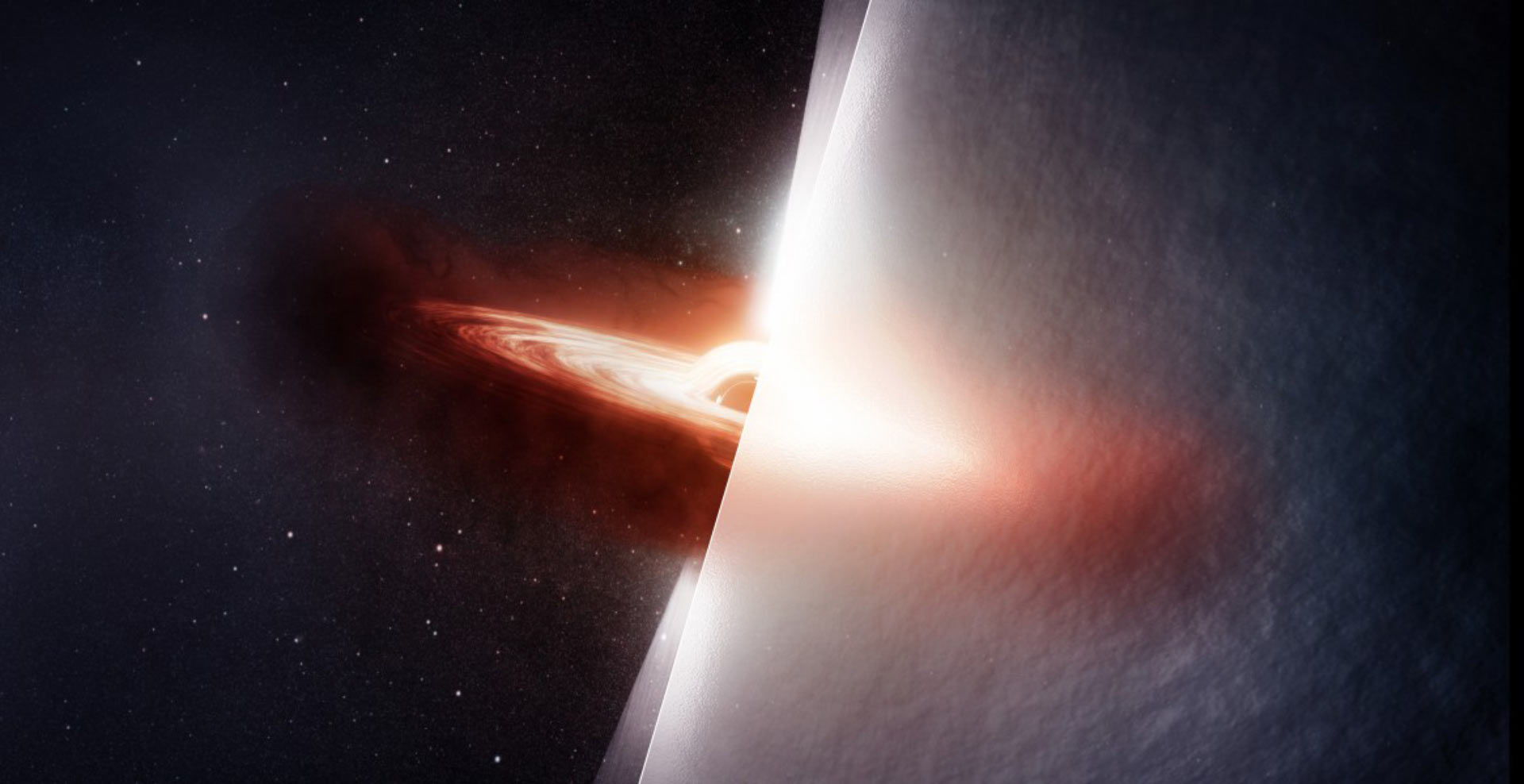
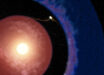
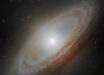
Radio signal from the quasar TXS 2005+403 travels roughly 10 billion light-years to reach Earth, traversing the Cygnus region, one of the most turbulent and scattering environments in the Milky Way Galaxy. On the left, this artist’s conception shows the quasar as it truly appears, with a bright accretion disk and jets blasting into the Galaxy like a beacon through the darkness. On the right, we see how turbulent gas distorts scientists’ view of the quasar in much the same way heat haze from a fire warps our view of the objects behind it. Image credit: Melissa Weiss / CfA.
The space between stars in our Milky Way Galaxy, known as the interstellar medium, is churning with clouds of ionized gas and electrons.
When waves of radio light from distant objects pass through this turbulent material, they are bent and distorted in the same way heat haze rising above a fire distorts our view of everything behind it.
That distortion has long allowed astronomers to infer that the turbulence exists, but understanding its structure has remained out of reach until now.
To measure the turbulence, Harvard & Smithsonian’s Center for Astrophysics astronomer Alexander Plavin and his colleagues set their sights on a quasar called TXS 2005+403.
This bright radio source is powered by a supermassive black hole located roughly 10 billion light-years away in the constellation of Cygnus.
As radio light from the quasar travels toward Earth, it passes through the Cygnus region, one of the most turbulent and strongly scattering environments in the Milky Way, causing the radio waves to be deflected and distorted.
“Most of what we see in the radio data isn’t coming from the quasar itself, it’s coming from the scattering caused by the turbulence in this region of the Milky Way,” Dr. Plavin said.
“That scattering and the distortions that come with it are what allows us to study the turbulence and better understand and infer its structure.”
To get a better look at the effects of turbulence on light from TXS 2005+403, the astronomers analyzed nearly a decade of archival observations from NSF’s Very Long Baseline Array (VLBA).
They expected that when radio light from the quasar passed though the Milky Way, it would spread out into a smooth blur and fade away.
Instead, they found persistent, distinct patterns, producing structured, patchy distortions in the light that could only have come from turbulence.
“The most distant pairs of telescopes should not have seen the quasar image, but to our surprise, they clearly detected its signal, or faint glow,” Dr. Plavin said.
“It can’t be explained by simple blurring or by the quasar itself, and it behaves the way turbulence is expected to, which is how we know we’re seeing the effects of interstellar turbulence.”
“The scattering properties along this line of sight through the Galaxy remain persistent over time.”
A paper on the findings appears in the Astrophysical Journal Letters.
_____
A.V. Plavin et al. 2026. Direct Very Long Baseline Interferometry Detection of Interstellar Turbulence Imprint on a Quasar: TXS 2005+403. ApJL 1003, L4; doi: 10.3847/2041-8213/ae60f4