NGC 1266 appears frozen between two cosmic identities, offering astronomers a close-up look at how star formation shuts down.
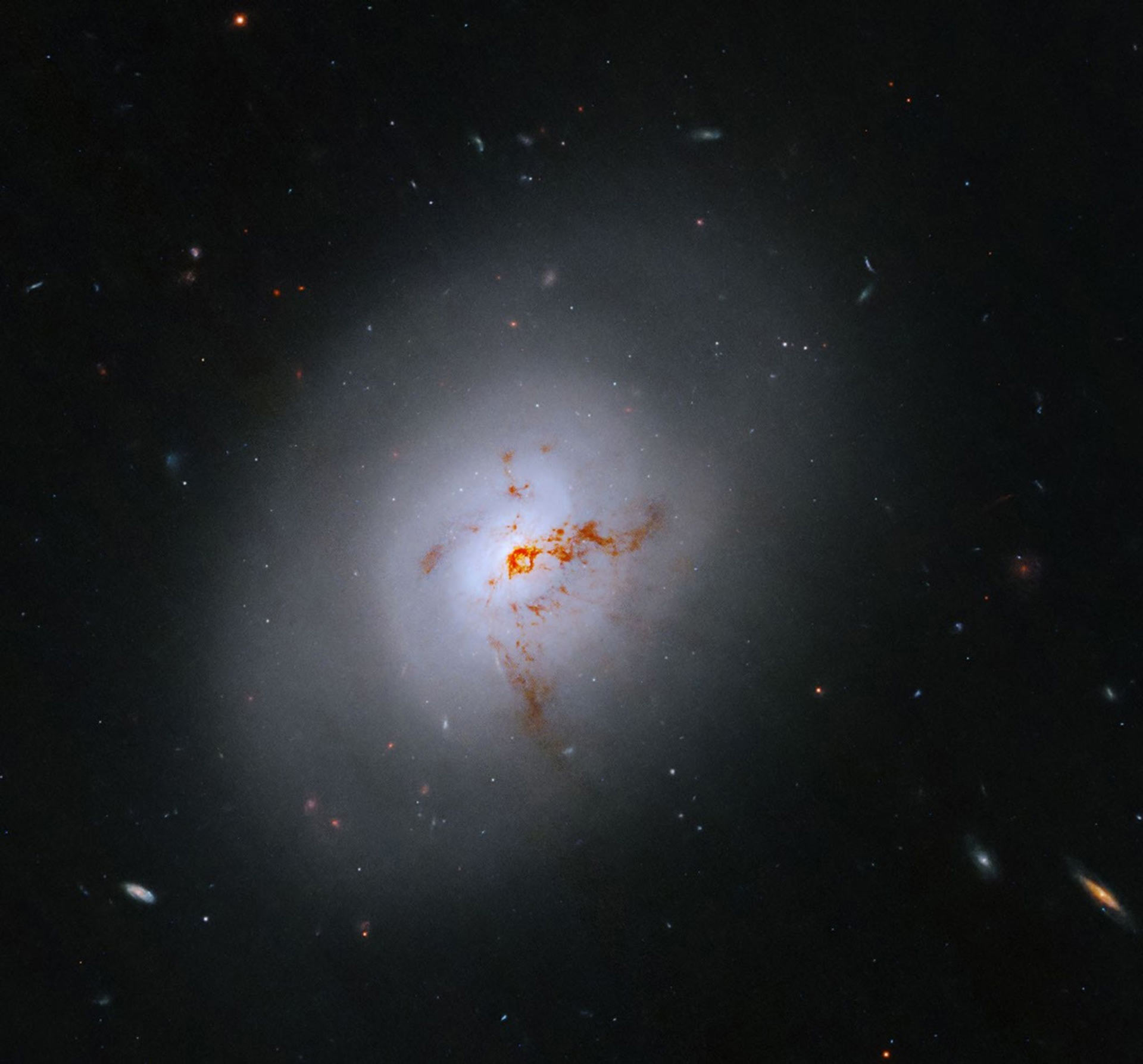
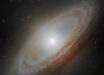
This Hubble image reveals the lenticular galaxy NGC 1266; reddish-brown clumps and filaments of dust partially obscure the galaxy’s full face, while red, blue, and orange light from distant galaxies shines through its diffuse outer regions and dots the inky-black background. Image credit: NASA / ESA / K. Alatalo, STScI / G. Kober, NASA & Catholic University of America.
NGC 1266 is a lenticular galaxy located in the constellation of Eridanus, about 100 million light-years away.
Astronomers classify lenticulars as transitional galaxies that represent an evolutionary bridge between spirals and ellipticals.
“Lenticulars are lens-shaped and have a bright central bulge and flattened disk like spirals, but they have no spiral arms and little to no star formation like ellipticals,” the Hubble astronomers said in a statement.
“As interesting as this galaxy’s structure and lenticular classification are, those traits aren’t its most intriguing features.”
“NGC 1266 is a rare post-starburst galaxy that is in transition between a galaxy that experienced a major burst of star formation and a quieter elliptical galaxy,” they added.
“Post-starburst galaxies have a young population of stars but few star-forming regions.”
“Roughly 1% of the local galaxy population is a post-starburst galaxy.”
NGC 1266 underwent a minor merger with another galaxy about 500 million years ago.
“The merger spurred the formation of new stars and increased the mass of the galaxy’s central bulge while funneling gas into its supermassive black hole,” the astronomers said.
“The additional matter made the black hole much more active, creating an active galactic nucleus.”
“The black hole’s increased activity would have generated powerful winds and jets of gas along its axis of rotation.”
“Over time, the burst of new stars and the black hole’s powerful jets would deplete the galaxy’s reservoir of star-forming gas, while the turbulence generated in these processes suppressed new stars from forming in the gas that remained.”
Using observations with Hubble and other observatories, astronomers detected a strong outflow of gas from NGC 1266 and that the space between its stars is shocked or highly disturbed.
They found that any remaining stellar nurseries are in the core of the galaxy, and that very little to no star formation happens beyond that core.
“These observations suggest the supermassive black hole in the galaxy’s heart may be suppressing star birth by stripping or ejecting star-forming gas from the galaxy,” the researchers said.
“The shockwaves from this process would create turbulence that disturbs the gas and dust between stars enough to stop any remaining matter from gravitationally condensing into infant stars.”