Researchers have developed a new method to identify whether black hole mergers occurred inside dense clouds of dark matter, potentially opening a fresh avenue for studying one of astronomy’s biggest mysteries.
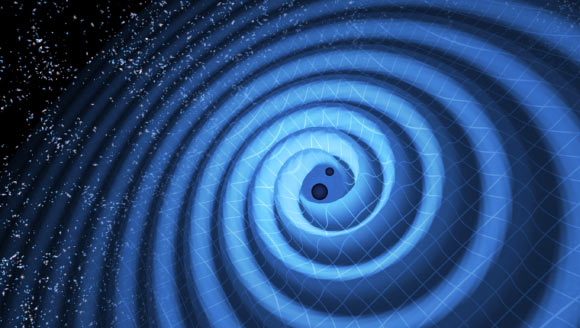
Gravitational waves observed by Laser Interferometer Gravitational-Wave Observatory (LIGO) twin detectors were produced during the final fraction of a second of the merger of two black holes to produce a single, more massive spinning black hole. Image credit: T. Pyle / LIGO.
Dark matter is an invisible, hypothetical form of matter that, unlike normal everyday matter, has no interactions with the electromagnetic force.
Dark matter can pass through light, magnetic fields, and any other form of energy along the electromagnetic spectrum without leaving a trace.
The only evidence that dark matter exists is through its apparent interaction with one other force: gravity.
By observing how gravity bends around distant galaxies, astronomers have surmised that there must be an extra force, outside of the galaxies’ own gravitational pull, to explain the bending fields, or lensing.
This extra force, physicists suspect, is dark matter, which could account for over 85% of the matter in the Universe.
But exactly what dark matter is is a matter of huge debate, with theories for dark matter particles that range widely in particle size and properties.
One class of proposed dark matter consists of light scalar particles, whose masses are many orders of magnitude lighter than an electron.
Theorists predict that such dark matter should behave not just as particles, but also as coordinated waves when moving near black holes.
When waves of dark matter come in contact with a rapidly spinning black hole, they predict that the black hole’s rotational energy can be transferred to the dark matter, amplifying it.
This phenomenon, known as superradiance, would whip up the waves to extremely high densities of dark matter, akin to churning cream into butter.
At high enough densities, light scalar dark matter, which is invisible by all other accounts, should leave an imprint on the gravitational waves that reverberate from the colliding black holes.
But exactly what would that imprint look like? And could such an imprint be detectable in gravitational waves that arrive on Earth, from black holes that merged many millions of light years away?
For answers to those questions, MIT physicist Josu Aurrekoetxea and his colleagues developed a model to predict the gravitational waveform, or the pattern of gravitational waves that two black holes would produce, if they collided in an environment of dark matter, versus in a vacuum.
“We know that dark matter is around us. It just has to be dense enough for us to see its effects,” Dr. Aurrekoetxea said.
“Black holes provide a mechanism to enhance this density, which we can now search for by analyzing the gravitational waves emitted when they merge.”
The researchers looked through the gravitational-wave signals recorded over the first three observing runs of LIGO-Virgo-KAGRA (LVK), the global network of observatories that detect gravitational waves from black hole mergers and other far-off astrophysical sources.
From 28 of the clearest signals, they found that 27 originated from black holes that merged in a vacuum.
But the pattern of one signal, GW 190728, showed possible signs of a dark matter imprint.
The scientists emphasize that they have not detected dark matter.
Rather, the new method offers a new way to screen gravitational-wave data for hints of dark matter, which physicists can then follow up and confirm with other techniques.
“The statistical significance of this is not high enough to claim a detection of dark matter, and further checks should be performed by independent groups,” Dr. Aurrekoetxea said.
“What we think is important to highlight is that without waveform models like ours, we could be detecting black hole mergers in dark matter environments, but systematically classifying them as having occurred in vacuum.”
“We now have the potential to discover dark matter around black holes as the LVK detectors keep collecting data in the coming years,” said Dr. Soumen Roy, a researcher at the Université Catholique de Louvain and Royal Observatory of Belgium.
“It is an exciting time to search for new physics using gravitational waves.”
“Using black holes to look for dark matter would be fantastic,” added Dr. Rodrigo Vicente, a researcher at the University of Amsterdam.
“We would be able to probe dark matter at scales much smaller than ever before.”
The findings appear today in the journal Physical Review Letters.
_____
Soumen Roy et al. 2026. Scalar Fields around Black Hole Binaries in LIGO-Virgo-KAGRA. Phys. Rev. Lett 136, 191402; doi: 10.1103/fv9z-zkxx