Researchers have discovered stromatolites — layered structures formed by microbial communities — inside a 42,000-year-old asteroid crater in South Korea, suggesting ancient post-impact lakes may have acted as ‘oxygen oases’ for early life.
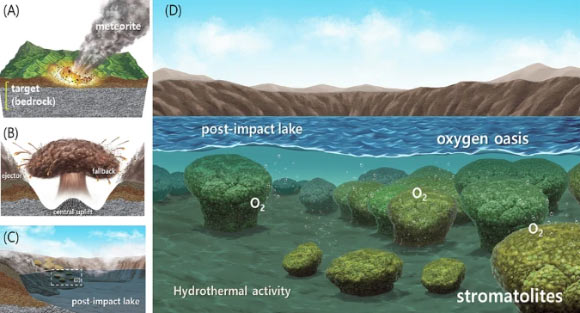
Lim et al. demonstrate that stromatolites — the oldest fossil evidence of oxygen-producing microbial life on early Earth — could have developed within impact craters, based on a detailed investigation of stromatolites and lake sediments in the Hapcheon impact crater, South Korea. Image credit: Lim et al., doi: 10.1038/s43247-026-03206-7.
“Stromatolite — laminated sedimentary structures accretionary away from appoint or limited surface — is considered the oldest evidence of life on Earth, dating back to approximately 3.5 billion years in the early Archean,” said lead author Dr. Jaesoo Lim and colleagues from the Korea Institute of Geoscience and Mineral Resources.
“Their laminated organo-sedimentary structures form through the trapping and binding of sediment grains by microbial activity or the precipitation of minerals driven by microbial metabolic processes.”
The researchers discovered multiple stromatolites — each measuring 10-20 cm in diameter — in the northwestern part of the Hapcheon crater in South Korea.
“Geochemical analyses of the stromatolites revealed several key features, including signatures of both extraterrestrial material and surrounding bedrock, as well as evidence of alteration by high-temperature water,” they said.
“The inner layers show stronger hydrothermal signals, suggesting they formed during an earlier, hotter phase.”
“Together, these findings support the interpretation that the stromatolites developed in a post-impact hydrothermal lake that gradually cooled over time.”
The results show that the Hapcheon impact event occurred approximately 42,300 years ago.
“The findings offer new insight into the Great Oxidation Event, a period around 2.4 billion years ago when oxygen levels in Earth’s atmosphere rose dramatically,” the scientists said.
“Impact-generated hydrothermal lakes could have served as localized habitats where oxygen-producing microbes could thrive.”
“These environments may have formed what the team describes as oxygen oases.”
The study also raises the possibility that similar environments may have existed on early Mars.
Because Mars is believed to have hosted water-filled impact craters in its early history, crater environments could be promising targets in the search for evidences of past life.
“This is the first comprehensive evidence suggesting that stromatolites could form in hydrothermal lakes created by asteroid impacts,” Dr. Lim said.
“Such environments may have provided favorable conditions for early microbial ecosystems.”
The study was published on April 16, 2026 in the journal Communications Earth & Environment.
_____
J. Lim et al. 2026. Discovery of stromatolite formation in post-impact hydrothermal lacustrine environments and its implications for early Earth. Commun Earth Environ 7, 334; doi: 10.1038/s43247-026-03206-7