Paleontologists from University College London and the University of Cambridge say the large predatory dinosaurs’ tiny arms evolved alongside massive heads and bone-crushing jaws, suggesting ancient predators increasingly relied on biting rather than grasping prey.

Life reconstruction of Tyrannosaurus mcraeensis. Image credit: Sergey Krasovskiy.
“Everyone knows Tyrannosaurus rex had tiny arms but other giant theropod dinosaurs also evolved relatively small forelimbs,” said Charlie Roger Scherer, a Ph.D. student at University College London.
“Carnotaurus had ridiculously tiny arms, smaller than Tyrannosaurus rex.”
“We sought to understand what was driving this change and found a strong relationship between short arms and large, powerfully built heads.”
In their research, Schere and colleagues looked at data for 82 species of carnivorous theropod dinosaurs.
They found that shortening of forelimbs occurred across five lineages: Abelisauridae, Carcharodontosauridae, Ceratosauridae, Megalosaurinae and Tyrannosauridae.
Smaller arms were closely linked to the development of large, powerful skulls and jaws, more so than to larger overall body size, indicating that tiny arms were not just a by-product of bodies getting bigger.

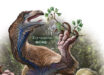
Torvosaurus gurneyi. Image credit: © Sergey Krasovskiy.
The researchers suggested that the increasing size of prey, in the form of gigantic sauropods and other large herbivores, may have resulted in a shift to hunting using jaws and head instead of claws.
The head took over from the arms as the method of attack. It’s a case of ‘use it or lose it’ — the arms are no longer useful and reduce in size over time.
“While our study identifies correlations and so cannot establish cause and effect, it is highly likely that strongly built skulls came before shorter forelimbs,” Scherer said.
“It would not make evolutionary sense for it to occur the other way round, and for these predators to give up their attack mechanism without having a back-up.”
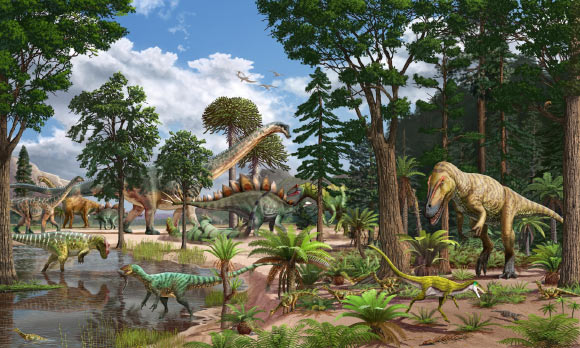
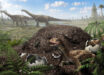
Ecosystem reconstruction of the Late Jurassic Dry Mesa Dinosaur Quarry around 150 million years ago in Colorado, the United States. Image credit: Sergey Krasovskiy / Pedro Salas.
For the study, the paleontologists developed a new way to quantify skull robustness, based on factors including how tightly connected the bones of the head were, the dimensions of the skull (a more compact shape is stronger than an elongated shape), and bite force.
On this measure, Tyrannosaurus rex scored highest, followed by Tyrannotitan, a theropod nearly as massive as Tyrannosaurus rex who lived in what is now Argentina in the Early Cretaceous epoch, more than 30 million years earlier than Tyrannosaurus rex.
“Increasingly gigantic prey may have resulted in an evolutionary arms race, where theropods developed strong skulls and jaws to better subdue this prey, and in many cases grew to gigantic sizes themselves,” the researchers said.
Their paper was published today in the Proceedings of the Royal Society B.
_____
Charlie Roger Scherer et al. 2026. Drivers and mechanisms of convergent forelimb reduction in non-avian theropod dinosaurs. Proc Biol Sci 293 (2071): 20260528; doi: 10.1098/rspb.2026.0528