New simulations suggest a violent collision 11 billion years ago reshaped our Galaxy and triggered a burst of star formation.
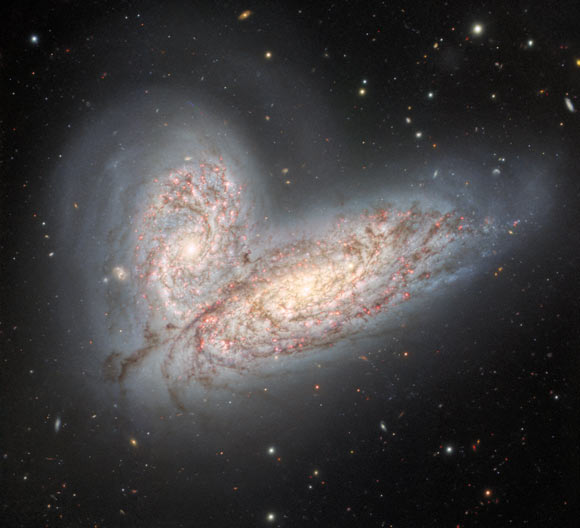
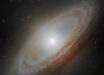
This image from the Gemini North telescope shows a pair of interacting spiral galaxies: NGC 4568 (bottom) and NGC 4567 (top). Image credit: International Gemini Observatory / NOIRLab / NSF / AURA / T.A. Rector, University of Alaska Anchorage & NSF’s NOIRLab / J. Miller, Gemini Observatory & NSF’s NOIRLab / M. Zamani, NSF’s NOIRLab / D. de Martin, NSF’s NOIRLab.
The Milky Way’s disk is a sprawling, rotating structure of stars and gas shaped somewhat like a cosmic pancake, with bright spiral arms extending outward from its center.
Most of the Galaxy’s stars — including the Sun — reside within this disk, which spins through space at speeds exceeding 220 km per second.
For decades, astronomers have been trying to pinpoint when this vast rotating structure first emerged.
“A key clue lies in the motions and ages of the stars: at some point in the Galaxy’s early history, the stars began moving in a coherent, rotating pattern, marking what scientists call the Galaxy’s spin-up time,” said Dr. Matthew Orkney from the University of Barcelona and the Institute of Space Studies of Catalonia and Dr. Chervin Laporte from CNRS.
“However, the Milky Way Galaxy did not form in isolation.”
“For decades, scientists have suspected that a violent collision with a smaller galaxy played an important role in shaping the Milky Way as we observe it today.”
“This suspicion was confirmed in 2018, when data from ESA’s Gaia mission revealed a large population of stars whose unusual motions could only be explained by a massive merger that occurred about 10 billion years ago.”
“This event is now known as the Gaia-Sausage-Enceladus (GSE) merger.”
To explore how rotating galactic disks emerge and evolve, Dr. Orkney and Dr. Laporte ran simulations of galaxies similar to the Milky Way under a variety of cosmic scenarios.
The models allowed the authors to examine how galaxies like our own respond to ancient collisions with smaller companions.
They found that rotating stellar disks may have formed far earlier in a galaxy’s history than astronomers once believed.
But the simulations also revealed that major galactic collisions can severely disrupt — or even completely destroy — those disks.
That means the point at which the Milky Way’s disk appears to settle into a stable rotation may not represent the birth of the disk itself.
Instead, it could mark the period when our Galaxy rebuilt and recovered after a catastrophic merger.
Using clues from the simulations, the researchers concluded that the Milky Way’s collision with the GSE galaxy likely took place around 11 billion years ago — earlier than many previous estimates had suggested.
Importantly, this proposed timeline matches a dramatic rise in star cluster formation within the Milky Way.
Such bursts of stellar birth are a natural aftermath of galactic collisions, as the impacts compress vast clouds of gas and ignite intense waves of star formation.
“Models of the GSE merger predict that a galactic firework should have followed the impact, raising star formation and fostering the formation of globular clusters. This is the first time this link has been made,” Dr. Laporte said.
“This research highlights the important relationship between galactic structure and ancient collisions, which must be understood in unison in order to understand the history of our Galaxy,” Dr. Orkney added.
The findings were published in the Monthly Notices of the Royal Astronomical Society.
_____
Matthew D.A. Orkney & Chervin F.P. Laporte. 2026. Build-up and survival of the disc: from numerical models of galaxy formation to the Milky Way. MNRAS 548 (4): staf2154; doi: 10.1093/mnras/staf2154