Long before sharks or reptiles ruled the seas, armor-plated fish called placoderms were already experimenting with different jaw designs to crush hard-shelled prey.
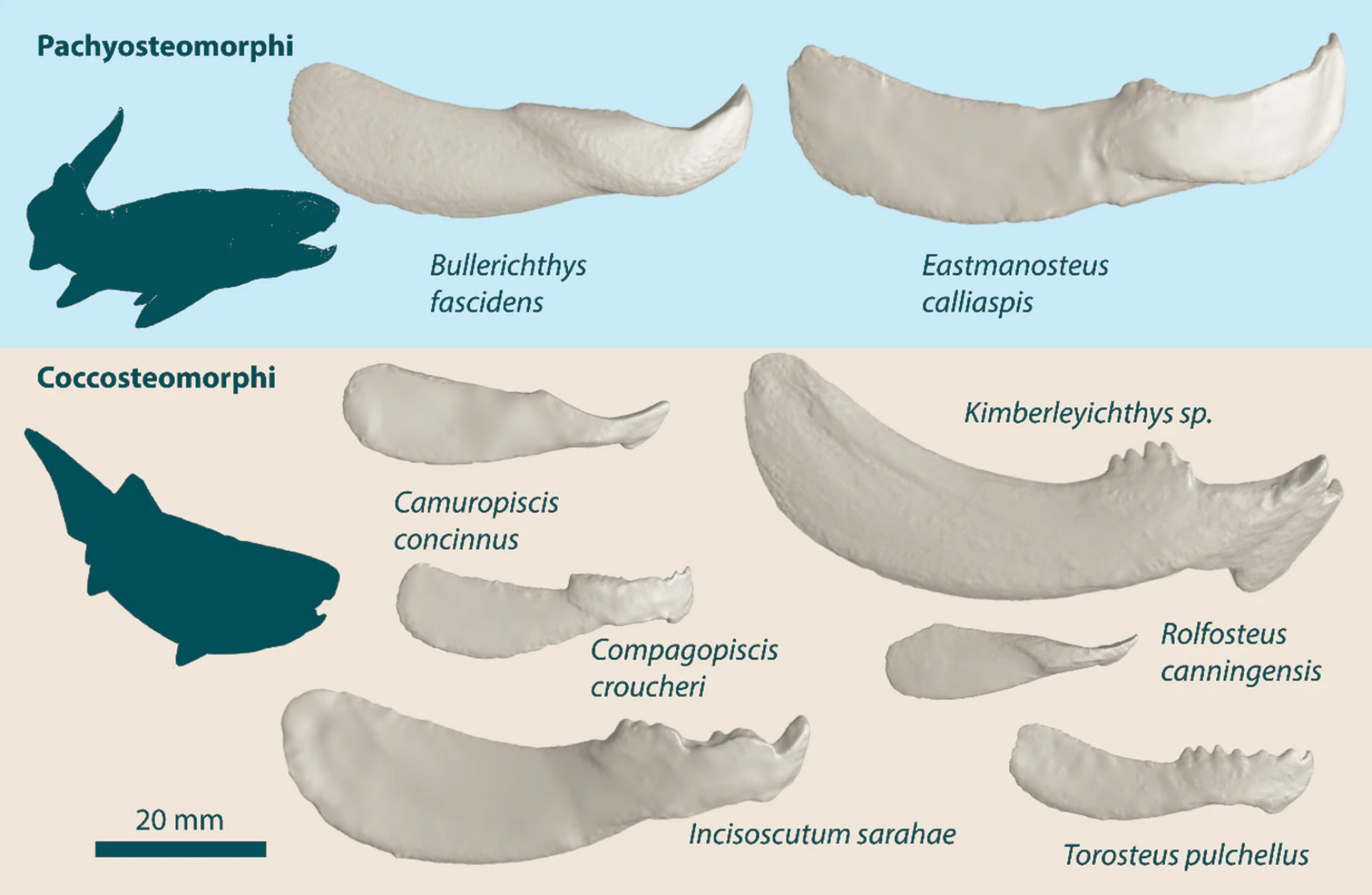
Devonian placoderm inferognathal jaw bones used display ranging size and morphology reflecting their evolutionary and ecological diversity. Image credit: Mitchell et al., doi: 10.1038/s41598-026-57261-3.
“Placoderms experimented with an extraordinary range of jaw shapes and biting parts during the early evolution of vertebrates,” said study’s senior author Dr. Alice Clement, a researcher at Flinders University.
“They provide a rare opportunity to understand how some of the first jaws became specialized for different diets.”
In the study, the scientists analyzed the lower jaws of eight placoderm species that lived during the Devonian period, around 385 million years ago.
The fossils were recovered from the famous Gogo Formation in Western Australia’s Kimberley region.
Using 3D digital modeling and engineering simulations, the authors tested how each jaw performed under bite forces and measured the complexity of each species’ dental surfaces.
The results revealed no single formula for ‘hard object feeding,’ or durophagy.
Smaller species had flat, simple jaw surfaces well-suited to crushing shelled prey small enough to swallow whole.
The largest species in the study — an undescribed member of the genus Kimberleyichthys — combined a structurally reinforced jaw with unusually complex, tooth-like structures that researchers compared to medieval war hammers.
Species of intermediate size tended to have sharper, blade-like jaws better suited for slicing soft tissue than crushing armor.
“It was an interesting surprise,” said Flinders University Ph.D. student Austin Fitzpatrick, co-author of the study.
“Both the smallest and largest animals had evolved strong jaws, but they’d solved the problem of processing harder foods in completely different ways.”
The findings suggest that a predator’s ability to eat armored prey depended not just on its own size, but on the size of that prey relative to its body.
“Unlike many animals around today, including humans, placoderms did not possess a single lower jaw bone,” said study’s first author Dr. Rex Mitchell, a researcher at Flinders University.
“Instead, their jaws consisted of paired bony plates supported by cartilage, with surfaces ranging from broad crushing plates to sharp slicing edges with tooth-like structures.”
The results appear in the journal Scientific Reports.
_____
D.R. Mitchell et al. 2026. Hard-object feeding adaptations infer relative predator-prey size relationships in Devonian placoderms. Sci Rep 16, 27017; doi: 10.1038/s41598-026-57261-3