Long thought to be fueled by increased atmospheric oxygen concentration, enormous griffinflies from the Carboniferous period, 300 million years ago, may have grown large for other reasons, according to new research led by University of Pretoria paleontologist Edward Snelling.

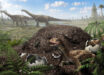
Gigantic griffinfly in a Carboniferous forest.
In the 1990s, scientists suggested a period of high atmospheric oxygen around 300 million years ago coincided with the occurrence of giant insects.
They proposed that a higher demand for oxygen and larger body sizes of giant insects ought to require a higher atmospheric oxygen concentration.
This made sense, because insects obtain oxygen through their unique tracheal system, which is a branching tree-like system of airways leading to their ends, the tracheoles.
Oxygen must move by diffusion down concentration gradients through the tracheoles to fuel the flight muscle cells.
Researchers reasoned that a flying insect of such gigantic proportions could not exist now, because the level of oxygen in the present atmosphere is too low to support the high demand for oxygen in the flight muscles.
In a new study, Dr. Snelling and his colleagues used high-power electron microscopy to assess how body size affects the number of tracheoles in flight muscle.
They found that the space occupied by tracheoles in the flight muscle is typically only 1% or less in most species, and that this observation holds when the relationship is extended to the griffinflies.
This suggests that the flight muscles of insects are not constrained by atmospheric oxygen levels as they could easily add tracheoles in the muscle, since they take up so little space.
“If atmospheric oxygen really sets a limit on the maximum body size of insects, then there ought to be evidence of compensation at the level of the tracheoles,” Dr. Snelling said.
“There is some compensation occurring in larger insects, but it is trivial in the grand scheme of things.”
“By comparison, capillaries in the cardiac muscle of birds and mammals occupy about ten-times the relative space than tracheoles occupy in the flight muscle of insects, so there must be great evolutionary potential to ramp up investment of tracheoles if oxygen transport were really limiting body size,” said Adelaide University’s Professor Roger Seymour.
“Some scientists counter argue that oxygen flow upstream of the tracheoles, or in other parts of the body, could still limit body size, so the theory of oxygen-constrained insect maximal size may not be dead yet.”
“Regardless, these new data definitively show that diffusion in the flight muscle tracheoles cannot provide such a limit. Scientists will have to look elsewhere for why these giants existed.”
“If oxygen does not limit maximal insect size, then perhaps other culprits are responsible for the small size of insects, such as predation from vertebrates, or biomechanical support limits on the exoskeleton itself.”
A paper describing this research was published this month in the journal Nature.
_____
E.P. Snelling et al. Oxygen supply through the tracheolar-muscle system does not constrain insect gigantism. Nature, published online March 25, 2026; doi: 10.1038/s41586-026-10291-3