Using the Karl G. Jansky Very Large Array (VLA) s and the Five-hundred-meter Aperture Spherical Radio Telescope (FAST), astronomers have created the sharpest-ever radio maps of neutral hydrogen around the Orion Nebula. They reveal giant expanding shells, mysterious cavities and elongated filaments, suggesting the famous stellar nursery was sculpted by multiple generations of massive stars rather than a single expanding bubble.
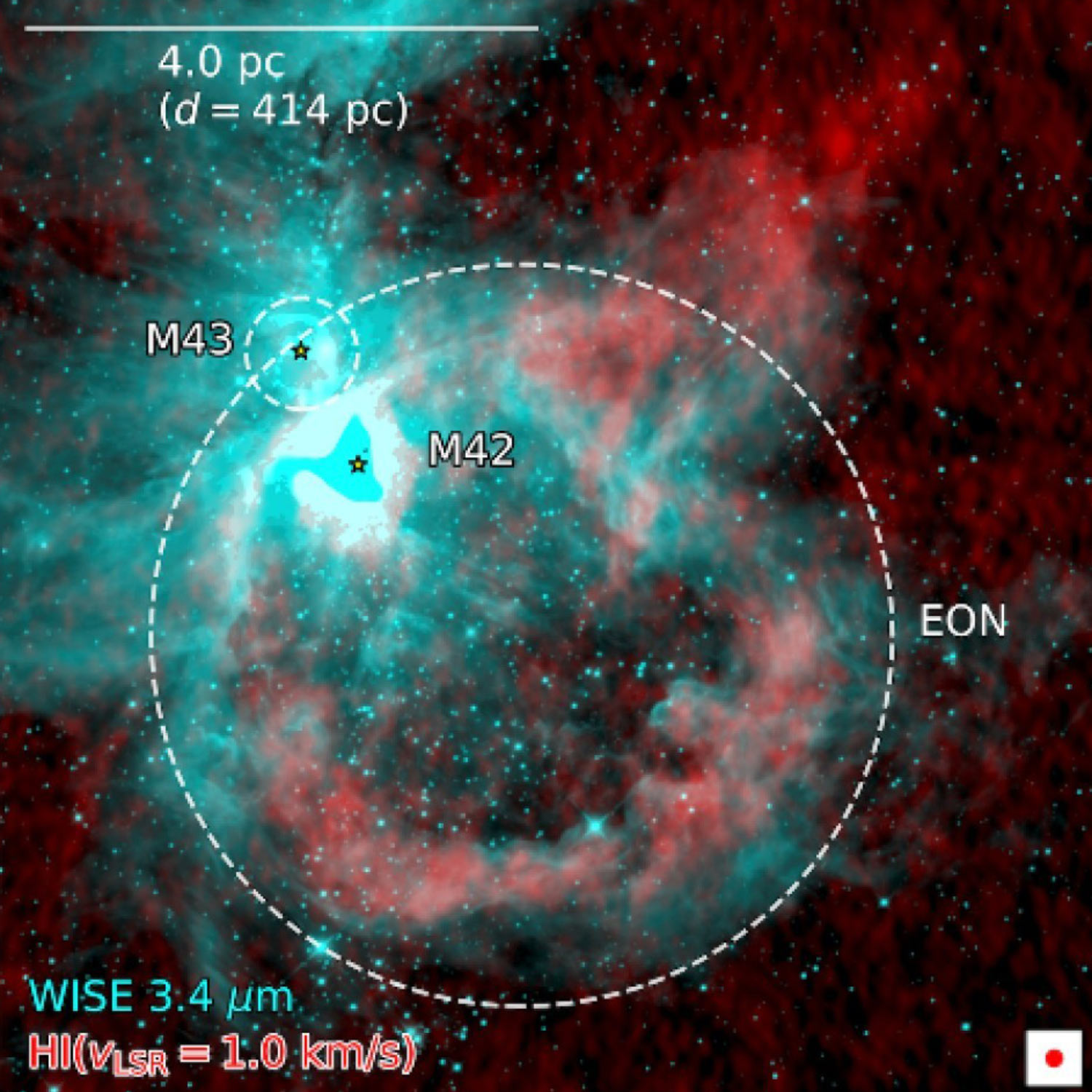
Extended Orion nebula shell sampled by HI emission from the combined VLA and FAST observations (shown in red), Hα emission from the European Southern Observatory Digitized Sky Survey (shown in green), and 3.4-μm emission registered by the Wide-field Infrared Survey Explorer (WISE) satellite (shown in blue). Image credit: Juan D. Soler, University of Vienna / NRAO / VLA / NASA / WISE.
Orion Nebula is a diffuse nebula located 1,350 light-years away in the constellation of Orion.
Also known as NGC 1976, Messier 42, M42, LBN 974, and Sharpless 281, the nebula spans about 24 light-years.
It can be seen with the naked eye as a fuzzy patch surrounding the star Theta Orionis in the Hunter’s Sword, below Orion’s belt.
At only 2 million years old, the Orion Nebula is an ideal laboratory for studying young stars and stars that are still forming.
It offers a glimpse of what might have happened when the Sun was born 4.6 billion years ago.
“Hydrogen is the most abundant element in the Universe,” said Dr. Juan Diego Soler from the University of Vienna and his colleagues.
“In its neutral atomic form, it emits faint radio waves at a wavelength of 21 cm, allowing astronomers to trace otherwise invisible gas between the stars.”
To detect this emission in unprecedented detail, the astronomers combined observations from the VLA and FAST telescopes.
“Previous studies suggested that the shell surrounding Orion contains around one thousand times the mass of the Sun,” they said.
“The new hydrogen observations indicate a mass nearly ten times lower.”
The new maps also reveal what appears to be a second expanding cavity inside the main shell, along with an elongated ‘protrusion’ of atomic gas extending roughly four light-years outward from the bubble.
These structures suggest that the Orion Nebula has been shaped by multiple episodes of stellar feedback rather than a single expanding bubble.
“The complexity revealed by these observations challenges the current understanding of star formation,” said Dr. Daniel Seifried, an astronomer at the University of Cologne.
“These stunning observations serve as a reference for many modern astrophysical simulations investigating the evolution of gas and stars in the Milky Way.”
“These are the kind of images that challenge the theoretical models and numerical simulations that we use to understand how massive stars affect their immediate surroundings.”
“This study is an exciting demonstration of the power of latest-generation radio telescopes to uncover new pieces to the star formation puzzle,” said Dr. Claire Murray, an astronomer at the Space Telescope Science Institute.
“Orion is only the beginning,” Dr. Soler said.
“Our newly developed methods show how future interferometers will reveal the hidden structure and dynamics of the interstellar medium — even in regions that astronomers already believed they understood well.”
The results were published in the journal Astronomy & Astrophysics.
_____
J.D. Soler et al. 2026. The Neutral Atomic Hydrogen in the solar neighborhood (NeAtHood) project. I. Ghost in the shell: Neutral atomic hydrogen in the extended Orion nebula. A&A 711, A85; doi: 10.1051/0004-6361/202659272